
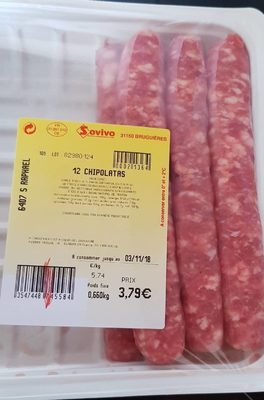
12 chipolatas
Health
Nutrition
Nutri-Score
 Lower nutritional quality
Nutri-Score data warning
Nutrient levels
Fat in moderate quantity (17.2%)
Saturated fat in high quantity (7%)
Sugars in low quantity (0.6%)
Salt in high quantity (1.81%)
Nutrition facts
| Nutrition facts | As sold for 100 g / 100 ml |
|---|---|
| Energy | ~ 911.8 kJ (220 kcal) |
| Fat | 17.2 g |
| Saturated fat | 7 g |
| Carbohydrates | 1 g |
| Sugars | 0.6 g |
| Dietary fiber | ~ 0 g |
| Proteins | 15.2 g |
| Salt | 1.81 g |
| Sodium | 0.724 g |
| Fruits, vegetables and legumes | ~ 0 % |
Nutrition facts (Detailed data)
| Nutrition facts | As sold for 100 g / 100 ml | As sold Per 100 g (packaging) | As sold Per 100 g (estimate) |
|---|---|---|---|
| Energy | ~ 911.8 kJ (220 kcal) | ? (220 kcal) | ~ 754.985 kJ (179 kcal) |
| Fat | 17.2 g | 17.2 g | ~ 8.4108 g |
| Saturated fat | 7 g | 7 g | ~ 3.0272 g |
| Carbohydrates | 1 g | 1 g | ~ 1.10959 g |
| Sugars | 0.6 g | 0.6 g | ~ 0.90319 g |
| Dietary fiber | ~ 0 g | ? | ~ 0 g |
| Proteins | 15.2 g | 15.2 g | ~ 25.026 g |
| Salt | 1.81 g | 1.81 g | ~ 0.98892407 g |
| Sodium | 0.724 g | 0.724 g | ~ 0.3945654385 g |
| Fruits, vegetables and legumes | ~ 0 % | ? | ~ 0 % |
Ingredients
Ingredients image

Ingredients list
Ingredient information
Ingredients analysis
No ingredients containing palm oil.
Contains non-vegan ingredients.
Contains non-vegetarian ingredients.
Food Processing
NOVA group
 Ultra-processed food and drink products
Elements that indicate the product is in NOVA group 4
How NOVA works
Additives
E120 - CochinealColour
Cochineal extract or carmine (E120) is a natural red colorant derived from the dried bodies of the female cochineal insect.
It is widely used to impart a pink, red, or purple hue to various food and beverage products, including yogurts, ice creams, confectionery, and fruit juices.
Although it is a natural additive, E120 is known to cause severe allergic reactions, including anaphylaxis, in some individuals. It is also not suitable for vegetarians or vegans due to its insect origin.
E160c - Paprika extractColour
No additive description is available yet.
E236 - Formic acid
Formic acid, systematically named methanoic acid, is the simplest carboxylic acid. The chemical formula is HCOOH or HCO2H. It is an important intermediate in chemical synthesis and occurs naturally, most notably in some ants. The word "formic" comes from the Latin word for ant, formica, referring to its early isolation by the distillation of ant bodies. Esters, salts, and the anion derived from formic acid are called formates. Industrially formic acid is produced from methanol.
E261 - Potassium acetatePreservative
Potassium acetate (KCH3COO) is the potassium salt of acetic acid.
E263 - Calcium acetatePreservativeStabiliser
CALCIUM ACETATE is a chemical compound which is a calcium salt of acetic acid. Calcium acetate is used as a food additive, as a stabilizer, buffer and sequestrant, mainly in candy products.
E316 - sodium erythorbate EFSA overexposure risk: noAntioxidant
SODIUM ERYTHORBATE is the sodium salt of erythorbic acid. Sodium erythorbate is produced from sugars derived from different sources, such as beets, sugar cane, and corn. It is used predominantly in meats, poultry, and soft drinks.
Environment
Green-Score, origins bonus, and transportation impact are shown for Worldwide .
Green Score
Overall grade
 High environmental impact
About Green-Score
Current scope
Life cycle analysis
Average impact of the category
Chipolata slim sausage, raw • Score: 43/100Life-cycle reference
Overall environmental impact by stage (PEF)
The overall environmental impact figure (PEF) comes from ADEME's Agribalyse database, for the category: Chipolata slim sausage, raw. Source: ADEME Agribalyse Database.
| Stage | Impact |
|---|---|
| Agriculture | 90.8 % |
| Processing | 1.1 % |
| Packaging | 3.4 % |
| Transportation | 2.8 % |
| Distribution | 1.5 % |
| Consumption | 0.4 % |
Bonuses and maluses
Origins of ingredients
Packaging impact
Green-Score for this product
Green-Score for this product
Final score: 37/100Final score breakdown
Carbon footprint
Carbon footprint
Climate impact by stage (CO2e)
The carbon emission figure comes from ADEME's Agribalyse database, for the category: Chipolata slim sausage, raw. Source: ADEME Agribalyse Database.
| Stage | Impact |
|---|---|
| Agriculture | 87.9 % |
| Processing | 0.6 % |
| Packaging | 6.0 % |
| Transportation | 4.6 % |
| Distribution | 0.8 % |
| Consumption | 0.1 % |
Packaging
Packaging impact
Packaging components
| Shape | Material | Recycling | Impact |
|---|---|---|---|
| Tray | Plastic | Unknown | High |
Declared packaging
Transportation
Manufacturing locations
Origins of ingredients
Origins breakdown
| Origin | Percent of ingredients | Impact |
|---|---|---|
| France | 100 % | Medium |
Data Source
Product data comes from Open Food Facts. Food Benchmark also adds translations, category comparisons and explanatory calculations.
The database is licensed under ODbL 1.0, individual contents under DbCL 1.0, and product photos under CC BY-SA 3.0.
Product added on July 10, 2014 at 11:12:34 AM UTC by jeanbono .
Last edit on March 17, 2026 at 3:21:59 PM UTC by new-nutrition-bot .
Product page also edited by date-limite-app, jeanbono, kiliweb, new-nutrition-bot, openfoodfacts-contributors, packbot, roboto-app, yuka.K4tzYv2yNsosQvP2-6sTjSK9SL_GOPQBKFAOoQ, yuka.RnBsY0Zab1poZEpVb01adndUek53bzFaeTV1TFFscTFHZllESVE9PQ.