

Berlingots
Labels
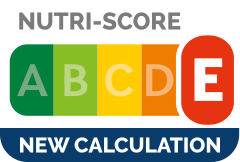 Bad nutritional quality
 Ultra-processed food and drink products
 Low environmental impact
Health
Nutrition
Label
Bad nutritional qualityNutrient levels
Fat in low quantity (0.5%)
Saturated fat in low quantity (0.1%)
Sugars in high quantity (65%)
Salt in low quantity (0.01%)
Nutrition label
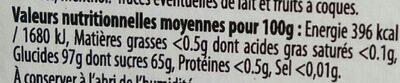
Nutrition facts
| Nutrition facts | As sold for 100 g / 100 ml |
|---|---|
| Energy | 1,680 kJ (396 kcal) |
| FAT | < 0.5 g |
| Saturated fat | < 0.1 g |
| Carbohydrates | 97 g |
| Sugars | 65 g |
| Dietary fiber | ? |
| Proteins | < 0.5 g |
| Salt | < 0.01 g |
| Sodium | < 0 g |
| Minerals | |
| Fruits, vegetables and legumes | ~ 2.5 % |
Nutrition facts (Detailed data)
| Nutrition facts | As sold for 100 g / 100 ml | As sold Per 100 g (packaging) | As sold Per 100 g (estimate) |
|---|---|---|---|
| Energy | 1,680 kJ (396 kcal) | 1,680 kJ (396 kcal) | ? |
| FAT | < 0.5 g | < 0.5 g | ? |
| Saturated fat | < 0.1 g | < 0.1 g | ? |
| Carbohydrates | 97 g | 97 g | ? |
| Sugars | 65 g | 65 g | ? |
| Added sugars | ~ 77.08 g | ? | ~ 77.08 g |
| Dietary fiber | ? | ? | ? |
| Proteins | < 0.5 g | < 0.5 g | ? |
| Salt | < 0.01 g | < 0.01 g | ? |
| Sodium | < 0 g | < 0 g | ? |
| Minerals | |||
| Fruits, vegetables and legumes | ~ 2.5 % | ? | ~ 2.5 % |
Estimated Activity Time
Approximate time needed to burn the energy in 100 g / 100 ml: 1,680 kJ. Reference adult weight: 70 kg. Energy density: Moderate.
Ingredients
Ingredients image
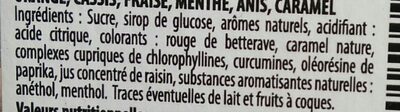
Ingredients list
Ingredient information
Traces
Ingredients analysis
No ingredients containing palm oil.
Unrecognized: fr:caramel-nature, fr:complexes-cupriques-de-chlorophyllines, fr:substances-aromatisantes-naturelles, fr:anethol
Vegan status unknown
Unrecognized: fr:caramel-nature, fr:complexes-cupriques-de-chlorophyllines, fr:anethol, en:menthol
Vegetarian status unknown
Unrecognized: fr:caramel-nature, fr:complexes-cupriques-de-chlorophyllines, fr:anethol, en:menthol
Food Processing
NOVA group
Ultra-processed food and drink productsElements that indicate the product is in NOVA group 4
How NOVA works
Additives
E100 - CurcuminColour
No additive description is available yet.
E150 - Caramel
CARAMEL is a medium to dark-orange confectionery product made by heating a variety of sugars.
E160c - Paprika extractColour
No additive description is available yet.
E162 - Beetroot redColour
Betanin, or Beetroot Red, is a red glycosidic food dye obtained from beets; its aglycone, obtained by hydrolyzing away the glucose molecule, is betanidin. As a food additive, its E number is E162. The color of betanin depends on pH; between four and five it is bright bluish-red, becoming blue-violet as the pH increases. Once the pH reaches alkaline levels betanin degrades by hydrolysis, resulting in a yellow-brown color. Betanin is a betalain pigment, together with isobetanin, probetanin, and neobetanin. Other pigments contained in beet are indicaxanthin and vulgaxanthins.
E330 - Citric acidAntioxidantSequestrant
Citric acid is a natural organic acid found in citrus fruits such as lemons, oranges, and limes.
It is widely used in the food industry as a flavor enhancer, acidulant, and preservative due to its tart and refreshing taste.
Citric acid is safe for consumption when used in moderation and is considered a generally recognized as safe (GRAS) food additive by regulatory agencies worldwide.
Environment
Green-Score, origins bonus, and transportation impact are shown for Worldwide .
Green Score
Overall grade
Low environmental impactAbout Green-Score
Current scope
Life cycle analysis
Average impact of the category
 Candies, all types • Score: 88/100
Life-cycle reference
Overall environmental impact by stage (PEF)
The overall environmental impact figure (PEF) comes from ADEME's Agribalyse database, for the category: Candies, all types. Source: ADEME Agribalyse Database.
| Stage | Impact |
|---|---|
| Agriculture | 47.6 % |
| Processing | 28.1 % |
| Packaging | 17.3 % |
| Transportation | 4.5 % |
| Distribution | 2.3 % |
| Consumption | 0.0 % |
Bonuses and maluses
Declared origins
Packaging impact
Green-Score for this product
Green-Score for this product
Final score: 73/100Final score breakdown
Carbon footprint
Carbon footprint
Climate impact by stage (CO2e)
The carbon emission figure comes from ADEME's Agribalyse database, for the category: Candies, all types. Source: ADEME Agribalyse Database.
| Stage | Impact |
|---|---|
| Agriculture | 46.7 % |
| Processing | 27.1 % |
| Packaging | 16.4 % |
| Transportation | 8.7 % |
| Distribution | 1.5 % |
| Consumption | 0.0 % |
Packaging
Packaging impact
Packaging materials
| Material | % | Packaging weight | Packaging weight per 100 g of product |
|---|---|---|---|
| Plastic | |||
| Total |
Declared packaging
Transportation
Manufacturing locations
Declared origins
Data Source
Data presented on this page is sourced from the Open Food Facts database. This platform does not alter the original dataset; its purpose is solely to enhance data visualization and user accessibility.
Product added on April 16, 2018 at 9:55:16 AM UTC by kiliweb .
Last edit on March 17, 2026 at 8:39:46 PM UTC by new-nutrition-bot .
Product page also edited by kiliweb, new-nutrition-bot, openfoodfacts-contributors, packbot, roboto-app, sebleouf, yuka.WUpFWURaNWV0dVFWdU13YzdDajRvbzh2M29LV1dVNmxBTk5JSUE9PQ.