
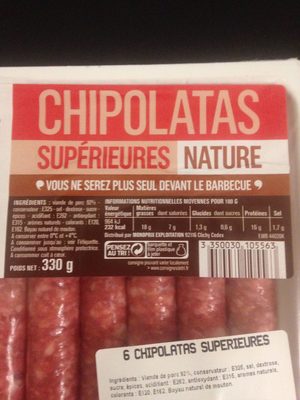
Chipolatas Supérieures Nature
Health
Nutrition
Nutri-Score
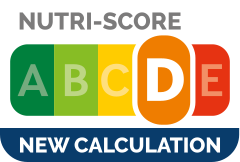 Lower nutritional quality
Nutri-Score data warning
Nutrient levels
Fat in moderate quantity (18%)
Saturated fat in high quantity (7%)
Sugars in low quantity (0.6%)
Salt in high quantity (1.7%)
Nutrition label

Nutrition facts
| Nutrition facts | As sold for 100 g / 100 ml | Compared to: Chipolatas |
|---|---|---|
| Energy | 964 kJ (231 kcal) | 979.667 kJ (237 kcal) (-2%) |
| Fat | 18 g | 18.655 g (-4%) |
| Saturated fat | 7 g | 7.074 g (-1%) |
| Carbohydrates | 1.3 g | 1.22 g (+7%) |
| Sugars | 0.6 g | 0.574 g (+5%) |
| Dietary fiber | ? | ? |
| Proteins | 16 g | 15.561 g (+3%) |
| Salt | 1.7 g | 1.772 g (-4%) |
| Sodium | 0.68 g | 0.709 g (-4%) |
| Fruits, vegetables and legumes | ~ 0 % | ? |
Nutrition facts (Detailed data)
| Nutrition facts | As sold for 100 g / 100 ml | As sold Per 100 g (packaging) | As sold Per 100 g (estimate) |
|---|---|---|---|
| Energy | 964 kJ (231 kcal) | 964 kJ (230 kcal) | ? |
| Fat | 18 g | 18 g | ? |
| Saturated fat | 7 g | 7 g | ? |
| Carbohydrates | 1.3 g | 1.3 g | ? |
| Sugars | 0.6 g | 0.6 g | ? |
| Dietary fiber | ? | ? | ? |
| Proteins | 16 g | 16 g | ? |
| Salt | 1.7 g | 1.7 g | ? |
| Sodium | 0.68 g | 0.68 g | ? |
| Fruits, vegetables and legumes | ~ 0 % | ? | ~ 0 % |
Ingredients
Ingredients image
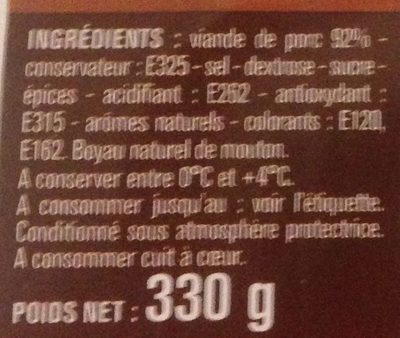
Ingredients list
Ingredient information
Added sugars
Ingredients analysis
No ingredients containing palm oil.
Contains non-vegan ingredients.
Unrecognized: en:natural-sheep-casing
Contains non-vegetarian ingredients.
Unrecognized: en:natural-sheep-casing
Food Processing
NOVA group
 Ultra-processed food and drink products
Elements that indicate the product is in NOVA group 4
How NOVA works
Additives
E120 - CochinealColour
Cochineal extract or carmine (E120) is a natural red colorant derived from the dried bodies of the female cochineal insect.
It is widely used to impart a pink, red, or purple hue to various food and beverage products, including yogurts, ice creams, confectionery, and fruit juices.
Although it is a natural additive, E120 is known to cause severe allergic reactions, including anaphylaxis, in some individuals. It is also not suitable for vegetarians or vegans due to its insect origin.
E162 - Beetroot redColour
Betanin, or Beetroot Red, is a red glycosidic food dye obtained from beets; its aglycone, obtained by hydrolyzing away the glucose molecule, is betanidin. As a food additive, its E number is E162. The color of betanin depends on pH; between four and five it is bright bluish-red, becoming blue-violet as the pH increases. Once the pH reaches alkaline levels betanin degrades by hydrolysis, resulting in a yellow-brown color. Betanin is a betalain pigment, together with isobetanin, probetanin, and neobetanin. Other pigments contained in beet are indicaxanthin and vulgaxanthins.
E262 - Sodium acetatesPreservativeSequestrant
SODIUM ACETATE, also abbreviated NaOAc,[8] is the sodium salt of acetic acid.
E315 - Erythorbic acid EFSA overexposure risk: noAntioxidant
Erythorbic acid (isoascorbic acid, D-araboascorbic acid) is a stereoisomer of ascorbic acid (vitamin C). It is synthesized by a reaction between methyl 2-keto-D-gluconate and sodium methoxide. It can also be synthesized from sucrose or by strains of Penicillium that have been selected for this feature. It is denoted by E number E315, and is widely used as an antioxidant in processed foods.Clinical trials have been conducted to investigate aspects of the nutritional value of erythorbic acid. One such trial investigated the effects of erythorbic acid on vitamin C metabolism in young women; no effect on vitamin C uptake or clearance from the body was found. A later study found that erythorbic acid is a potent enhancer of nonheme-iron absorption.Since the U.S. Food and Drug Administration banned the use of sulfites as a preservative in foods intended to be eaten fresh (such as salad bar ingredients), the use of erythorbic acid as a food preservative has increased. It is also used as a preservative in cured meats and frozen vegetables.It was first synthesized in 1933 by the German chemists Kurt Maurer and Bruno Schiedt.
E325 - sodium lactateAntioxidantEmulsifierHumectantThickener
SODIUM LACTATE is the sodium salt of lactic acid, and has a mild saline taste. It is produced by fermentation of a sugar source, such as corn or beets. It acts as a preservative, acidity regulator, and bulking agent.
Environment
Green-Score, origins bonus, and transportation impact are shown for Worldwide .
Green Score
Overall grade
 Very high environmental impact
About Green-Score
Current scope
Life cycle analysis
Average impact of the category
 Chipolata slim sausage, raw • Score: 43/100
Life-cycle reference
Overall environmental impact by stage (PEF)
The overall environmental impact figure (PEF) comes from ADEME's Agribalyse database, for the category: Chipolata slim sausage, raw. Source: ADEME Agribalyse Database.
| Stage | Impact |
|---|---|
| Agriculture | 90.8 % |
| Processing | 1.1 % |
| Packaging | 3.4 % |
| Transportation | 2.8 % |
| Distribution | 1.5 % |
| Consumption | 0.4 % |
Bonuses and maluses
Declared origins
Packaging impact
Green-Score for this product
Green-Score for this product
Final score: 28/100Final score breakdown
Carbon footprint
Carbon footprint
Climate impact by stage (CO2e)
The carbon emission figure comes from ADEME's Agribalyse database, for the category: Chipolata slim sausage, raw. Source: ADEME Agribalyse Database.
| Stage | Impact |
|---|---|
| Agriculture | 87.9 % |
| Processing | 0.6 % |
| Packaging | 6.0 % |
| Transportation | 4.6 % |
| Distribution | 0.8 % |
| Consumption | 0.1 % |
Packaging
Packaging impact
Packaging components
| Shape | Material | Recycling | Impact |
|---|---|---|---|
| Tray | Plastic | Unknown | High |
Declared packaging
Transportation
Declared origins
Forest footprint
Forest footprint
Deforestation risk details
Data Source
Product data comes from Open Food Facts. Food Benchmark also adds translations, category comparisons and explanatory calculations.
The database is licensed under ODbL 1.0, individual contents under DbCL 1.0, and product photos under CC BY-SA 3.0.
Product added on January 9, 2017 at 8:04:51 PM UTC by openfoodfacts-contributors .
Last edit on March 17, 2026 at 11:57:27 PM UTC by new-nutrition-bot .
Product page also edited by anonymous-mjbvuzm22y, date-limite-app, new-nutrition-bot, openfoodfacts-contributors, packbot, segundo.