

Merguez veritables
Labels
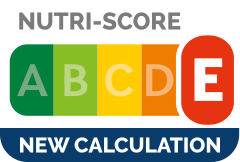 Bad nutritional quality
 Ultra-processed food and drink products
Health
Nutrition
Label
Bad nutritional qualityNutrient levels
Fat in high quantity (24%)
Saturated fat in high quantity (9.6%)
Sugars in low quantity (1%)
Salt in high quantity (1.7%)
Nutrition label
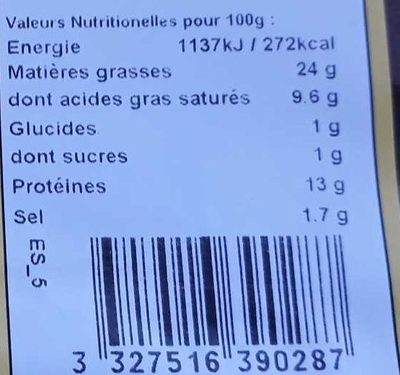
Nutrition facts
| Nutrition facts | As sold for 100 g / 100 ml |
|---|---|
| Energy | ~ 1,126 kJ (272 kcal) |
| FAT | 24 g |
| Saturated fat | 9.6 g |
| Carbohydrates | 1 g |
| Sugars | 1 g |
| Dietary fiber | ? |
| Proteins | 13 g |
| Salt | 1.7 g |
| Sodium | 0.68 g |
| Minerals | |
| Fruits, vegetables and legumes | ~ 0 % |
Nutrition facts (Detailed data)
| Nutrition facts | As sold for 100 g / 100 ml | As sold Per 100 g (packaging) | As sold Per 100 g (estimate) |
|---|---|---|---|
| Energy | ~ 1,126 kJ (272 kcal) | ? (272 kcal) | ? |
| FAT | 24 g | 24 g | ? |
| Saturated fat | 9.6 g | 9.6 g | ? |
| Carbohydrates | 1 g | 1 g | ? |
| Sugars | 1 g | 1 g | ? |
| Added sugars | ~ 0.24 g | ? | ~ 0.24 g |
| Dietary fiber | ? | ? | ? |
| Proteins | 13 g | 13 g | ? |
| Salt | 1.7 g | 1.7 g | ? |
| Sodium | 0.68 g | 0.68 g | ? |
| Minerals | |||
| Fruits, vegetables and legumes | ~ 0 % | ? | ~ 0 % |
Estimated Activity Time
Approximate time needed to burn the energy in 100 g / 100 ml: 1,126 kJ. Reference adult weight: 70 kg. Energy density: Moderate.
Ingredients
Ingredients image

Ingredients list
Ingredient information
Ingredients analysis
Palm oil content unknown
Contains non-vegan ingredients.
Unrecognized: fr:boyau-nature-de-mouton
Contains non-vegetarian ingredients.
Unrecognized: fr:boyau-nature-de-mouton
Food Processing
NOVA group
Ultra-processed food and drink productsElements that indicate the product is in NOVA group 4
How NOVA works
Additives
E120 - CochinealColour
Cochineal extract or carmine (E120) is a natural red colorant derived from the dried bodies of the female cochineal insect.
It is widely used to impart a pink, red, or purple hue to various food and beverage products, including yogurts, ice creams, confectionery, and fruit juices.
Although it is a natural additive, E120 is known to cause severe allergic reactions, including anaphylaxis, in some individuals. It is also not suitable for vegetarians or vegans due to its insect origin.
E301 - Sodium ascorbateAntioxidant
SODIUM ASCORBATE is one of a number of mineral salts of ascorbic acid (vitamin C).
E325 - sodium lactateAntioxidantEmulsifierHumectantThickener
SODIUM LACTATE is the sodium salt of lactic acid, and has a mild saline taste. It is produced by fermentation of a sugar source, such as corn or beets. It acts as a preservative, acidity regulator, and bulking agent.
E330 - Citric acidAntioxidantSequestrant
Citric acid is a natural organic acid found in citrus fruits such as lemons, oranges, and limes.
It is widely used in the food industry as a flavor enhancer, acidulant, and preservative due to its tart and refreshing taste.
Citric acid is safe for consumption when used in moderation and is considered a generally recognized as safe (GRAS) food additive by regulatory agencies worldwide.
Environment
Green-Score, origins bonus, and transportation impact are shown for Worldwide .
Green Score
Overall grade
About Green-Score
Current scope
Life cycle analysis
Average impact of the category
Life-cycle reference
Overall environmental impact by stage (PEF)
The overall environmental impact figure (PEF) comes from ADEME's Agribalyse database, for the category: Merguez sausage, raw. Source: ADEME Agribalyse Database.
| Stage | Impact |
|---|---|
| Agriculture | 97.4 % |
| Processing | 0.3 % |
| Packaging | 1.0 % |
| Transportation | 1.0 % |
| Distribution | 0.4 % |
| Consumption | 0.1 % |
Bonuses and maluses
Origins of ingredients
Packaging impact
Green-Score for this product
Green-Score for this product
Final score breakdown
Carbon footprint
Carbon footprint
Climate impact by stage (CO2e)
The carbon emission figure comes from ADEME's Agribalyse database, for the category: Merguez sausage, raw. Source: ADEME Agribalyse Database.
| Stage | Impact |
|---|---|
| Agriculture | 96.7 % |
| Processing | 0.3 % |
| Packaging | 1.4 % |
| Transportation | 1.3 % |
| Distribution | 0.2 % |
| Consumption | 0.0 % |
Packaging
Packaging impact
Packaging materials
| Material | % | Packaging weight | Packaging weight per 100 g of product |
|---|---|---|---|
| Plastic | |||
| Total |
Declared packaging
Data precision
Transportation
Origins of ingredients
Origins breakdown
| Origin | Percent of ingredients | Impact |
|---|---|---|
| France | 83 % | Medium |
| Unknown | 17 % | Medium |
Data Source
Data presented on this page is sourced from the Open Food Facts database. This platform does not alter the original dataset; its purpose is solely to enhance data visualization and user accessibility.
Product added on May 6, 2018 at 10:02:18 AM UTC by openfoodfacts-contributors .
Last edit on March 17, 2026 at 8:13:56 PM UTC by new-nutrition-bot .
Product page also edited by anonymous-gvbvuzpk5m, driveoff, kiliweb, naruyoko, navig491, new-nutrition-bot, openfoodfacts-contributors, packbot, yuka.P-9TI-GpMs8TAMKN-Ngu5wGxT93yDM9nEy5dog, yuka.YXJFaEZiUXNyY01Vc2ZFeTRSVHo5czV0OTVUNWVWS21JZklCSVE9PQ.