
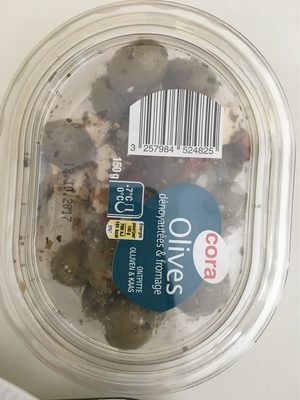
Olives dénoyautées & fromage Cora
Health
Nutrition
Nutri-Score
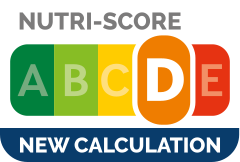 Lower nutritional quality
Nutri-Score data warning
Nutrient levels
Fat in moderate quantity (17%)
Saturated fat in moderate quantity (4.5%)
Sugars in low quantity (1%)
Salt in high quantity (2.75%)
Nutrition facts
| Nutrition facts | As sold for 100 g / 100 ml | Compared to: Green pitted olives |
|---|---|---|
| Energy | ~ 789.8 kJ (191 kcal) | 651.207 kJ (160 kcal) (+21%) |
| Fat | 17 g | 16.009 g (+6%) |
| Saturated fat | 4.5 g | 2.517 g (+79%) |
| Carbohydrates | 1.6 g | 1.278 g (+25%) |
| Sugars | 1 g | 0.192 g (+421%) |
| Dietary fiber | 3.1 g | ? |
| Proteins | 6.4 g | 1.111 g (+476%) |
| Salt | 2.75 g | 3.375 g (-19%) |
| Sodium | 1.1 g | 1.349 g (-18%) |
| Fruits, vegetables and legumes | ~ 67.7777777777778 % | ? |
Nutrition facts (Detailed data)
| Nutrition facts | As sold for 100 g / 100 ml | As sold Per 100 g (packaging) | As sold Per 100 g (estimate) |
|---|---|---|---|
| Energy | ~ 789.8 kJ (191 kcal) | ? (191 kcal) | ~ 978.387222222222 kJ (237 kcal) |
| Fat | 17 g | 17 g | ~ 22.6177777777778 g |
| Saturated fat | 4.5 g | 4.5 g | ~ 6.68130555555555 g |
| Carbohydrates | 1.6 g | 1.6 g | ~ 0.377944444444445 g |
| Sugars | 1 g | 1 g | ~ 0.180944444444444 g |
| Dietary fiber | 3.1 g | 3.1 g | ~ 2.44333333333333 g |
| Proteins | 6.4 g | 6.4 g | ~ 6.36855555555556 g |
| Salt | 2.75 g | 2.75 g | ~ 3.455915 g |
| Sodium | 1.1 g | 1.1 g | ~ 1.38164194444445 g |
| Fruits, vegetables and legumes | ~ 67.7777777777778 % | ? | ~ 67.7777777777778 % |
Ingredients
Ingredients image
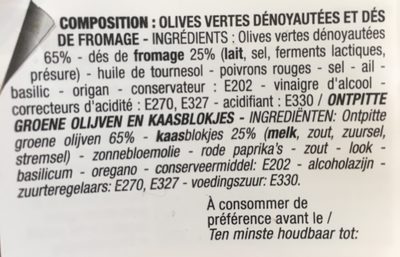
Ingredients list
Ingredient information
Allergens
Ingredients analysis
No ingredients containing palm oil.
Contains non-vegan ingredients.
Unrecognized: fr:e202-origan-basilic
Vegetarian status unknown
Unrecognized: fr:e202-origan-basilic
Food Processing
NOVA group
 Ultra-processed food and drink products
Elements that indicate the product is in NOVA group 4
How NOVA works
Additives
E202 - Potassium sorbate EFSA overexposure risk: highPreservative
Potassium sorbate (E202) is a synthetic food preservative commonly used to extend the shelf life of various food products.
It works by inhibiting the growth of molds, yeast, and some bacteria, preventing spoilage. When added to foods, it helps maintain their freshness and quality.
Some studies have shown that when combined with nitrites, potassium sorbate have genotoxic activity in vitro. However, potassium sorbate is generally recognized as safe (GRAS) by regulatory authorities.
E270 - Lactic acid
LACTIC ACID is an organic compound with the formula CH3CH(OH)CO2H. In the form of its conjugate base called lactate (this is thus different and kept as a separate ingredient). Lactic acid is chiral, consisting of two optical isomers. One is known as L-(+)-lactic acid or (S)-lactic acid and the other, its mirror image, is D-(−)-lactic acid or (R)-lactic acid in food the L-variant is used
E327 - calcium lactateThickener
Calcium lactate is a white crystalline salt with formula C6H10CaO6, consisting of two lactate anions H3C(CHOH)CO−2 for each calcium cation Ca2+. It forms several hydrates, the most common being the pentahydrate C6H10CaO6·5H2O. Calcium lactate is used in medicine, mainly to treat calcium deficiencies; and as a food additive with E number of E327. Some cheese crystals consist of calcium lactate.
E330 - Citric acidAntioxidantSequestrant
Citric acid is a natural organic acid found in citrus fruits such as lemons, oranges, and limes.
It is widely used in the food industry as a flavor enhancer, acidulant, and preservative due to its tart and refreshing taste.
Citric acid is safe for consumption when used in moderation and is considered a generally recognized as safe (GRAS) food additive by regulatory agencies worldwide.
Environment
Green-Score, origins bonus, and transportation impact are shown for Worldwide .
Green Score
Overall grade
 Very low environmental impact
About Green-Score
Current scope
Life cycle analysis
Average impact of the category
 Olive, green, stuffed (anchovy, sweet peppers, etc…) • Score: 95/100
Life-cycle reference
Overall environmental impact by stage (PEF)
The overall environmental impact figure (PEF) comes from ADEME's Agribalyse database, for the category: Olive, green, stuffed (anchovy, sweet peppers, etc…). Source: ADEME Agribalyse Database.
| Stage | Impact |
|---|---|
| Agriculture | 30.4 % |
| Processing | 0.0 % |
| Packaging | 40.4 % |
| Transportation | 20.4 % |
| Distribution | 7.1 % |
| Consumption | 1.9 % |
Bonuses and maluses
Declared origins
Packaging impact
Green-Score for this product
Green-Score for this product
Final score: 75/100Final score breakdown
Carbon footprint
Carbon footprint
Climate impact by stage (CO2e)
The carbon emission figure comes from ADEME's Agribalyse database, for the category: Olive, green, stuffed (anchovy, sweet peppers, etc…). Source: ADEME Agribalyse Database.
| Stage | Impact |
|---|---|
| Agriculture | 4.2 % |
| Processing | 0.0 % |
| Packaging | 59.7 % |
| Transportation | 31.9 % |
| Distribution | 3.6 % |
| Consumption | 0.6 % |
Packaging
Packaging impact
Data precision
Transportation
Declared origins
Forest footprint
Forest footprint
Deforestation risk details
Data Source
Product data comes from Open Food Facts. Food Benchmark also adds translations, category comparisons and explanatory calculations.
The database is licensed under ODbL 1.0, individual contents under DbCL 1.0, and product photos under CC BY-SA 3.0.
Product added on August 19, 2017 at 12:43:03 PM UTC by kiliweb .
Last edit on March 17, 2026 at 11:19:45 PM UTC by new-nutrition-bot .
Product page also edited by kiliweb, new-nutrition-bot, openfoodfacts-contributors, roboto-app, segundo, teolemon, yuka.LrxDOYavJ5IoMMHoi4UL7QSgJMv4AMJUSH0Vog.