

Paëlla royale
Health
Nutrition
Nutri-Score
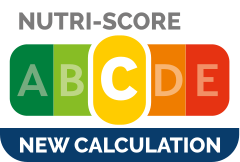 Average nutritional quality
Nutri-Score data warning
Nutrient levels
Fat in moderate quantity (4.4%)
Saturated fat in low quantity (1.4%)
Sugars in low quantity (1%)
Salt in moderate quantity (1%)
Nutrition label
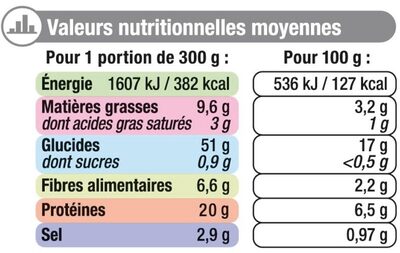
Nutrition facts
| Nutrition facts | As sold for 100 g / 100 ml | Compared to: Paella |
|---|---|---|
| Energy | 581 kJ (138 kcal) | 579.331 kJ (140 kcal) (~0%) |
| Fat | 4.4 g | 4.396 g (~0%) |
| Saturated fat | 1.4 g | 0.944 g (+48%) |
| Carbohydrates | 18 g | 16.809 g (+7%) |
| Sugars | 1 g | 1.216 g (-18%) |
| Dietary fiber | 1 g | ? |
| Proteins | 6 g | 6.775 g (-11%) |
| Salt | 1 g | 0.888 g (+13%) |
| Sodium | 0.4 g | 0.355 g (+13%) |
| Fruits, vegetables and legumes | ~ 3.603515625 % | ? |
Nutrition facts (Detailed data)
| Nutrition facts | As sold for 100 g / 100 ml | As sold Per 100 g (packaging) | As sold Per 100 g (estimate) |
|---|---|---|---|
| Energy | 581 kJ (138 kcal) | 581 kJ (138 kcal) | ? |
| Fat | 4.4 g | 4.4 g | ? |
| Saturated fat | 1.4 g | 1.4 g | ? |
| Carbohydrates | 18 g | 18 g | ? |
| Sugars | 1 g | 1 g | ? |
| Dietary fiber | 1 g | 1 g | ? |
| Proteins | 6 g | 6 g | ? |
| Salt | 1 g | 1 g | ? |
| Sodium | 0.4 g | 0.4 g | ? |
| Fruits, vegetables and legumes | ~ 3.603515625 % | ? | ~ 3.603515625 % |
Serving size
Ingredients
Ingredients image
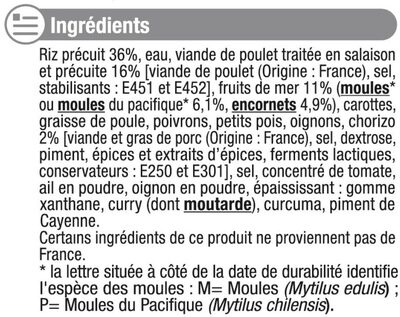
Ingredients list
Ingredient information
Added sugars
Allergens
Ingredients analysis
Palm oil content unknown
Contains non-vegan ingredients.
Contains non-vegetarian ingredients.
Food Processing
NOVA group
 Ultra-processed food and drink products
Elements that indicate the product is in NOVA group 4
How NOVA works
Additives
E250 - Sodium nitrite EFSA overexposure risk: highPreservative
Sodium nitrite (E250) is a salt used for curing and preserving meat products.
It plays a critical role in preventing the growth of Clostridium botulinum, the bacterium responsible for botulism, in cured meats like bacon, ham, and sausages. It also provides the characteristic pink color and flavor.
However, nitrites can react with amines in the stomach to form nitrosamines, which are potent carcinogens. High intake of processed meats containing nitrites is associated with an increased risk of colorectal cancer. Regulatory bodies have set strict limits on its use in food.
E301 - Sodium ascorbateAntioxidant
SODIUM ASCORBATE is one of a number of mineral salts of ascorbic acid (vitamin C).
E415 - Xanthan gumEmulsifierStabiliserThickener
Xanthan gum (E415) is a natural polysaccharide derived from fermented sugars, often used in the food industry as a thickening and stabilizing agent.
This versatile food additive enhances texture and prevents ingredient separation in a wide range of products, including salad dressings, sauces, and gluten-free baked goods.
It is considered safe for consumption even at high intake amounts.
E451 - Triphosphates EFSA overexposure risk: highEmulsifierHumectantSequestrantStabiliserThickener
Sodium triphosphate (STP), also sodium tripolyphosphate (STPP), or tripolyphosphate (TPP),) is an inorganic compound with formula Na5P3O10. It is the sodium salt of the polyphosphate penta-anion, which is the conjugate base of triphosphoric acid. It is produced on a large scale as a component of many domestic and industrial products, especially detergents. Environmental problems associated with eutrophication are attributed to its widespread use.
E452 - Polyphosphates EFSA overexposure risk: highEmulsifierHumectantSequestrantStabiliserThickener
No additive description is available yet.
Environment
Green-Score, origins bonus, and transportation impact are shown for Worldwide .
Green Score
Overall grade
 High environmental impact
About Green-Score
Current scope
Life cycle analysis
Average impact of the category
 Paëlla • Score: 54/100
Life-cycle reference
Overall environmental impact by stage (PEF)
The overall environmental impact figure (PEF) comes from ADEME's Agribalyse database, for the category: Paëlla. Source: ADEME Agribalyse Database.
| Stage | Impact |
|---|---|
| Agriculture | 74.1 % |
| Processing | 9.0 % |
| Packaging | 7.1 % |
| Transportation | 6.6 % |
| Distribution | 2.0 % |
| Consumption | 1.4 % |
Bonuses and maluses
Origins of ingredients
Packaging impact
Green-Score for this product
Green-Score for this product
Final score: 36/100Final score breakdown
Carbon footprint
Carbon footprint
Climate impact by stage (CO2e)
The carbon emission figure comes from ADEME's Agribalyse database, for the category: Paëlla. Source: ADEME Agribalyse Database.
| Stage | Impact |
|---|---|
| Agriculture | 60.1 % |
| Processing | 9.7 % |
| Packaging | 16.6 % |
| Transportation | 12.0 % |
| Distribution | 1.3 % |
| Consumption | 0.6 % |
Packaging
Packaging impact
Packaging components
| Shape | Material | Recycling | Impact |
|---|---|---|---|
| Tray | Plastic | Unknown | High |
| Seal | Cardboard | Unknown | Low |
| Sleeve | Unknown | Unknown | High |
Declared packaging
Data precision
Transportation
Manufacturing locations
Origins of ingredients
Origins breakdown
| Origin | Percent of ingredients | Impact |
|---|---|---|
| Unknown | 84 % | High |
| France | 16 % | High |
Forest footprint
Forest footprint
Ingredients linked to forest pressure
| Ingredient | Type | Percent in product | Forest footprint |
|---|---|---|---|
| Chicken Meat | Poulet Standard | 8.00 % | 0.20 |
Data Source
Product data comes from Open Food Facts. Food Benchmark also adds translations, category comparisons and explanatory calculations.
The database is licensed under ODbL 1.0, individual contents under DbCL 1.0, and product photos under CC BY-SA 3.0.
Product added on February 11, 2013 at 12:10:56 PM UTC by nash .
Last edit on March 14, 2026 at 8:36:23 PM UTC by new-nutrition-bot .
Product page also edited by jacob80, jim, manu1400, naruyoko, nash, new-nutrition-bot, org-systeme-u, packbot, quechoisir, sebleouf, segundo, systeme-u, systeme-u-off, tacite-mass-editor.
Source List
- Systeme U
- systeme-u