

Cassoulet 420g
Health
Nutrition
Nutri-Score
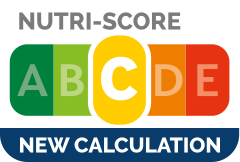 Average nutritional quality
Nutri-Score data warning
Nutrient levels
Fat in moderate quantity (5.1%)
Saturated fat in moderate quantity (1.9%)
Sugars in low quantity (0.9%)
Salt in moderate quantity (0.84%)
Nutrition facts
| Nutrition facts | As sold for 100 g / 100 ml | Compared to: fr:Cassoulet (plat complet) |
|---|---|---|
| Energy | 474 kJ (119 kcal) | 553 kJ (132 kcal) (-14%) |
| Fat | 5.1 g | 6.3 g (-19%) |
| Saturated fat | 1.9 g | 2.16 g (-12%) |
| Carbohydrates | 8.1 g | 8.45 g (-4%) |
| Sugars | 0.9 g | 0.52 g (+73%) |
| Dietary fiber | 3.2 g | ? |
| Proteins | 7.2 g | 8.35 g (-14%) |
| Salt | 0.84 g | 0.807 g (+4%) |
| Sodium | 0.336 g | 0.322 g (+4%) |
| Fruits, vegetables and legumes | ~ 33.2 % | ? |
Nutrition facts (Detailed data)
| Nutrition facts | As sold for 100 g / 100 ml | As sold Per 100 g (packaging) | As sold Per 100 g (estimate) |
|---|---|---|---|
| Energy | 474 kJ (119 kcal) | 474 kJ (119 kcal) | ? |
| Fat | 5.1 g | 5.1 g | ? |
| Saturated fat | 1.9 g | 1.9 g | ? |
| Carbohydrates | 8.1 g | 8.1 g | ? |
| Sugars | 0.9 g | 0.9 g | ? |
| Dietary fiber | 3.2 g | 3.2 g | ? |
| Proteins | 7.2 g | 7.2 g | ? |
| Salt | 0.84 g | 0.84 g | ? |
| Sodium | 0.336 g | 0.336 g | ? |
| Fruits, vegetables and legumes | ~ 33.2 % | ? | ~ 33.2 % |
Serving size
Ingredients
Ingredients image

Ingredients list
Ingredient information
Added sugars
Allergens
Traces
Ingredients analysis
Palm oil content unknown
Contains non-vegan ingredients.
Unrecognized: fr:saucisses
Contains non-vegetarian ingredients.
Unrecognized: fr:saucisses
Food Processing
NOVA group
 Ultra-processed food and drink products
Elements that indicate the product is in NOVA group 4
How NOVA works
Additives
E14XX - Modified StarchEmulsifierStabiliserThickener
No additive description is available yet.
E250 - Sodium nitrite EFSA overexposure risk: highPreservative
Sodium nitrite (E250) is a salt used for curing and preserving meat products.
It plays a critical role in preventing the growth of Clostridium botulinum, the bacterium responsible for botulism, in cured meats like bacon, ham, and sausages. It also provides the characteristic pink color and flavor.
However, nitrites can react with amines in the stomach to form nitrosamines, which are potent carcinogens. High intake of processed meats containing nitrites is associated with an increased risk of colorectal cancer. Regulatory bodies have set strict limits on its use in food.
E407 - Carrageenan EFSA overexposure risk: highCarrierEmulsifierHumectantStabiliserThickener
Carrageenan (E407), derived from red seaweed, is widely employed in the food industry as a gelling, thickening, and stabilizing agent, notably in dairy and meat products.
It can exist in various forms, each imparting distinct textural properties to food.
However, its degraded form, often referred to as poligeenan, has raised health concerns due to its potential inflammatory effects and its classification as a possible human carcinogen (Group 2B) by the International Agency for Research on Cancer (IARC).
Nevertheless, food-grade carrageenan has been deemed safe by various regulatory bodies when consumed in amounts typically found in food.
E407a - Processed eucheuma seaweed EFSA overexposure risk: highCarrierEmulsifierHumectantStabiliserThickener
Carrageenans or carrageenins ( karr-ə-gee-nənz, from Irish carraigín, "little rock") are a family of linear sulfated polysaccharides that are extracted from red edible seaweeds. They are widely used in the food industry, for their gelling, thickening, and stabilizing properties. Their main application is in dairy and meat products, due to their strong binding to food proteins. There are three main varieties of carrageenan, which differ in their degree of sulfation. Kappa-carrageenan has one sulfate group per disaccharide, iota-carrageenan has two, and lambda-carrageenan has three. Gelatinous extracts of the Chondrus crispus (Irish moss) seaweed have been used as food additives since approximately the fifteenth century. Carrageenan is a vegetarian and vegan alternative to gelatin in some applications or may be used to replace gelatin in confectionery.
E412 - Guar gumEmulsifierStabiliserThickener
Guar gum (E412) is a natural food additive derived from guar beans.
This white, odorless powder is valued for its remarkable thickening and stabilizing properties, making it a common ingredient in various food products, including sauces, dressings, and ice creams.
When used in moderation, guar gum is considered safe for consumption, with no known adverse health effects.
E415 - Xanthan gumEmulsifierStabiliserThickener
Xanthan gum (E415) is a natural polysaccharide derived from fermented sugars, often used in the food industry as a thickening and stabilizing agent.
This versatile food additive enhances texture and prevents ingredient separation in a wide range of products, including salad dressings, sauces, and gluten-free baked goods.
It is considered safe for consumption even at high intake amounts.
E451 - Triphosphates EFSA overexposure risk: highEmulsifierHumectantSequestrantStabiliserThickener
Sodium triphosphate (STP), also sodium tripolyphosphate (STPP), or tripolyphosphate (TPP),) is an inorganic compound with formula Na5P3O10. It is the sodium salt of the polyphosphate penta-anion, which is the conjugate base of triphosphoric acid. It is produced on a large scale as a component of many domestic and industrial products, especially detergents. Environmental problems associated with eutrophication are attributed to its widespread use.
E509 - Calcium chloride EFSA overexposure risk: moderateStabiliserThickenerCoagulant
Calcium chloride is an inorganic compound, a salt with the chemical formula CaCl2. It is a colorless crystalline solid at room temperature, highly soluble in water. Calcium chloride is commonly encountered as a hydrated solid with generic formula CaCl2(H2O)x, where x = 0, 1, 2, 4, and 6. These compounds are mainly used for de-icing and dust control. Because the anhydrous salt is hygroscopic, it is used as a desiccant.
Environment
Green-Score, origins bonus, and transportation impact are shown for Worldwide .
Green Score
Overall grade
 Very low environmental impact
About Green-Score
Current scope
Life cycle analysis
Average impact of the category
 White bean stew, canned • Score: 98/100
Life-cycle reference
Overall environmental impact by stage (PEF)
The overall environmental impact figure (PEF) comes from ADEME's Agribalyse database, for the category: White bean stew, canned. Source: ADEME Agribalyse Database.
| Stage | Impact |
|---|---|
| Agriculture | 17.6 % |
| Processing | 26.0 % |
| Packaging | 28.9 % |
| Transportation | 14.9 % |
| Distribution | 6.6 % |
| Consumption | 6.1 % |
Bonuses and maluses
Origins of ingredients
Packaging impact
Green-Score for this product
Green-Score for this product
Final score: 80/100Final score breakdown
Carbon footprint
Carbon footprint
Climate impact by stage (CO2e)
The carbon emission figure comes from ADEME's Agribalyse database, for the category: White bean stew, canned. Source: ADEME Agribalyse Database.
| Stage | Impact |
|---|---|
| Agriculture | 7.9 % |
| Processing | 32.3 % |
| Packaging | 32.8 % |
| Transportation | 22.5 % |
| Distribution | 2.7 % |
| Consumption | 1.9 % |
Packaging
Packaging impact
Data precision
Transportation
Origins of ingredients
Origins breakdown
| Origin | Percent of ingredients | Impact |
|---|---|---|
| Unknown | 80 % | High |
| France | 20 % | High |
Forest footprint
Forest footprint
Deforestation risk details
Data Source
Product data comes from Open Food Facts. Food Benchmark also adds translations, category comparisons and explanatory calculations.
The database is licensed under ODbL 1.0, individual contents under DbCL 1.0, and product photos under CC BY-SA 3.0.
Product added on July 23, 2017 at 8:50:42 AM UTC by kiliweb .
Last edit on March 17, 2026 at 11:30:15 PM UTC by new-nutrition-bot .
Product page also edited by ele94, jecrivaine, kiliweb, new-nutrition-bot, openfoodfacts-contributors, org-les-mousquetaires, roboto-app, segundo, teolemon.
Source List
- les-mousquetaires