
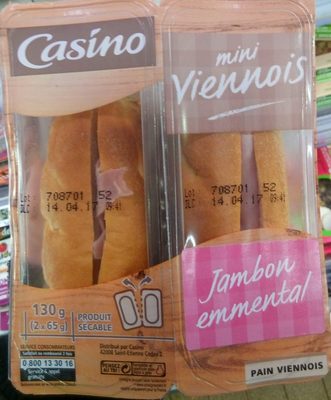
Mini Viennois jambon emmental
Health
Nutrition
Nutri-Score
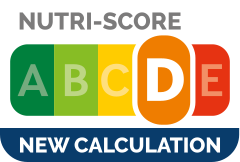 Lower nutritional quality
Nutrient levels
Fat in moderate quantity (8.4%)
Saturated fat in moderate quantity (2.6%)
Sugars in low quantity (4%)
Salt in high quantity (1.9%)
Nutrition label

Nutrition facts
| Nutrition facts | As sold for 100 g / 100 ml | Compared to: fr:Snacks et apéritifs |
|---|---|---|
| Energy | 1042 kJ (248 kcal) | 838.75 kJ (200 kcal) (+24%) |
| Fat | 8.4 g | 8.829 g (-5%) |
| Saturated fat | 2.6 g | 2.95 g (-12%) |
| Carbohydrates | 31 g | 21.967 g (+41%) |
| Sugars | 4 g | 4.379 g (-9%) |
| Dietary fiber | 0 g | ? |
| Proteins | 12 g | 6.688 g (+79%) |
| Salt | 1.9 g | 0.904 g (+110%) |
| Sodium | 0.76 g | 0.362 g (+110%) |
| Fruits, vegetables and legumes | ~ 0 % | ? |
Nutrition facts (Detailed data)
| Nutrition facts | As sold for 100 g / 100 ml | As sold Per 100 g (packaging) | As sold Per 100 g (estimate) |
|---|---|---|---|
| Energy | 1042 kJ (248 kcal) | 1042 kJ (248 kcal) | ? |
| Fat | 8.4 g | 8.4 g | ? |
| Saturated fat | 2.6 g | 2.6 g | ? |
| Carbohydrates | 31 g | 31 g | ? |
| Sugars | 4 g | 4 g | ? |
| Dietary fiber | 0 g | 0 g | ? |
| Proteins | 12 g | 12 g | ? |
| Salt | 1.9 g | 1.9 g | ? |
| Sodium | 0.76 g | 0.76 g | ? |
| Fruits, vegetables and legumes | ~ 0 % | ? | ~ 0 % |
Serving size
Ingredients
Ingredients image

Ingredients list
Ingredient information
Added sugars
Allergens
Traces
Ingredients analysis
Palm oil content unknown
Contains non-vegan ingredients.
Contains non-vegetarian ingredients.
Food Processing
NOVA group
 Ultra-processed food and drink products
Elements that indicate the product is in NOVA group 4
How NOVA works
Additives
E14XX - Modified StarchEmulsifierStabiliserThickener
No additive description is available yet.
E160c - Paprika extractColour
No additive description is available yet.
E161b - LuteinColour
LUTEIN is a xanthophyll and one of 600 known naturally occurring carotenoids. Lutein is extracted from the petals of African marigold (Tagetes erecta). It is approved for use in the EU and Australia and New Zealand. In the United States lutein may not be used as a food coloring for foods intended for human consumption, but can be added to animal feed.
E202 - Potassium sorbate EFSA overexposure risk: highPreservative
Potassium sorbate (E202) is a synthetic food preservative commonly used to extend the shelf life of various food products.
It works by inhibiting the growth of molds, yeast, and some bacteria, preventing spoilage. When added to foods, it helps maintain their freshness and quality.
Some studies have shown that when combined with nitrites, potassium sorbate have genotoxic activity in vitro. However, potassium sorbate is generally recognized as safe (GRAS) by regulatory authorities.
E224 - Potassium metabisulphite EFSA overexposure risk: highAntioxidantPreservative
POTASSIUM METABISULFITE, K2S2O5, also known as potassium pyrosulfite, is a white crystalline powder with a pungent sulfur odour. The main use for the chemical is as an antioxidant or chemical sterilant.
E250 - Sodium nitrite EFSA overexposure risk: highPreservative
Sodium nitrite (E250) is a salt used for curing and preserving meat products.
It plays a critical role in preventing the growth of Clostridium botulinum, the bacterium responsible for botulism, in cured meats like bacon, ham, and sausages. It also provides the characteristic pink color and flavor.
However, nitrites can react with amines in the stomach to form nitrosamines, which are potent carcinogens. High intake of processed meats containing nitrites is associated with an increased risk of colorectal cancer. Regulatory bodies have set strict limits on its use in food.
E300 - Ascorbic acidAntioxidantSequestrant
No additive description is available yet.
E301 - Sodium ascorbateAntioxidant
SODIUM ASCORBATE is one of a number of mineral salts of ascorbic acid (vitamin C).
E330 - Citric acidAntioxidantSequestrant
Citric acid is a natural organic acid found in citrus fruits such as lemons, oranges, and limes.
It is widely used in the food industry as a flavor enhancer, acidulant, and preservative due to its tart and refreshing taste.
Citric acid is safe for consumption when used in moderation and is considered a generally recognized as safe (GRAS) food additive by regulatory agencies worldwide.
E407a - Processed eucheuma seaweed EFSA overexposure risk: highCarrierEmulsifierHumectantStabiliserThickener
Carrageenans or carrageenins ( karr-ə-gee-nənz, from Irish carraigín, "little rock") are a family of linear sulfated polysaccharides that are extracted from red edible seaweeds. They are widely used in the food industry, for their gelling, thickening, and stabilizing properties. Their main application is in dairy and meat products, due to their strong binding to food proteins. There are three main varieties of carrageenan, which differ in their degree of sulfation. Kappa-carrageenan has one sulfate group per disaccharide, iota-carrageenan has two, and lambda-carrageenan has three. Gelatinous extracts of the Chondrus crispus (Irish moss) seaweed have been used as food additives since approximately the fifteenth century. Carrageenan is a vegetarian and vegan alternative to gelatin in some applications or may be used to replace gelatin in confectionery.
E415 - Xanthan gumEmulsifierStabiliserThickener
Xanthan gum (E415) is a natural polysaccharide derived from fermented sugars, often used in the food industry as a thickening and stabilizing agent.
This versatile food additive enhances texture and prevents ingredient separation in a wide range of products, including salad dressings, sauces, and gluten-free baked goods.
It is considered safe for consumption even at high intake amounts.
E417 - Tara gumStabiliserThickener
No additive description is available yet.
E451 - Triphosphates EFSA overexposure risk: highEmulsifierHumectantSequestrantStabiliserThickener
Sodium triphosphate (STP), also sodium tripolyphosphate (STPP), or tripolyphosphate (TPP),) is an inorganic compound with formula Na5P3O10. It is the sodium salt of the polyphosphate penta-anion, which is the conjugate base of triphosphoric acid. It is produced on a large scale as a component of many domestic and industrial products, especially detergents. Environmental problems associated with eutrophication are attributed to its widespread use.
E471 - Mono- and diglycerides of fatty acidsEmulsifierStabiliser
Mono- and diglycerides of fatty acids (E471), are food additives commonly used as emulsifiers in various processed foods.
These compounds consist of glycerol molecules linked to one or two fatty acid chains, which help stabilize and blend water and oil-based ingredients. E471 enhances the texture and shelf life of products like margarine, baked goods, and ice cream, ensuring a smooth and consistent texture.
It is generally considered safe for consumption within established regulatory limits.
E481 - Sodium stearoyl-2-lactylate EFSA overexposure risk: highEmulsifierStabiliser
Sodium stearoyl-2-lactylate (sodium stearoyl lactylate or SSL) is a versatile, FDA approved food additive used to improve the mix tolerance and volume of processed foods. It is one type of a commercially available lactylate. SSL is non-toxic, biodegradable, and typically manufactured using biorenewable feedstocks. Because SSL is a safe and highly effective food additive, it is used in a wide variety of products ranging from baked goods and desserts to pet foods.As described by the Food Chemicals Codex 7th edition, SSL is a cream-colored powder or brittle solid. SSL is currently manufactured by the esterification of stearic acid with lactic acid and partially neutralized with either food-grade soda ash (sodium carbonate) or caustic soda (concentrated sodium hydroxide). Commercial grade SSL is a mixture of sodium salts of stearoyl lactylic acids and minor proportions of other sodium salts of related acids. The HLB for SSL is 10-12. SSL is slightly hygroscopic, soluble in ethanol and in hot oil or fat, and dispersible in warm water. These properties are the reason that SSL is an excellent emulsifier for fat-in-water emulsions and can also function as a humectant.
Environment
Green-Score, origins bonus, and transportation impact are shown for Worldwide .
Green Score
Overall grade
 High environmental impact
About Green-Score
Current scope
Life cycle analysis
Average impact of the category
 Sandwich made with wholemeal loaf bread, ham and cheese • Score: 48/100
Life-cycle reference
Overall environmental impact by stage (PEF)
The overall environmental impact figure (PEF) comes from ADEME's Agribalyse database, for the category: Sandwich made with wholemeal loaf bread, ham and cheese. Source: ADEME Agribalyse Database.
| Stage | Impact |
|---|---|
| Agriculture | 77.0 % |
| Processing | 8.5 % |
| Packaging | 9.2 % |
| Transportation | 3.3 % |
| Distribution | 1.7 % |
| Consumption | 0.4 % |
Bonuses and maluses
Origins of ingredients
Packaging impact
Green-Score for this product
Green-Score for this product
Final score: 32/100Final score breakdown
Carbon footprint
Carbon footprint
Climate impact by stage (CO2e)
The carbon emission figure comes from ADEME's Agribalyse database, for the category: Sandwich made with wholemeal loaf bread, ham and cheese. Source: ADEME Agribalyse Database.
| Stage | Impact |
|---|---|
| Agriculture | 80.8 % |
| Processing | 6.0 % |
| Packaging | 6.9 % |
| Transportation | 5.3 % |
| Distribution | 0.9 % |
| Consumption | 0.1 % |
Packaging

Packaging impact
Packaging components
| Shape | Material | Recycling | Impact |
|---|---|---|---|
| Seal | Plastic | Unknown | High |
| Tray | Unknown | Unknown | High |
Declared packaging
Data precision
Transportation
Origins of ingredients
Origins breakdown
| Origin | Percent of ingredients | Impact |
|---|---|---|
| Unknown | 81 % | High |
| European Union | 19 % | High |
Forest footprint
Forest footprint
Ingredients linked to forest pressure
| Ingredient | Type | Percent in product | Forest footprint |
|---|---|---|---|
| EGG Yolk | Oeufs Importés | 0.29 % | 0.00 |
Additional information
- Other information
- Conditionné sous atmosphère protectrice. NE PAS CONGELER.jambon de porc : origine UE
- Conservation conditions
- A conserver entre 0°C et +4°C - A consommer immédiatement après ouverture
- Disposal instructions
- Barquette et opercule en plastique
Data Source
Product data comes from Open Food Facts. Food Benchmark also adds translations, category comparisons and explanatory calculations.
The database is licensed under ODbL 1.0, individual contents under DbCL 1.0, and product photos under CC BY-SA 3.0.
Product added on April 10, 2017 at 10:35:11 AM UTC by sebleouf .
Last edit on March 17, 2026 at 10:37:33 PM UTC by new-nutrition-bot .
Product page also edited by casino, casino-off, ecoscore-impact-estimator, new-nutrition-bot, openfoodfacts-contributors, org-casino, packbot, roboto-app, sebleouf.
Source List
- Casino
- casino