

Cheeseburger
Health
Nutrition
Nutri-Score
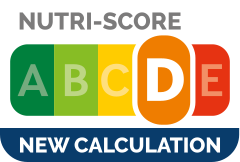 Lower nutritional quality
Nutri-Score data warning
Nutrient levels
Fat in moderate quantity (12%)
Saturated fat in high quantity (5.3%)
Sugars in low quantity (4.5%)
Salt in moderate quantity (1.2%)
Nutrition label

Nutrition facts
| Nutrition facts | As sold for 100 g / 100 ml | Compared to: Cheeseburgers |
|---|---|---|
| Energy | 1056 kJ (252 kcal) | 1,093.881 kJ (262 kcal) (-3%) |
| Fat | 12 g | 12.753 g (-6%) |
| Saturated fat | 5.3 g | 5.301 g (~0%) |
| Carbohydrates | 22 g | 23.394 g (-6%) |
| Sugars | 4.5 g | 4.159 g (+8%) |
| Dietary fiber | 1.7 g | ? |
| Proteins | 14 g | 12.879 g (+9%) |
| Salt | 1.2 g | 1.404 g (-15%) |
| Sodium | 0.48 g | 0.563 g (-15%) |
| Fruits, vegetables and legumes | ~ 7.93125 % | ? |
Nutrition facts (Detailed data)
| Nutrition facts | As sold for 100 g / 100 ml | As sold Per 100 g (packaging) | As sold Per 100 g (estimate) |
|---|---|---|---|
| Energy | 1056 kJ (252 kcal) | 1056 kJ (252 kcal) | ? |
| Fat | 12 g | 12 g | ? |
| Saturated fat | 5.3 g | 5.3 g | ? |
| Carbohydrates | 22 g | 22 g | ? |
| Sugars | 4.5 g | 4.5 g | ? |
| Dietary fiber | 1.7 g | 1.7 g | ? |
| Proteins | 14 g | 14 g | ? |
| Salt | 1.2 g | 1.2 g | ? |
| Sodium | 0.48 g | 0.48 g | ? |
| Fruits, vegetables and legumes | ~ 7.93125 % | ? | ~ 7.93125 % |
Ingredients
Ingredients image

Ingredients list
Ingredient information
Added sugars
Allergens
Traces
Ingredients analysis
Palm oil content unknown
Contains non-vegan ingredients.
Contains non-vegetarian ingredients.
Food Processing
NOVA group
 Ultra-processed food and drink products
Elements that indicate the product is in NOVA group 4
How NOVA works
Additives
E14XX - Modified StarchEmulsifierStabiliserThickener
No additive description is available yet.
E160c - Paprika extractColour
No additive description is available yet.
E202 - Potassium sorbate EFSA overexposure risk: highPreservative
Potassium sorbate (E202) is a synthetic food preservative commonly used to extend the shelf life of various food products.
It works by inhibiting the growth of molds, yeast, and some bacteria, preventing spoilage. When added to foods, it helps maintain their freshness and quality.
Some studies have shown that when combined with nitrites, potassium sorbate have genotoxic activity in vitro. However, potassium sorbate is generally recognized as safe (GRAS) by regulatory authorities.
E222 - Sodium bisulphite EFSA overexposure risk: highAntioxidantPreservative
SODIUM BISULFITE is a chemical compound with the chemical formula NaHSO3.
E224 - Potassium metabisulphite EFSA overexposure risk: highAntioxidantPreservative
POTASSIUM METABISULFITE, K2S2O5, also known as potassium pyrosulfite, is a white crystalline powder with a pungent sulfur odour. The main use for the chemical is as an antioxidant or chemical sterilant.
E270 - Lactic acid
LACTIC ACID is an organic compound with the formula CH3CH(OH)CO2H. In the form of its conjugate base called lactate (this is thus different and kept as a separate ingredient). Lactic acid is chiral, consisting of two optical isomers. One is known as L-(+)-lactic acid or (S)-lactic acid and the other, its mirror image, is D-(−)-lactic acid or (R)-lactic acid in food the L-variant is used
E300 - Ascorbic acidAntioxidantSequestrant
No additive description is available yet.
E331 - Sodium citratesEmulsifierSequestrantStabiliser
DISODIUM CITRATE, more properly, disodium hydrogen citrate, is an acid salt of citric acid with the chemical formula Na2C6H6O7. It is used as an antioxidant in food and to improve the effects of other antioxidants. It is also used as an acidity regulator and sequestrant. Typical products include gelatin, jam, sweets, ice cream, carbonated beverages, milk powder, wine, and processed cheeses.
E407 - Carrageenan EFSA overexposure risk: highCarrierEmulsifierHumectantStabiliserThickener
Carrageenan (E407), derived from red seaweed, is widely employed in the food industry as a gelling, thickening, and stabilizing agent, notably in dairy and meat products.
It can exist in various forms, each imparting distinct textural properties to food.
However, its degraded form, often referred to as poligeenan, has raised health concerns due to its potential inflammatory effects and its classification as a possible human carcinogen (Group 2B) by the International Agency for Research on Cancer (IARC).
Nevertheless, food-grade carrageenan has been deemed safe by various regulatory bodies when consumed in amounts typically found in food.
E471 - Mono- and diglycerides of fatty acidsEmulsifierStabiliser
Mono- and diglycerides of fatty acids (E471), are food additives commonly used as emulsifiers in various processed foods.
These compounds consist of glycerol molecules linked to one or two fatty acid chains, which help stabilize and blend water and oil-based ingredients. E471 enhances the texture and shelf life of products like margarine, baked goods, and ice cream, ensuring a smooth and consistent texture.
It is generally considered safe for consumption within established regulatory limits.
E482 - Calcium stearoyl-2-lactylate EFSA overexposure risk: highEmulsifierStabiliser
Calcium stearoyl-2-lactylate (calcium stearoyl lactylate or CSL) or E482 is a versatile, FDA approved food additive. It is one type of a commercially available lactylate. CSL is non-toxic, biodegradable, and typically manufactured using biorenewable feedstocks. Because CSL is a safe and highly effective food additive, it is used in a wide variety of products from baked goods and desserts to packaging.As described by the Food Chemicals Codex 7th edition, CSL is a cream-colored powder. CSL is currently manufactured by the esterification of stearic acid and lactic acid with partial neutralization using food-grade hydrated lime (calcium hydroxide). Commercial grade CSL is a mixture of calcium salts of stearoyl lactic acid, with minor proportions of other salts of related acids. The HLB for CSL is 5.1. It is slightly soluble in hot water. The pH of a 2% aqueous suspension is approximately 4.7.
E509 - Calcium chloride EFSA overexposure risk: moderateStabiliserThickenerCoagulant
Calcium chloride is an inorganic compound, a salt with the chemical formula CaCl2. It is a colorless crystalline solid at room temperature, highly soluble in water. Calcium chloride is commonly encountered as a hydrated solid with generic formula CaCl2(H2O)x, where x = 0, 1, 2, 4, and 6. These compounds are mainly used for de-icing and dust control. Because the anhydrous salt is hygroscopic, it is used as a desiccant.
E920 - l-cysteine
Cysteine (symbol Cys or C; ) is a semi-essential proteinogenic amino acid with the formula HO2CCH(NH2)CH2SH. The thiol side chain in cysteine often participates in enzymatic reactions, as a nucleophile. The thiol is susceptible to oxidation to give the disulfide derivative cystine, which serves an important structural role in many proteins. When used as a food additive, it has the E number E920. It is encoded by the codons UGU and UGC. Cysteine has the same structure as serine, but with one of its oxygen atoms replaced by sulfur; replacing it with selenium gives selenocysteine. (Like other natural proteinogenic amino acids cysteine has (L) chirality in the older D/L notation based on homology to D and L glyceraldehyde. In the newer R/S system of designating chirality, based on the atomic numbers of atoms near the asymmetric carbon, cysteine (and selenocysteine) have R chirality, because of the presence of sulfur (resp. selenium) as a second neighbor to the asymmetric carbon. The remaining chiral amino acids, having lighter atoms in that position, have S chirality.)
Environment
Green-Score, origins bonus, and transportation impact are shown for Worldwide .
Green Score
Overall grade
 Very high environmental impact
About Green-Score
Current scope
Life cycle analysis
Average impact of the category
 Cheeseburger, from fast foods restaurant • Score: 15/100
Life-cycle reference
Overall environmental impact by stage (PEF)
The overall environmental impact figure (PEF) comes from ADEME's Agribalyse database, for the category: Cheeseburger, from fast foods restaurant. Source: ADEME Agribalyse Database.
| Stage | Impact |
|---|---|
| Agriculture | 90.6 % |
| Processing | 3.1 % |
| Packaging | 2.4 % |
| Transportation | 1.3 % |
| Distribution | 0.5 % |
| Consumption | 2.0 % |
Bonuses and maluses
Origins of ingredients
Packaging impact
Green-Score for this product
Green-Score for this product
Final score: 0/100Final score breakdown
Carbon footprint
Carbon footprint
Climate impact by stage (CO2e)
The carbon emission figure comes from ADEME's Agribalyse database, for the category: Cheeseburger, from fast foods restaurant. Source: ADEME Agribalyse Database.
| Stage | Impact |
|---|---|
| Agriculture | 92.6 % |
| Processing | 1.7 % |
| Packaging | 3.6 % |
| Transportation | 1.6 % |
| Distribution | 0.2 % |
| Consumption | 0.5 % |
Packaging
Packaging impact
Data precision
Transportation
Origins of ingredients
Origins breakdown
| Origin | Percent of ingredients | Impact |
|---|---|---|
| Unknown | 66 % | High |
| France | 34 % | High |
Forest footprint
Forest footprint
Deforestation risk details
Additional information
- Other information
- conditionné sous atmosphère protectrice.
- Conservation conditions
- A conserver entre 0°C et +4°C. A consommer rapidement après ouverture. ne pas congeler
- Recycling instructions
- boîte carton
- Disposal instructions
- film plastique
Data Source
Product data comes from Open Food Facts. Food Benchmark also adds translations, category comparisons and explanatory calculations.
The database is licensed under ODbL 1.0, individual contents under DbCL 1.0, and product photos under CC BY-SA 3.0.
Product added on December 22, 2017 at 11:26:41 AM UTC by kiliweb .
Last edit on March 17, 2026 at 11:27:26 PM UTC by new-nutrition-bot .
Product page also edited by casino, casino-off, jecrivaine, kiliweb, new-nutrition-bot, openfoodfacts-contributors, roboto-app, segundo, teolemon, yuka.RzY1UUZKb0grcWNGa004UXd4bk01NGdyN1pDWWJWNnRGOVFSSVE9PQ.
Source List
- Casino
- casino