
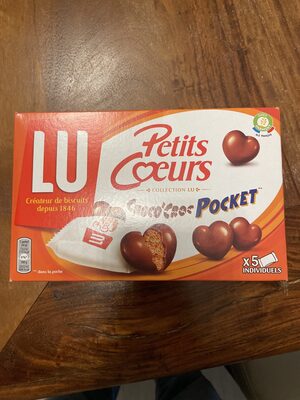
Petits coeurs
Health
Nutrition
Nutri-Score
 Lower nutritional quality
Nutri-Score data warning
Nutrient levels
Fat in high quantity (23%)
Saturated fat in high quantity (14%)
Sugars in high quantity (42%)
Salt in low quantity (0.15%)
Nutrition label

Nutrition facts
| Nutrition facts | As sold for 100 g / 100 ml | Compared to: Milk chocolate biscuits |
|---|---|---|
| Energy | ~ 2021.9 kJ (487 kcal) | 2,100.034 kJ (502 kcal) (-4%) |
| Fat | 23 g | 24.288 g (-5%) |
| Saturated fat | 14 g | 13.453 g (+4%) |
| Carbohydrates | 60 g | 62.764 g (-4%) |
| Sugars | 42 g | 34.871 g (+20%) |
| Dietary fiber | 4.2 g | ? |
| Proteins | 6.9 g | 6.711 g (+3%) |
| Salt | 0.15 g | 0.524 g (-71%) |
| Sodium | 0.06 g | 0.209 g (-71%) |
| Fruits, vegetables and legumes | ~ 0 % | ? |
Nutrition facts (Detailed data)
| Nutrition facts | As sold for 100 g / 100 ml | As sold Per 100 g (packaging) | As sold Per 100 g (estimate) |
|---|---|---|---|
| Energy | ~ 2021.9 kJ (487 kcal) | ? (487 kcal) | ~ 1989.0675390625 kJ (475 kcal) |
| Fat | 23 g | 23 g | ~ 22.409425 g |
| Saturated fat | 14 g | 14 g | ~ 13.39269725 g |
| Carbohydrates | 60 g | 60 g | ~ 57.488574609375 g |
| Sugars | 42 g | 42 g | ~ 39.647318234375 g |
| Dietary fiber | 4.2 g | 4.2 g | ~ 5.173810625 g |
| Proteins | 6.9 g | 6.9 g | ~ 8.10652925 g |
| Salt | 0.15 g | 0.15 g | ~ 0.180521447734377 g |
| Sodium | 0.06 g | 0.06 g | ~ 0.065620500628907 g |
| Fruits, vegetables and legumes | ~ 0 % | ? | ~ 0 % |
Serving size
Ingredients
Ingredients image
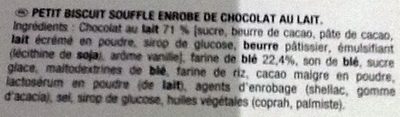
Ingredients list
Ingredient information
Added sugars
Allergens
Ingredients analysis
Contains ingredients containing palm oil.
Contains non-vegan ingredients.
Contains non-vegetarian ingredients.
Food Processing
NOVA group
 Ultra-processed food and drink products
Elements that indicate the product is in NOVA group 4
How NOVA works
Additives
E322 - LecithinsAntioxidantEmulsifier
Lecithins are natural compounds commonly used in the food industry as emulsifiers and stabilizers.
Extracted from sources like soybeans and eggs, lecithins consist of phospholipids that enhance the mixing of oil and water, ensuring smooth textures in various products like chocolates, dressings, and baked goods.
They do not present any known health risks.
E322i - LecithinAntioxidantEmulsifier
Lecithins are natural compounds commonly used in the food industry as emulsifiers and stabilizers.
Extracted from sources like soybeans and eggs, lecithins consist of phospholipids that enhance the mixing of oil and water, ensuring smooth textures in various products like chocolates, dressings, and baked goods.
They do not present any known health risks.
E414 - Acacia gumCarrierEmulsifierStabiliserThickener
Gum arabic, also known as acacia gum, arabic gum, gum acacia, acacia, Senegal gum and Indian gum, and by other names, is a natural gum consisting of the hardened sap of various species of the acacia tree. Originally, gum arabic was collected from Acacia nilotica which was called the "gum arabic tree"; in the present day, gum arabic is collected from acacia species, predominantly Acacia senegal and Vachellia (Acacia) seyal; the term "gum arabic" does not indicate a particular botanical source. In a few cases so‐called "gum arabic" may not even have been collected from Acacia species, but may originate from Combretum, Albizia or some other genus. Producers harvest the gum commercially from wild trees, mostly in Sudan (80%) and throughout the Sahel, from Senegal to Somalia—though it is historically cultivated in Arabia and West Asia. Gum arabic is a complex mixture of glycoproteins and polysaccharides. It is the original source of the sugars arabinose and ribose, both of which were first discovered and isolated from it, and are named after it. Gum arabic is soluble in water. It is edible, and used primarily in the food industry as a stabilizer, with EU E number E414. Gum arabic is a key ingredient in traditional lithography and is used in printing, paint production, glue, cosmetics and various industrial applications, including viscosity control in inks and in textile industries, though less expensive materials compete with it for many of these roles. While gum arabic is now produced throughout the African Sahel, it is still harvested and used in the Middle East.
E904 - Shellac
Shellac is a resin secreted by the female lac bug, on trees in the forests of India and Thailand. It is processed and sold as dry flakes (pictured) and dissolved in alcohol to make liquid shellac, which is used as a brush-on colorant, food glaze and wood finish. Shellac functions as a tough natural primer, sanding sealant, tannin-blocker, odour-blocker, stain, and high-gloss varnish. Shellac was once used in electrical applications as it possesses good insulation qualities and it seals out moisture. Phonograph and 78 rpm gramophone records were made of it until they were replaced by vinyl long-playing records from the 1950s onwards. From the time it replaced oil and wax finishes in the 19th century, shellac was one of the dominant wood finishes in the western world until it was largely replaced by nitrocellulose lacquer in the 1920s and 1930s.
Environment
Green-Score, origins bonus, and transportation impact are shown for Worldwide .
Green Score
Overall grade
 Very high environmental impact
About Green-Score
Current scope
Life cycle analysis
Average impact of the category
 Biscuit (cookie), with chocolate, prepacked • Score: 53/100
Life-cycle reference
Overall environmental impact by stage (PEF)
The overall environmental impact figure (PEF) comes from ADEME's Agribalyse database, for the category: Biscuit (cookie), with chocolate, prepacked. Source: ADEME Agribalyse Database.
| Stage | Impact |
|---|---|
| Agriculture | 75.7 % |
| Processing | 7.8 % |
| Packaging | 11.4 % |
| Transportation | 4.1 % |
| Distribution | 1.1 % |
| Consumption | 0.0 % |
Bonuses and maluses
Declared origins
Threatened species risk
Packaging impact
Green-Score for this product
Green-Score for this product
Final score: 27/100Final score breakdown
Carbon footprint
Carbon footprint
Climate impact by stage (CO2e)
The carbon emission figure comes from ADEME's Agribalyse database, for the category: Biscuit (cookie), with chocolate, prepacked. Source: ADEME Agribalyse Database.
| Stage | Impact |
|---|---|
| Agriculture | 79.6 % |
| Processing | 3.1 % |
| Packaging | 13.2 % |
| Transportation | 3.8 % |
| Distribution | 0.4 % |
| Consumption | 0.0 % |
Packaging
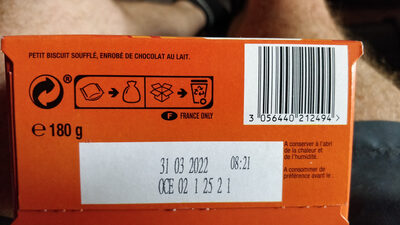
Packaging impact
Packaging components
| Shape | Material | Recycling | Impact |
|---|---|---|---|
| Individual BAG | Plastic | Unknown | High |
| Unknown | Cardboard | Unknown | Low |
Declared packaging
Data precision
Transportation
Declared origins
Forest footprint
Forest footprint
Deforestation risk details
Data Source
Product data comes from Open Food Facts. Food Benchmark also adds translations, category comparisons and explanatory calculations.
The database is licensed under ODbL 1.0, individual contents under DbCL 1.0, and product photos under CC BY-SA 3.0.
Product added on April 15, 2014 at 10:50:39 AM UTC by jitrixis .
Last edit on March 17, 2026 at 9:34:15 AM UTC by new-nutrition-bot .
Product page also edited by amzac, asmoth, driveoff, ecoscore-impact-estimator, inf, jitrixis, kiliweb, ldlre, magasins-u, michelpick, new-nutrition-bot, openfoodfacts-contributors, packbot, pateuch53, smoothie-app, yuka.R3ZvRFNZQThwS0Vwdjg4Wm9FS0U0OEpPOTZHaldqcVRKTVE2SUE9PQ, yuka.RzcwaVBxc3psUG9nZzgxaXd6SDcwNGhzM1lHYmNWcVZjc1FXSVE9PQ, yuka.Ui9zcExvOFRxLzhXbzl0bTBDSGswTk54LzZLbmJGM29COUFESVE9PQ, yuka.V3EwSlRabFJ2dFF2d01RN3B4bk4zdjVWMVo2UVJUL3BON000SUE9PQ, yuka.WUpnbEZ2OFJuNmNueDhBbnBqUHAvY3dxNGJ5R0EybU9lc1lWSVE9PQ, yuka.WW9GY0thQTc5dk5TbnNZLzlFL2w1OHhYN2JTVFlIRzRGTEVBSVE9PQ, yuka.Zi9zc0RZTXhudmhhZzhjdTl6ei85OVZGM2NHNVhHanBlOVZLSUE9PQ, yuka.sY2b0xO6T85zoF3NwEKvlh1eSNPDuSP1bBzhkxGwxvS0c7PVfdJRsrrmaqs, yuka.sY2b0xO6T85zoF3NwEKvllN5XfzehwjEPCTmoE2B9_yrC53QUf4u-dPTEao, yuka.sY2b0xO6T85zoF3NwEKvlnJqDMDc_x_AECTtoRexw9OoNpLLTI5DvbDqNas.