

BLEDILAIT Croissance mini 3 250ml De 1 à 3 ans
Health
Nutrition
Nutri-Score data warning
Nutrition label
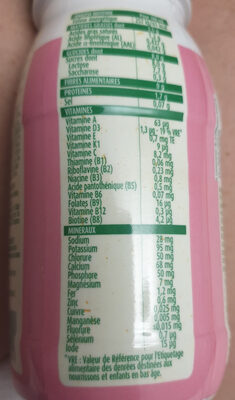
Nutrition facts
| Nutrition facts | As sold for 100 g / 100 ml | Compared to: Baby milks |
|---|---|---|
| Energy | 257 kJ (61 kcal) | 866.534 kJ (209 kcal) (-70%) |
| Fat | 2.5 g | 9.548 g (-74%) |
| Saturated fat | 1.2 g | 2.707 g (-56%) |
| Alpha linolenic acid | 0.042 g | ? |
| Linoleic acid | 0.437 g | 1.417 g (-69%) |
| Carbohydrates | 8 g | 23.979 g (-67%) |
| Sugars | 8 g | 15.242 g (-48%) |
| Sucrose | 0.3 g | 0.515 g (-42%) |
| Lactose | 7.7 g | 16.353 g (-53%) |
| Dietary fiber | 0 g | ? |
| Proteins | 1.7 g | 4.447 g (-62%) |
| Salt | 0.07 g | 0.181 g (-61%) |
| Sodium | 0.028 g | 0.073 g (-62%) |
| Vitamin A | 0.000063 g | 166.675 µg (-62%) |
| Vitamin D | 0.000001 g | 3.881 µg (-74%) |
| Vitamin E | 0.0007 g | 2.993 mg (-77%) |
| Vitamin K | 0.000009 g | 13.451 µg (-33%) |
| Vitamin C | 0.0082 g | ? |
| Vitamin PP | 0.0008 g | ? |
| Folates | 0.000016 g | ? |
| Biotin | 0.0000042 g | 5.414 µg (-22%) |
| Pantothenic acid | 0.0005 g | ? |
| Potassium | 0.095 g | 208.756 mg (-54%) |
| Chloride | 0.05 g | 139.652 mg (-64%) |
| Calcium | 0.068 g | 165.085 mg (-59%) |
| Phosphorus | 0.05 g | 104.836 mg (-52%) |
| Iron | 0.0012 g | 2.07 mg (-42%) |
| Magnesium | 0.007 g | 15.981 mg (-56%) |
| Zinc | 0.0006 g | 1.409 mg (-57%) |
| Copper | 0.000025 g | 11.38 mg (-100%) |
| Manganese | 0.000005 g | 1.811 mg (-100%) |
| Fluoride | 0.000015 g | 2.256 mg (-99%) |
| Selenium | 0.0000007 g | 6.755 µg (-90%) |
| Iodine | 0.000015 g | 33.643 µg (-55%) |
| Fruits, vegetables and legumes | ~ 0 % | ? |
Nutrition facts (Detailed data)
| Nutrition facts | As sold for 100 g / 100 ml | As sold Per 100 g (packaging) | As sold Per 100 g (estimate) |
|---|---|---|---|
| Energy | 257 kJ (61 kcal) | 257 kJ (61 kcal) | ? |
| Fat | 2.5 g | 2.5 g | ? |
| Saturated fat | 1.2 g | 1.2 g | ? |
| Alpha linolenic acid | 0.042 g | 0.042 g | ? |
| Linoleic acid | 0.437 g | 0.437 g | ? |
| Carbohydrates | 8 g | 8 g | ? |
| Sugars | 8 g | 8 g | ? |
| Sucrose | 0.3 g | 0.3 g | ? |
| Lactose | 7.7 g | 7.7 g | ? |
| Dietary fiber | 0 g | 0 g | ? |
| Proteins | 1.7 g | 1.7 g | ? |
| Salt | 0.07 g | 0.07 g | ? |
| Sodium | 0.028 g | 0.028 g | ? |
| Vitamin A | 0.000063 g | 0.000063 g | ? |
| Vitamin D | 0.000001 g | 0.000001 g | ? |
| Vitamin E | 0.0007 g | 0.0007 g | ? |
| Vitamin K | 0.000009 g | 0.000009 g | ? |
| Vitamin C | 0.0082 g | 0.0082 g | ? |
| Vitamin PP | 0.0008 g | 0.0008 g | ? |
| Folates | 0.000016 g | 0.000016 g | ? |
| Biotin | 0.0000042 g | 0.0000042 g | ? |
| Pantothenic acid | 0.0005 g | 0.0005 g | ? |
| Potassium | 0.095 g | 0.095 g | ? |
| Chloride | 0.05 g | 0.05 g | ? |
| Calcium | 0.068 g | 0.068 g | ? |
| Phosphorus | 0.05 g | 0.05 g | ? |
| Iron | 0.0012 g | 0.0012 g | ? |
| Magnesium | 0.007 g | 0.007 g | ? |
| Zinc | 0.0006 g | 0.0006 g | ? |
| Copper | 0.000025 g | 0.000025 g | ? |
| Manganese | 0.000005 g | 0.000005 g | ? |
| Fluoride | 0.000015 g | 0.000015 g | ? |
| Selenium | 0.0000007 g | 0.0000007 g | ? |
| Iodine | 0.000015 g | 0.000015 g | ? |
| Fruits, vegetables and legumes | ~ 0 % | ? | ~ 0 % |
Serving size
Ingredients
Ingredients image
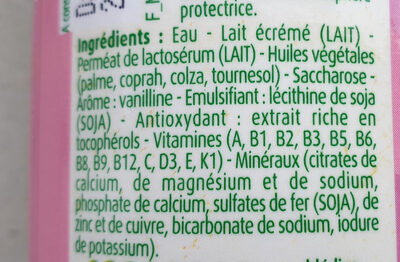
Ingredients list
Ingredient information
Added sugars
Allergens
Ingredients analysis
Contains ingredients containing palm oil.
Contains non-vegan ingredients.
Vegetarian status unknown
Food Processing
NOVA group
 Ultra-processed food and drink products
Elements that indicate the product is in NOVA group 4
How NOVA works
Additives
E306 - Tocopherol-rich extract
No additive description is available yet.
E322 - LecithinsAntioxidantEmulsifier
Lecithins are natural compounds commonly used in the food industry as emulsifiers and stabilizers.
Extracted from sources like soybeans and eggs, lecithins consist of phospholipids that enhance the mixing of oil and water, ensuring smooth textures in various products like chocolates, dressings, and baked goods.
They do not present any known health risks.
E322i - LecithinAntioxidantEmulsifier
Lecithins are natural compounds commonly used in the food industry as emulsifiers and stabilizers.
Extracted from sources like soybeans and eggs, lecithins consist of phospholipids that enhance the mixing of oil and water, ensuring smooth textures in various products like chocolates, dressings, and baked goods.
They do not present any known health risks.
Environment
Green-Score, origins bonus, and transportation impact are shown for Worldwide .
Green Score
Overall grade
 Low environmental impact
About Green-Score
Current scope
Life cycle analysis
Average impact of the category
 Baby milk, first milk, ready to feed • Score: 98/100
Life-cycle reference
Overall environmental impact by stage (PEF)
The overall environmental impact figure (PEF) comes from ADEME's Agribalyse database, for the category: Baby milk, first milk, ready to feed. Source: ADEME Agribalyse Database.
| Stage | Impact |
|---|---|
| Agriculture | 48.7 % |
| Processing | 2.1 % |
| Packaging | 14.8 % |
| Transportation | 20.2 % |
| Distribution | 11.2 % |
| Consumption | 3.1 % |
Bonuses and maluses
Declared origins
Threatened species risk
Packaging impact
Green-Score for this product
Green-Score for this product
Final score: 73/100Final score breakdown
Carbon footprint
Carbon footprint
Climate impact by stage (CO2e)
The carbon emission figure comes from ADEME's Agribalyse database, for the category: Baby milk, first milk, ready to feed. Source: ADEME Agribalyse Database.
| Stage | Impact |
|---|---|
| Agriculture | 48.6 % |
| Processing | 1.7 % |
| Packaging | 16.5 % |
| Transportation | 27.8 % |
| Distribution | 4.6 % |
| Consumption | 0.9 % |
Packaging
Packaging impact
Packaging components
| Shape | Material | Recycling | Impact |
|---|---|---|---|
| Unknown | Plastic | Unknown | High |
Declared packaging
Data precision
Transportation
Declared origins
Forest footprint
Forest footprint
Deforestation risk details
Additional information
- Preparation
- Il est important de bien respecter les instructions suivantes afin d'éviter des risques pour la santé de votre bébé : lavez-vous toujours les mains ainsi que votre plan de travail avant de préparer le biberon. Préparez le biberon juste avant le repas. Une fois préparé, il est recommandé de consommer le biberon dans la demi-heure. Si votre bébé n'a pas tout bu, jetez le reste du biberon sans hésiter.
- Conservation conditions
- Avant ouverture, conserver à température ambiante dans un endroit propre et sec. Après ouverture, conserver refermé, maximum 48 heures au réfrigérateur.
- Customer service
- Service consommateur Blédina, 81 rue de Sans Souci 69576 LIMONEST Cedex France
Data Source
Product data comes from Open Food Facts. Food Benchmark also adds translations, category comparisons and explanatory calculations.
The database is licensed under ODbL 1.0, individual contents under DbCL 1.0, and product photos under CC BY-SA 3.0.
Product added on December 14, 2019 at 7:25:06 PM UTC by kiliweb .
Last edit on March 17, 2026 at 7:59:54 AM UTC by new-nutrition-bot .
Product page also edited by inf, j2m9544, kiliweb, new-nutrition-bot, openfoodfacts-contributors, org-bledina, packbot, roboto-app, yuka.ZktjRE5wMEN2dWt6dHRzd3BVejYvZlVvKzZTcVUyR0hBTzBWSVE9PQ.
Source List
- bledina