

BLEDINA BLEDINER BRIQUES Légumes variés 2x250ml Dés 12 mois
Health
Nutrition
Nutri-Score data warning
Nutrition label
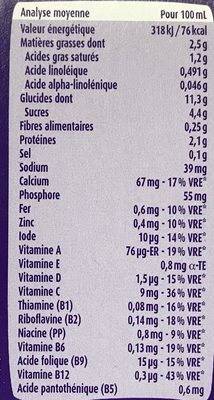
Nutrition facts
| Nutrition facts | As sold for 100 g / 100 ml | Compared to: Evening meals for babies |
|---|---|---|
| Energy | 311 kJ (74 kcal) | 277.552 kJ (66 kcal) (+12%) |
| Fat | 2.2 g | 2.069 g (+6%) |
| Saturated fat | 1 g | 0.48 g (+108%) |
| Alpha linolenic acid | 0.04 g | ? |
| Linoleic acid | 0.37 g | 0.48 g (-23%) |
| Carbohydrates | 11.3 g | 8.867 g (+27%) |
| Sugars | 4.8 g | 2.688 g (+79%) |
| Dietary fiber | 0.5 g | ? |
| Proteins | 2 g | 2.318 g (-14%) |
| Salt | 0.1 g | 0.166 g (-40%) |
| Sodium | 0.04 g | 0.067 g (-40%) |
| Vitamin A | 0.000074 g | 16.12 µg (+359%) |
| Vitamin D | 0.000001 g | 0.211 µg (+374%) |
| Vitamin E | 0.00093 g | 0.766 mg (+21%) |
| Vitamin K | 0.0000097 g | ? |
| Vitamin C | 0.0112 g | ? |
| Vitamin PP | 0.0011 g | ? |
| Biotin | 0.0000058 g | ? |
| Pantothenic acid | 0.0004 g | ? |
| Potassium | 0.087 g | 210.484 mg (-59%) |
| Calcium | 0.072 g | 48.306 mg (+49%) |
| Phosphorus | 0.048 g | 64.078 mg (-25%) |
| Iron | 0.0006 g | 0.738 mg (-19%) |
| Zinc | 0.0003 g | 0.474 mg (-37%) |
| Iodine | 0.00001 g | 6.584 µg (+52%) |
| Fruits, vegetables and legumes | ~ 0 % | ? |
Nutrition facts (Detailed data)
| Nutrition facts | As sold for 100 g / 100 ml | As sold Per 100 g (packaging) | As sold Per 100 g (estimate) |
|---|---|---|---|
| Energy | 311 kJ (74 kcal) | 311 kJ (74 kcal) | ? |
| Fat | 2.2 g | 2.2 g | ? |
| Saturated fat | 1 g | 1 g | ? |
| Alpha linolenic acid | 0.04 g | 0.04 g | ? |
| Linoleic acid | 0.37 g | 0.37 g | ? |
| Carbohydrates | 11.3 g | 11.3 g | ? |
| Sugars | 4.8 g | 4.8 g | ? |
| Dietary fiber | 0.5 g | 0.5 g | ? |
| Proteins | 2 g | 2 g | ? |
| Salt | 0.1 g | 0.1 g | ? |
| Sodium | 0.04 g | 0.04 g | ? |
| Vitamin A | 0.000074 g | 0.000074 g | ? |
| Vitamin D | 0.000001 g | 0.000001 g | ? |
| Vitamin E | 0.00093 g | 0.00093 g | ? |
| Vitamin K | 0.0000097 g | 0.0000097 g | ? |
| Vitamin C | 0.0112 g | 0.0112 g | ? |
| Vitamin PP | 0.0011 g | 0.0011 g | ? |
| Biotin | 0.0000058 g | 0.0000058 g | ? |
| Pantothenic acid | 0.0004 g | 0.0004 g | ? |
| Potassium | 0.087 g | 0.087 g | ? |
| Calcium | 0.072 g | 0.072 g | ? |
| Phosphorus | 0.048 g | 0.048 g | ? |
| Iron | 0.0006 g | 0.0006 g | ? |
| Zinc | 0.0003 g | 0.0003 g | ? |
| Iodine | 0.00001 g | 0.00001 g | ? |
| Fruits, vegetables and legumes | ~ 0 % | ? | ~ 0 % |
Serving size
Ingredients
Ingredients image
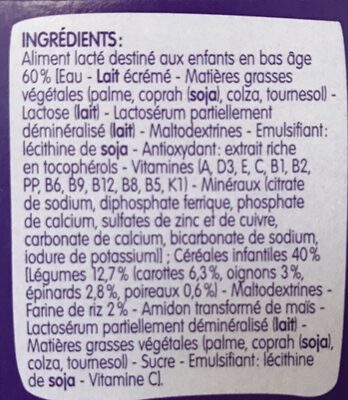
Ingredients list
Ingredient information
Added sugars
Allergens
Ingredients analysis
Contains ingredients containing palm oil.
Contains non-vegan ingredients.
Unrecognized: fr:oignons-enpoudre, fr:iodure-depotassium
Vegetarian status unknown
Unrecognized: fr:oignons-enpoudre, fr:iodure-depotassium
Food Processing
NOVA group
 Ultra-processed food and drink products
Elements that indicate the product is in NOVA group 4
How NOVA works
Additives
E306 - Tocopherol-rich extract
No additive description is available yet.
E322 - LecithinsAntioxidantEmulsifier
Lecithins are natural compounds commonly used in the food industry as emulsifiers and stabilizers.
Extracted from sources like soybeans and eggs, lecithins consist of phospholipids that enhance the mixing of oil and water, ensuring smooth textures in various products like chocolates, dressings, and baked goods.
They do not present any known health risks.
E322i - LecithinAntioxidantEmulsifier
Lecithins are natural compounds commonly used in the food industry as emulsifiers and stabilizers.
Extracted from sources like soybeans and eggs, lecithins consist of phospholipids that enhance the mixing of oil and water, ensuring smooth textures in various products like chocolates, dressings, and baked goods.
They do not present any known health risks.
E500 - Sodium carbonatesStabiliserThickener
Sodium carbonates (E500) are compounds commonly used in food preparation as leavening agents, helping baked goods rise by releasing carbon dioxide when they interact with acids.
Often found in baking soda, they regulate the pH of food, preventing it from becoming too acidic or too alkaline. In the culinary world, sodium carbonates can also enhance the texture and structure of foods, such as noodles, by modifying the gluten network.
Generally recognized as safe, sodium carbonates are non-toxic when consumed in typical amounts found in food.
E500ii - Sodium hydrogen carbonateStabiliserThickener
Sodium hydrogen carbonate, also known as E500ii, is a food additive commonly used as a leavening agent.
When added to recipes, it releases carbon dioxide gas upon exposure to heat or acids, causing dough to rise and resulting in a light, fluffy texture in baked goods.
It is generally recognized as safe (GRAS) by regulatory authorities when used in appropriate quantities and poses no significant health risks when consumed in typical food applications.
E525 - Potassium hydroxide
Potassium hydroxide is an inorganic compound with the formula KOH, and is commonly called caustic potash. Along with sodium hydroxide (NaOH), this colorless solid is a prototypical strong base. It has many industrial and niche applications, most of which exploit its corrosive nature and its reactivity toward acids. An estimated 700,000 to 800,000 tonnes were produced in 2005. About 100 times more NaOH than KOH is produced annually. KOH is noteworthy as the precursor to most soft and liquid soaps, as well as numerous potassium-containing chemicals.
Environment
Green-Score, origins bonus, and transportation impact are shown for Worldwide .
Green Score
Overall grade
 Unknown environmental impact
About Green-Score
Current scope
Green-Score availability
Bonuses and maluses
Declared origins
Threatened species risk
Packaging impact
Packaging
Packaging impact
Packaging components
| Shape | Material | Recycling | Impact |
|---|---|---|---|
| Brick | Cardboard | Unknown | Low |
Declared packaging
Transportation
Manufacturing locations
Declared origins
Forest footprint
Forest footprint
Deforestation risk details
Additional information
- Preparation
- Brique prête à l'emploi ou à consommer tiède. Ne pas faire bouillir, ni chauffer la brique directement au four à micro-ondes. Ne pas ajouter de sucre.
- Customer service
- blédina SAS - CS13754 - 81 rue de Sans Souci - 69576 Limonest Cedex, blédina SAS - CS13754 - 81 rue de Sans Souci - 69576 Limonest Cedex
Data Source
Product data comes from Open Food Facts. Food Benchmark also adds translations, category comparisons and explanatory calculations.
The database is licensed under ODbL 1.0, individual contents under DbCL 1.0, and product photos under CC BY-SA 3.0.
Product added on September 15, 2016 at 1:39:04 PM UTC by openfoodfacts-contributors .
Last edit on March 18, 2026 at 12:29:44 AM UTC by new-nutrition-bot .
Product page also edited by autorotate-bot, date-limite-app, julien000, khanagi, kiliweb, magasins-u, marilyn, new-nutrition-bot, openfoodfacts-contributors, org-bledina, packbot, roboto-app, tacite, teolemon, yuka.YTZNWUlmMEdvUHNFZ01FaTNSbmN3LzhxMXJTdFgwKzNNN1pNSUE9PQ.
Source List
- bledina