
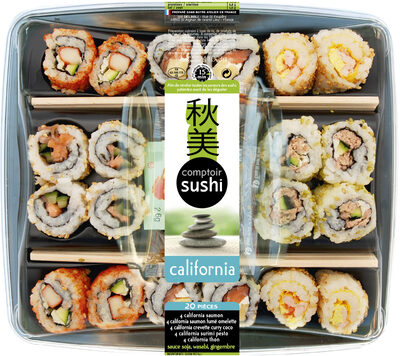
California Roll
Health
Nutrition
Nutri-Score
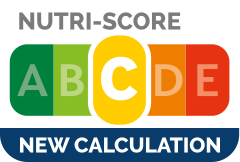 Average nutritional quality
Nutri-Score data warning
Nutrient levels
Fat in moderate quantity (6.3%)
Saturated fat in moderate quantity (2.3%)
Sugars in low quantity (2.7%)
Salt in high quantity (1.6%)
Nutrition label

Nutrition facts
| Nutrition facts | As sold for 100 g / 100 ml | Compared to: Sushis |
|---|---|---|
| Energy | ~ 656.4 kJ (156 kcal) | 675.257 kJ (160 kcal) (-3%) |
| Fat | 6.3 g | 4.377 g (+44%) |
| Saturated fat | 2.3 g | 0.896 g (+157%) |
| Carbohydrates | 19.2 g | 24.049 g (-20%) |
| Sugars | 2.7 g | 4.293 g (-37%) |
| Dietary fiber | ~ 0.855403125 g | ? |
| Proteins | 5.7 g | 5.608 g (+2%) |
| Salt | 1.6 g | 1.318 g (+21%) |
| Sodium | 0.64 g | 0.526 g (+22%) |
| Fruits, vegetables and legumes | ~ 6.71875 % | ? |
Nutrition facts (Detailed data)
| Nutrition facts | As sold for 100 g / 100 ml | As sold Per 100 g (packaging) | As sold Per 100 g (estimate) |
|---|---|---|---|
| Energy | ~ 656.4 kJ (156 kcal) | ? (156 kcal) | ~ 189.376035 kJ (45 kcal) |
| Fat | 6.3 g | 6.3 g | ~ 3.641271625 g |
| Saturated fat | 2.3 g | 2.3 g | ~ 1.4018596875 g |
| Carbohydrates | 19.2 g | 19.2 g | ~ 53.628240375 g |
| Sugars | 2.7 g | 2.7 g | ~ 0.246020375 g |
| Dietary fiber | ~ 0.855403125 g | ? | ~ 0.855403125 g |
| Proteins | 5.7 g | 5.7 g | ~ 9.6134583125 g |
| Salt | 1.6 g | 1.6 g | ~ 0.2638545375 g |
| Sodium | 0.64 g | 0.64 g | ~ 0.104699421 g |
| Fruits, vegetables and legumes | ~ 6.71875 % | ? | ~ 6.71875 % |
Ingredients
Ingredients list
Ingredient information
Added sugars
Allergens
Traces
Ingredients analysis
Palm oil content unknown
Contains non-vegan ingredients.
Unrecognized: fr:saumon-atlantique-salmo-salar, fr:saumon-atlantique-salmo-salar, fr:thon-listao-katsuwonus-pelamis, fr:arome-wasabi, fr:algue-yakinori, fr:graines-de-sesame-noires-grillees, en:mustard
Contains non-vegetarian ingredients.
Unrecognized: fr:saumon-atlantique-salmo-salar, fr:saumon-atlantique-salmo-salar, fr:thon-listao-katsuwonus-pelamis, fr:arome-wasabi, fr:algue-yakinori, fr:graines-de-sesame-noires-grillees, en:mustard
Food Processing
NOVA group
 Ultra-processed food and drink products
Elements that indicate the product is in NOVA group 4
How NOVA works
Additives
E1400 - DextrinCarrierEmulsifierStabiliserThickener
Dextrins are a group of low-molecular-weight carbohydrates produced by the hydrolysis of starch or glycogen. Dextrins are mixtures of polymers of D-glucose units linked by α-(1→4) or α-(1→6) glycosidic bonds. Dextrins can be produced from starch using enzymes like amylases, as during digestion in the human body and during malting and mashing, or by applying dry heat under acidic conditions (pyrolysis or roasting). The latter process is used industrially, and also occurs on the surface of bread during the baking process, contributing to flavor, color and crispness. Dextrins produced by heat are also known as pyrodextrins. The starch hydrolyses during roasting under acidic conditions, and short-chained starch parts partially rebranch with α-(1,6) bonds to the degraded starch molecule. See also Maillard Reaction. Dextrins are white, yellow, or brown powders that are partially or fully water-soluble, yielding optically active solutions of low viscosity. Most of them can be detected with iodine solution, giving a red coloration; one distinguishes erythrodextrin (dextrin that colours red) and achrodextrin (giving no colour). White and yellow dextrins from starch roasted with little or no acid are called British gum.
E160a - caroteneColour
β-Carotene is an organic, strongly colored red-orange pigment abundant in plants and fruits. It is a member of the carotenes, which are terpenoids (isoprenoids), synthesized biochemically from eight isoprene units and thus having 40 carbons. Among the carotenes, β-carotene is distinguished by having beta-rings at both ends of the molecule. β-Carotene is biosynthesized from geranylgeranyl pyrophosphate.β-Carotene is the most common form of carotene in plants. When used as a food coloring, it has the E number E160a. The structure was deduced by Karrer et al. in 1930. In nature, β-carotene is a precursor (inactive form) to vitamin A via the action of beta-carotene 15,15'-monooxygenase.Isolation of β-carotene from fruits abundant in carotenoids is commonly done using column chromatography. It can also be extracted from the beta-carotene rich algae, Dunaliella salina. The separation of β-carotene from the mixture of other carotenoids is based on the polarity of a compound. β-Carotene is a non-polar compound, so it is separated with a non-polar solvent such as hexane. Being highly conjugated, it is deeply colored, and as a hydrocarbon lacking functional groups, it is very lipophilic.
E160c - Paprika extractColour
No additive description is available yet.
E260 - Acetic acidPreservative
ACETIC ACID, systematically named ethanoic acid, is a colourless liquid organic compound with the chemical formula CH3COOH (also written as CH3CO2H or C2H4O2).
E300 - Ascorbic acidAntioxidantSequestrant
No additive description is available yet.
E322 - LecithinsAntioxidantEmulsifier
Lecithins are natural compounds commonly used in the food industry as emulsifiers and stabilizers.
Extracted from sources like soybeans and eggs, lecithins consist of phospholipids that enhance the mixing of oil and water, ensuring smooth textures in various products like chocolates, dressings, and baked goods.
They do not present any known health risks.
E330 - Citric acidAntioxidantSequestrant
Citric acid is a natural organic acid found in citrus fruits such as lemons, oranges, and limes.
It is widely used in the food industry as a flavor enhancer, acidulant, and preservative due to its tart and refreshing taste.
Citric acid is safe for consumption when used in moderation and is considered a generally recognized as safe (GRAS) food additive by regulatory agencies worldwide.
E339 - Sodium phosphates EFSA overexposure risk: highEmulsifierHumectantPreservativeSequestrantStabiliserThickener
TRISODIUM PHOSPHATE is the inorganic compound with the chemical formula Na3PO4.
E422 - GlycerolHumectantThickener
Glycerol (; also called glycerine or glycerin; see spelling differences) is a simple polyol compound. It is a colorless, odorless, viscous liquid that is sweet-tasting and non-toxic. The glycerol backbone is found in all lipids known as triglycerides. It is widely used in the food industry as a sweetener and humectant and in pharmaceutical formulations. Glycerol has three hydroxyl groups that are responsible for its solubility in water and its hygroscopic nature.
E471 - Mono- and diglycerides of fatty acidsEmulsifierStabiliser
Mono- and diglycerides of fatty acids (E471), are food additives commonly used as emulsifiers in various processed foods.
These compounds consist of glycerol molecules linked to one or two fatty acid chains, which help stabilize and blend water and oil-based ingredients. E471 enhances the texture and shelf life of products like margarine, baked goods, and ice cream, ensuring a smooth and consistent texture.
It is generally considered safe for consumption within established regulatory limits.
E621 - Monosodium glutamate EFSA overexposure risk: highFlavour Enhancer
Monosodium glutamate (MSG), or E621, is the sodium salt of glutamic acid, an amino acid found naturally in many foods.
It is widely used as a flavor enhancer to provide an "umami" or savory taste to a variety of processed foods, including soups, snack chips, and frozen meals.
MSG is generally recognized as safe (GRAS) by food authorities. However, some people report sensitivity to MSG, experiencing short-term symptoms like headaches and flushing, though scientific studies have not shown a consistent link.
Environment
Green-Score, origins bonus, and transportation impact are shown for Worldwide .
Green Score
Overall grade
 Unknown environmental impact
About Green-Score
Current scope
Green-Score availability
Bonuses and maluses
Declared origins
Packaging impact
Packaging
Packaging impact
Packaging components
| Shape | Material | Recycling | Impact |
|---|---|---|---|
| BOX | Unknown | Unknown | High |
Declared packaging
Data precision
Transportation
Manufacturing locations
Declared origins
Forest footprint
Forest footprint
Ingredients linked to forest pressure
| Ingredient | Type | Percent in product | Forest footprint |
|---|---|---|---|
| Fresh EGG | Oeufs Importés | 1.03 % | 0.00 |
Data Source
Product data comes from Open Food Facts. Food Benchmark also adds translations, category comparisons and explanatory calculations.
The database is licensed under ODbL 1.0, individual contents under DbCL 1.0, and product photos under CC BY-SA 3.0.
Product added on April 9, 2018 at 4:46:13 PM UTC by kiliweb .
Last edit on March 17, 2026 at 8:43:00 AM UTC by new-nutrition-bot .
Product page also edited by jade2019, kiliweb, new-nutrition-bot, openfoodfacts-contributors, packbot, roboto-app, sara-aithammou, teolemon, yuka.MJBDMdGKRt0TAvX3zY4szhPmNcbAMvtIJXRSow, yuka.UWZzQ0lxMExvNmdFbDhNNTRETCt5dmtwNDRTR2ZIMmVLOFJBSVE9PQ, yuka.WlpvbEM2QThyTUFGbVBZQTdFUGIwNGhRMzUvNGYxSHVMKzBjSVE9PQ.