

Nouilles chinoises
Health
Nutrition
Nutri-Score
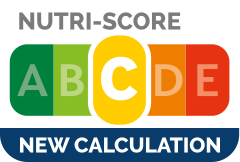 Average nutritional quality
Nutri-Score data warning
Nutrient levels
Fat in moderate quantity (3.8%)
Saturated fat in low quantity (0.5%)
Sugars in low quantity (2.2%)
Salt in moderate quantity (1.3%)
Nutrition label

Nutrition facts
| Nutrition facts | As sold for 100 g / 100 ml | Compared to: Chinese noodles |
|---|---|---|
| Energy | 554 kJ (132 kcal) | 963.255 kJ (233 kcal) (-42%) |
| Fat | 3.8 g | 4.379 g (-13%) |
| Saturated fat | 0.5 g | 1.4 g (-64%) |
| Carbohydrates | 19 g | 38.732 g (-51%) |
| Sugars | 2.2 g | 2.267 g (-3%) |
| Dietary fiber | 1.1 g | ? |
| Proteins | 4.8 g | 6.781 g (-29%) |
| Salt | 1.3 g | 1.162 g (+12%) |
| Sodium | 0.52 g | 0.466 g (+12%) |
| Fruits, vegetables and legumes | ~ 14.171875 % | ? |
Nutrition facts (Detailed data)
| Nutrition facts | As sold for 100 g / 100 ml | As sold Per 100 g (packaging) | As sold Per 100 g (estimate) |
|---|---|---|---|
| Energy | 554 kJ (132 kcal) | 554 kJ (132 kcal) | ? |
| Fat | 3.8 g | 3.8 g | ? |
| Saturated fat | 0.5 g | 0.5 g | ? |
| Carbohydrates | 19 g | 19 g | ? |
| Sugars | 2.2 g | 2.2 g | ? |
| Dietary fiber | 1.1 g | 1.1 g | ? |
| Proteins | 4.8 g | 4.8 g | ? |
| Salt | 1.3 g | 1.3 g | ? |
| Sodium | 0.52 g | 0.52 g | ? |
| Fruits, vegetables and legumes | ~ 14.171875 % | ? | ~ 14.171875 % |
Ingredients
Ingredients image

Ingredients list
Ingredient information
Added sugars
Allergens
Traces
Ingredients analysis
No ingredients containing palm oil.
Contains non-vegan ingredients.
Unrecognized: fr:sol, fr:farine-de-pois-fractionnee
Contains non-vegetarian ingredients.
Unrecognized: fr:sol, fr:farine-de-pois-fractionnee
Food Processing
NOVA group
 Ultra-processed food and drink products
Elements that indicate the product is in NOVA group 4
How NOVA works
Additives
E14XX - Modified StarchEmulsifierStabiliserThickener
No additive description is available yet.
E150a - Plain caramel EFSA overexposure risk: noColour
Caramel color or caramel coloring is a water-soluble food coloring.
E202 - Potassium sorbate EFSA overexposure risk: highPreservative
Potassium sorbate (E202) is a synthetic food preservative commonly used to extend the shelf life of various food products.
It works by inhibiting the growth of molds, yeast, and some bacteria, preventing spoilage. When added to foods, it helps maintain their freshness and quality.
Some studies have shown that when combined with nitrites, potassium sorbate have genotoxic activity in vitro. However, potassium sorbate is generally recognized as safe (GRAS) by regulatory authorities.
E211 - Sodium benzoate EFSA overexposure risk: highPreservative
SODIUM BENZOATE is a substance which has the chemical formula NaC7H5O2
E261 - Potassium acetatePreservative
Potassium acetate (KCH3COO) is the potassium salt of acetic acid.
E262 - Sodium acetatesPreservativeSequestrant
SODIUM ACETATE, also abbreviated NaOAc,[8] is the sodium salt of acetic acid.
E262i - Sodium acetatePreservativeSequestrant
No additive description is available yet.
E270 - Lactic acid
LACTIC ACID is an organic compound with the formula CH3CH(OH)CO2H. In the form of its conjugate base called lactate (this is thus different and kept as a separate ingredient). Lactic acid is chiral, consisting of two optical isomers. One is known as L-(+)-lactic acid or (S)-lactic acid and the other, its mirror image, is D-(−)-lactic acid or (R)-lactic acid in food the L-variant is used
E326 - potassium lactateAntioxidantEmulsifierHumectant
POTASSIUM LACTATE is a compound with formula KC3H5O3. It is produced by neutralizing lactic acid which is fermented from a sugar source. Potassium lactate is commonly used in meat and poultry products to extend shelf life and increase food safety as it has a broad antimicrobial action. lactic acid and lactates can be consumed by all religious groups, vegans and vegetarians. Although the name refers to milk, it is not made from milk and thus suitable for people with milk allergy or lactose intolerance.
E407a - Processed eucheuma seaweed EFSA overexposure risk: highCarrierEmulsifierHumectantStabiliserThickener
Carrageenans or carrageenins ( karr-ə-gee-nənz, from Irish carraigín, "little rock") are a family of linear sulfated polysaccharides that are extracted from red edible seaweeds. They are widely used in the food industry, for their gelling, thickening, and stabilizing properties. Their main application is in dairy and meat products, due to their strong binding to food proteins. There are three main varieties of carrageenan, which differ in their degree of sulfation. Kappa-carrageenan has one sulfate group per disaccharide, iota-carrageenan has two, and lambda-carrageenan has three. Gelatinous extracts of the Chondrus crispus (Irish moss) seaweed have been used as food additives since approximately the fifteenth century. Carrageenan is a vegetarian and vegan alternative to gelatin in some applications or may be used to replace gelatin in confectionery.
E451 - Triphosphates EFSA overexposure risk: highEmulsifierHumectantSequestrantStabiliserThickener
Sodium triphosphate (STP), also sodium tripolyphosphate (STPP), or tripolyphosphate (TPP),) is an inorganic compound with formula Na5P3O10. It is the sodium salt of the polyphosphate penta-anion, which is the conjugate base of triphosphoric acid. It is produced on a large scale as a component of many domestic and industrial products, especially detergents. Environmental problems associated with eutrophication are attributed to its widespread use.
Environment
Green-Score, origins bonus, and transportation impact are shown for Worldwide .
Green Score
Overall grade
 Unknown environmental impact
About Green-Score
Current scope
Green-Score availability
Bonuses and maluses
Declared origins
Packaging impact
Packaging
Packaging impact
Data precision
Transportation
Declared origins
Forest footprint
Forest footprint
Ingredients linked to forest pressure
| Ingredient | Type | Percent in product | Forest footprint |
|---|---|---|---|
| Chicken Meat | Poulet Importé | 2.93 % | 0.08 |
Data Source
Product data comes from Open Food Facts. Food Benchmark also adds translations, category comparisons and explanatory calculations.
The database is licensed under ODbL 1.0, individual contents under DbCL 1.0, and product photos under CC BY-SA 3.0.
Product added on March 5, 2019 at 11:16:25 AM UTC by kiliweb .
Last edit on March 17, 2026 at 8:31:09 AM UTC by new-nutrition-bot .
Product page also edited by ecoscore-impact-estimator, inf, julic97, kiliweb, new-nutrition-bot, openfoodfacts-contributors, quechoisir, roboto-app, scanbot, thefilou, xoo, yuka.UjdFeUtxa0VpOVl3bnZZNTEwNzMwZThvNnMrcllsN21KTTRTSWc9PQ.