

Les surgelés - Macarons
Health
Nutrition
Nutri-Score
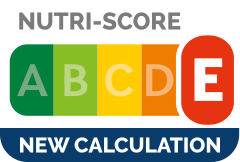 Lower nutritional quality
Nutri-Score data warning
Nutrient levels
Fat in moderate quantity (16%)
Saturated fat in moderate quantity (4.2%)
Sugars in high quantity (46%)
Salt in low quantity (0.1%)
Nutrition label

Nutrition facts
| Nutrition facts | As sold for 100 g / 100 ml | Compared to: fr:Assortiments de macarons |
|---|---|---|
| Energy | ~ 1663 kJ (402 kcal) | 1,726.022 kJ (414 kcal) (-4%) |
| Fat | 16 g | 16.206 g (-1%) |
| Saturated fat | 4.2 g | 4.347 g (-3%) |
| Carbohydrates | 55 g | 56.503 g (-3%) |
| Sugars | 46 g | 50.733 g (-9%) |
| Dietary fiber | ~ 2.6734890625 g | ? |
| Proteins | 8 g | 8.431 g (-5%) |
| Salt | 0.1 g | 0.153 g (-35%) |
| Sodium | 0.04 g | 0.061 g (-34%) |
| Fruits, vegetables and legumes | ~ 9.94125 % | ? |
Nutrition facts (Detailed data)
| Nutrition facts | As sold for 100 g / 100 ml | As sold Per 100 g (packaging) | As sold Per 100 g (estimate) |
|---|---|---|---|
| Energy | ~ 1663 kJ (402 kcal) | ? (402 kcal) | ~ 1362.8736328125 kJ (325 kcal) |
| Fat | 16 g | 16 g | ~ 15.9196411132812 g |
| Saturated fat | 4.2 g | 4.2 g | ~ 5.85014483007813 g |
| Carbohydrates | 55 g | 55 g | ~ 39.70566109375 g |
| Sugars | 46 g | 46 g | ~ 32.67469375 g |
| Dietary fiber | ~ 2.6734890625 g | ? | ~ 2.6734890625 g |
| Proteins | 8 g | 8 g | ~ 4.31247896484375 g |
| Salt | 0.1 g | 0.1 g | ~ 0.023007380859375 g |
| Sodium | 0.04 g | 0.04 g | ~ 0.006874981171875 g |
| Fruits, vegetables and legumes | ~ 9.94125 % | ? | ~ 9.94125 % |
Ingredients
Ingredients image

Ingredients list
Ingredient information
Added sugars
Allergens
Ingredients analysis
No ingredients containing palm oil.
Contains non-vegan ingredients.
Unrecognized: fr:1-blanc-d-oeuf-en-poudre, fr:hydroxypropylmethytcellulose, fr:ius-concentre-de-citron-jaune
Contains non-vegetarian ingredients.
Unrecognized: fr:1-blanc-d-oeuf-en-poudre, fr:hydroxypropylmethytcellulose, fr:ius-concentre-de-citron-jaune
Food Processing
NOVA group
 Ultra-processed food and drink products
Elements that indicate the product is in NOVA group 4
How NOVA works
Additives
E120 - CochinealColour
Cochineal extract or carmine (E120) is a natural red colorant derived from the dried bodies of the female cochineal insect.
It is widely used to impart a pink, red, or purple hue to various food and beverage products, including yogurts, ice creams, confectionery, and fruit juices.
Although it is a natural additive, E120 is known to cause severe allergic reactions, including anaphylaxis, in some individuals. It is also not suitable for vegetarians or vegans due to its insect origin.
E14XX - Modified StarchEmulsifierStabiliserThickener
No additive description is available yet.
E1505 - Triethyl citrateCarrierEmulsifierSequestrantStabiliser
Triethyl citrate is an ester of citric acid. It is a colorless, odorless liquid used as a food additive (E number E1505) to stabilize foams, especially as whipping aid for egg white. It is also used in pharmaceutical coatings and plastics.Triethyl citrate is also used as a plasticizer for polyvinyl chloride (PVC) and similar plastics.Triethyl citrate has been used as a pseudo-emulsifier in e-cigarette juices. It functions essentially like lecithin used in food products, but with the possibility of vaporization which lecithin does not have.
E160 - Carotenoids
No additive description is available yet.
E162 - Beetroot redColour
Betanin, or Beetroot Red, is a red glycosidic food dye obtained from beets; its aglycone, obtained by hydrolyzing away the glucose molecule, is betanidin. As a food additive, its E number is E162. The color of betanin depends on pH; between four and five it is bright bluish-red, becoming blue-violet as the pH increases. Once the pH reaches alkaline levels betanin degrades by hydrolysis, resulting in a yellow-brown color. Betanin is a betalain pigment, together with isobetanin, probetanin, and neobetanin. Other pigments contained in beet are indicaxanthin and vulgaxanthins.
E163 - AnthocyaninsColour
Anthocyanins (also anthocyans; from Greek: ἄνθος (anthos) "flower" and κυάνεος/κυανοῦς kyaneos/kyanous "dark blue") are water-soluble vacuolar pigments that, depending on their pH, may appear red, purple, or blue. Food plants rich in anthocyanins include the blueberry, raspberry, black rice, and black soybean, among many others that are red, blue, purple, or black. Some of the colors of autumn leaves are derived from anthocyanins.Anthocyanins belong to a parent class of molecules called flavonoids synthesized via the phenylpropanoid pathway. They occur in all tissues of higher plants, including leaves, stems, roots, flowers, and fruits. Anthocyanins are derived from anthocyanidins by adding sugars. They are odorless and moderately astringent. Although approved to color foods and beverages in the European Union, anthocyanins are not approved for use as a food additive because they have not been verified as safe when used as food or supplement ingredients. There is no conclusive evidence anthocyanins have any effect on human biology or diseases.
E330 - Citric acidAntioxidantSequestrant
Citric acid is a natural organic acid found in citrus fruits such as lemons, oranges, and limes.
It is widely used in the food industry as a flavor enhancer, acidulant, and preservative due to its tart and refreshing taste.
Citric acid is safe for consumption when used in moderation and is considered a generally recognized as safe (GRAS) food additive by regulatory agencies worldwide.
E401 - sodium alginateCarrierEmulsifierHumectantSequestrantStabiliserThickener
No additive description is available yet.
E440 - PectinsEmulsifierStabiliserThickener
Pectins (E440) are natural carbohydrates, predominantly found in fruits, that act as gelling agents in the food industry, creating the desirable jelly-like texture in jams, jellies, and marmalades.
Pectins stabilize and thicken various food products, such as desserts, confectioneries, and beverages, ensuring a uniform consistency and quality.
Recognized as safe by various health authorities, pectins have been widely used without notable adverse effects when consumed in typical dietary amounts.
Environment
Green-Score, origins bonus, and transportation impact are shown for Worldwide .
Green Score
Overall grade
 Very high environmental impact
About Green-Score
Current scope
Life cycle analysis
Average impact of the category
 Macaron filled with jam or cream • Score: 48/100
Life-cycle reference
Overall environmental impact by stage (PEF)
The overall environmental impact figure (PEF) comes from ADEME's Agribalyse database, for the category: Macaron filled with jam or cream. Source: ADEME Agribalyse Database.
| Stage | Impact |
|---|---|
| Agriculture | 72.7 % |
| Processing | 7.5 % |
| Packaging | 15.6 % |
| Transportation | 3.4 % |
| Distribution | 0.9 % |
| Consumption | 0.0 % |
Bonuses and maluses
Declared origins
Packaging impact
Green-Score for this product
Green-Score for this product
Final score: 28/100Final score breakdown
Carbon footprint
Carbon footprint
Climate impact by stage (CO2e)
The carbon emission figure comes from ADEME's Agribalyse database, for the category: Macaron filled with jam or cream. Source: ADEME Agribalyse Database.
| Stage | Impact |
|---|---|
| Agriculture | 82.6 % |
| Processing | 4.2 % |
| Packaging | 9.0 % |
| Transportation | 3.7 % |
| Distribution | 0.4 % |
| Consumption | 0.0 % |
Packaging
Packaging impact
Data precision
Transportation
Declared origins
Forest footprint
Forest footprint
Ingredients linked to forest pressure
| Ingredient | Type | Percent in product | Forest footprint |
|---|---|---|---|
| Powdered EGG White | Oeufs Importés | 2.00 % | 0.00 |
Data Source
Product data comes from Open Food Facts. Food Benchmark also adds translations, category comparisons and explanatory calculations.
The database is licensed under ODbL 1.0, individual contents under DbCL 1.0, and product photos under CC BY-SA 3.0.
Product added on January 7, 2018 at 10:11:15 AM UTC by kiliweb .
Last edit on March 17, 2026 at 11:32:35 PM UTC by new-nutrition-bot .
Product page also edited by autorotate-bot, big-brother, kiliweb, new-nutrition-bot, openfoodfacts-contributors, quechoisir, roboto-app, teolemon, yuka.RjRjUEZJMGJsdllLaWMwdnB3N2E0NE42N0s2T1FYNnJKN1lOSVE9PQ, yuka.UWFZbU1ya0FuNk13bDhCbTd5L1h3UE40MnFhbFVqdTRCZFk5SUE9PQ.