
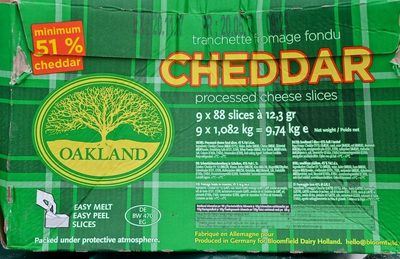
Processed Cheese Slices Cheddar
Labels
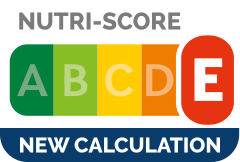 Bad nutritional quality
 Ultra-processed food and drink products
 Not computed
Health
Nutrition
Serving Size
Nutri-Score label
Bad nutritional qualityNutrient levels for 100 g
Fat in high quantity (26 g, 26%)
What you need to know
A high consumption of fat, especially saturated fats, can raise cholesterol, which increases the risk of heart diseases.
Recommendation: Limit the consumption of fat and saturated fat
Choose products with lower fat and saturated fat content.
Saturated fat in high quantity (17.5 g, 17.5%)
What you need to know
A high consumption of fat, especially saturated fats, can raise cholesterol, which increases the risk of heart diseases.
Recommendation: Limit the consumption of fat and saturated fat
Choose products with lower fat and saturated fat content.
Sugars in low quantity (4 g, 4%)
What you need to know
A high consumption of sugar can cause weight gain and tooth decay. It also augments the risk of type 2 diabetes and cardio-vascular diseases.
Recommendation: Limit the consumption of sugar and sugary drinks
Sugary drinks should be limited as much as possible. Choose products with lower sugar content.
Salt in high quantity (3.7 g, 3.7%)
What you need to know
A high consumption of salt (or sodium) can cause raised blood pressure, which can increase the risk of heart disease and stroke.
Recommendation: Limit the consumption of salt and salted food
Reduce the quantity of salt used when cooking. Limit the consumption of salty snacks.
Nutrition Facts
| Nutrition Facts | As sold for 100 g / 100 ml | Per serving 12,3 g |
|---|---|---|
| Energy | 1,447 kJ | 178 kJ |
| Fat | 26 g | 3.2 g |
| Saturated fat | 17.5 g | 2.15 g |
| Carbohydrates | 6.5 g | 0.8 g |
| Sugars | 4 g | 0.49 g |
| Dietary fiber | ? | ? |
| Proteins | 19 g | 2.34 g |
| Salt | 3.7 g | 0.46 g |
| Sodium | 1.48 g | 0.18 g |
Ingredients
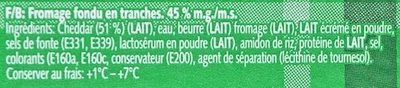
Ingredients List
Ingredient Information
Food Processing
NOVA Group label
Ultra-processed food and drink productsElements that indicate the product is in the NOVA group 4:
- Additives: E160a - carotene
- Additives: E160c - Paprika extract
- Additives: E322 - Lecithins
- Ingredients: Colour
- Ingredients: Milk Proteins
- Ingredients: Whey
The NOVA classification assigns food products into 4 groups based on their degree of processing:
- Unprocessed or minimally processed foods
- Processed culinary ingredients
- Processed foods
- Ultra-processed food and drink products
Ingredients analysis
Palm oil free
Palm oil content unknown
Vegan
Contains non-vegan ingredients.
Unrecognized ingredients: fr:agent-de-separation
Vegetarian
Vegetarian status unknown
Unrecognized ingredients: fr:agent-de-separation
Additives
E160a - caroteneColour
β-Carotene is an organic, strongly colored red-orange pigment abundant in plants and fruits. It is a member of the carotenes, which are terpenoids (isoprenoids), synthesized biochemically from eight isoprene units and thus having 40 carbons. Among the carotenes, β-carotene is distinguished by having beta-rings at both ends of the molecule. β-Carotene is biosynthesized from geranylgeranyl pyrophosphate.β-Carotene is the most common form of carotene in plants. When used as a food coloring, it has the E number E160a. The structure was deduced by Karrer et al. in 1930. In nature, β-carotene is a precursor (inactive form) to vitamin A via the action of beta-carotene 15,15'-monooxygenase.Isolation of β-carotene from fruits abundant in carotenoids is commonly done using column chromatography. It can also be extracted from the beta-carotene rich algae, Dunaliella salina. The separation of β-carotene from the mixture of other carotenoids is based on the polarity of a compound. β-Carotene is a non-polar compound, so it is separated with a non-polar solvent such as hexane. Being highly conjugated, it is deeply colored, and as a hydrocarbon lacking functional groups, it is very lipophilic.
E160c - Paprika extractColour
No additive description is available yet.
E200 - Sorbic acidPreservative
SORBIC ACID, or 2,4-hexadienoic acid, is a natural organic compound used as a food preservative. It has the chemical formula CH3(CH)4CO2H.
E322 - LecithinsAntioxidantEmulsifier
Lecithins are natural compounds commonly used in the food industry as emulsifiers and stabilizers.
Extracted from sources like soybeans and eggs, lecithins consist of phospholipids that enhance the mixing of oil and water, ensuring smooth textures in various products like chocolates, dressings, and baked goods.
They do not present any known health risks.
E322i - LecithinAntioxidantEmulsifier
Lecithins are natural compounds commonly used in the food industry as emulsifiers and stabilizers.
Extracted from sources like soybeans and eggs, lecithins consist of phospholipids that enhance the mixing of oil and water, ensuring smooth textures in various products like chocolates, dressings, and baked goods.
They do not present any known health risks.
E331 - Sodium citratesEmulsifierSequestrantStabiliser
DISODIUM CITRATE, more properly, disodium hydrogen citrate, is an acid salt of citric acid with the chemical formula Na2C6H6O7. It is used as an antioxidant in food and to improve the effects of other antioxidants. It is also used as an acidity regulator and sequestrant. Typical products include gelatin, jam, sweets, ice cream, carbonated beverages, milk powder, wine, and processed cheeses.
E339 - Sodium phosphatesEmulsifierHumectantPreservativeSequestrantStabiliserThickener
TRISODIUM PHOSPHATE is the inorganic compound with the chemical formula Na3PO4.
Environment
Environmental score label
Not computedCarbon footprint
No carbon footprint data is available for this product.
Packaging
Plastic, Cardboard, Fresh
Transportation and origins
Origins of ingredients
No origin information provided.
Manufacturing places
Allemagne
Threatened species
1 ingredient(s) may be linked to palm oil supply chains.
Environmental labels
No environmental labels identified.
Data Source
Product added on July 31, 2017 at 2:27:24 PM UTC by beniben .
Last edit on December 16, 2024 at 3:17:26 PM UTC by roboto-app .
Product page also edited by beniben, packbot, roboto-app.