
Dessert Perte De Poids Care Free Sirop (300G)
Health
Nutrition
Nutri-Score
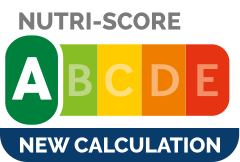 Very good nutritional quality
Nutri-Score data warning
Nutrient levels
Fat in low quantity (0%)
Saturated fat in low quantity (0%)
Sugars in low quantity (0%)
Salt in low quantity (0%)
Nutrition facts
| Nutrition facts | As sold for 100 g / 100 ml | Compared to: Syrups |
|---|---|---|
| Energy | ~ 0 kJ (12 kcal) | 1,020.911 kJ (236 kcal) (-100%) |
| Fat | 0 g | 0.106 g (-100%) |
| Saturated fat | 0 g | 0.021 g (-100%) |
| Carbohydrates | 0 g | 59.213 g (-100%) |
| Sugars | 0 g | 53.185 g (-100%) |
| Dietary fiber | 0 g | ? |
| Proteins | 0 g | 0.136 g (-100%) |
| Salt | 0 g | 0.037 g (-100%) |
| Sodium | 0 g | 0.015 g (-100%) |
| Fruits, vegetables and legumes | ~ 0 % | ? |
Nutrition facts (Detailed data)
| Nutrition facts | As sold for 100 g / 100 ml | As sold Per 100 g (packaging) | As sold Per 100 g (estimate) |
|---|---|---|---|
| Energy | ~ 0 kJ (12 kcal) | ? (12 kcal) | ? |
| Fat | 0 g | 0 g | ? |
| Saturated fat | 0 g | 0 g | ? |
| Carbohydrates | 0 g | 0 g | ? |
| Sugars | 0 g | 0 g | ? |
| Dietary fiber | 0 g | 0 g | ? |
| Proteins | 0 g | 0 g | ? |
| Salt | 0 g | 0 g | ? |
| Sodium | 0 g | 0 g | ? |
| Fruits, vegetables and legumes | ~ 0 % | ? | ~ 0 % |
Ingredients
Ingredients image
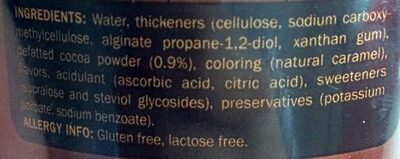
Ingredients list
Ingredient information
Ingredients analysis
No ingredients containing palm oil.
Vegan status unknown
Unrecognized: en:alginate-propane-1-2-diol, en:natural-caramel, en:avors, en:potassium-sorpate
Vegetarian status unknown
Unrecognized: en:alginate-propane-1-2-diol, en:natural-caramel, en:avors, en:potassium-sorpate
Food Processing
NOVA group
 Ultra-processed food and drink products
Elements that indicate the product is in NOVA group 4
How NOVA works
Additives
E150 - Caramel
CARAMEL is a medium to dark-orange confectionery product made by heating a variety of sugars.
E211 - Sodium benzoate EFSA overexposure risk: highPreservative
SODIUM BENZOATE is a substance which has the chemical formula NaC7H5O2
E300 - Ascorbic acidAntioxidantSequestrant
No additive description is available yet.
E330 - Citric acidAntioxidantSequestrant
Citric acid is a natural organic acid found in citrus fruits such as lemons, oranges, and limes.
It is widely used in the food industry as a flavor enhancer, acidulant, and preservative due to its tart and refreshing taste.
Citric acid is safe for consumption when used in moderation and is considered a generally recognized as safe (GRAS) food additive by regulatory agencies worldwide.
E415 - Xanthan gumEmulsifierStabiliserThickener
Xanthan gum (E415) is a natural polysaccharide derived from fermented sugars, often used in the food industry as a thickening and stabilizing agent.
This versatile food additive enhances texture and prevents ingredient separation in a wide range of products, including salad dressings, sauces, and gluten-free baked goods.
It is considered safe for consumption even at high intake amounts.
E460 - CelluloseCarrierEmulsifierHumectantStabiliserThickener
CELLULOSE is an organic compound with the formula (C6H10O5)n, a polysaccharide consisting of a linear chain of several hundred to many thousands of linked D-glucose units. Cellulose is used as emulsifier, thickener and stabilizer in processed foods. Cellulose powder is, for example, used in processed cheese to prevent caking inside the package.
E466 - Sodium carboxy methyl celluloseEmulsifierHumectantStabiliserThickener
Carboxymethyl cellulose (CMC) or cellulose gum or tylose powder is a cellulose derivative with carboxymethyl groups (-CH2-COOH) bound to some of the hydroxyl groups of the glucopyranose monomers that make up the cellulose backbone. It is often used as its sodium salt, sodium carboxymethyl cellulose.
E955 - SucraloseSweetener
Sucralose is an artificial sweetener and sugar substitute. The majority of ingested sucralose is not broken down by the body, so it is noncaloric. In the European Union, it is also known under the E number E955. It is produced by chlorination of sucrose. Sucralose is about 320 to 1,000 times sweeter than sucrose, three times as sweet as both aspartame and acesulfame potassium, and twice as sweet as sodium saccharin. Evidence of benefit is lacking for long-term weight loss with some data supporting weight gain and heart disease risks.It is stable under heat and over a broad range of pH conditions. Therefore, it can be used in baking or in products that require a long shelf life. The commercial success of sucralose-based products stems from its favorable comparison to other low-calorie sweeteners in terms of taste, stability, and safety. Common brand names of sucralose-based sweeteners are Splenda, Zerocal, Sukrana, SucraPlus, Candys, Cukren, and Nevella. Canderel Yellow also contains sucralose, but the original Canderel and Green Canderel do not.
E960 - Steviol glycosides EFSA overexposure risk: moderateSweetener
Steviol glycosides are the chemical compounds responsible for the sweet taste of the leaves of the South American plant Stevia rebaudiana (Asteraceae) and the main ingredients (or precursors) of many sweeteners marketed under the generic name stevia and several trade names. They also occur in the related species Stevia phlebophylla (but in no other species of Stevia) and in the plant Rubus chingii (Rosaceae).Steviol glycosides from Stevia rebaudiana have been reported to be between 30 and 320 times sweeter than sucrose, although there is some disagreement in the technical literature about these numbers. They are heat-stable, pH-stable, and do not ferment. Additionally, they do not induce a glycemic response when ingested, because humans can not metabolize stevia. This makes them attractive as natural sugar substitutes for diabetics and other people on carbohydrate-controlled diets. Steviol glycosides stimulate the insulin secretion through potentiation of the β-cell, preventing high blood glucose after a meal. The acceptable daily intake (ADI) for steviol glycosides, expressed as steviol equivalents, has been established to be 4 mg/kg body weight/day, and is based on no observed effects of a 100 fold higher dose in a rat study.
Environment
Green-Score, origins bonus, and transportation impact are shown for Worldwide .
Green Score
Overall grade
 Unknown environmental impact
About Green-Score
Current scope
Green-Score availability
Bonuses and maluses
Declared origins
Packaging impact
Packaging
Packaging impact
Data precision
Transportation
Declared origins
Forest footprint
Forest footprint
Deforestation risk details
Data Source
Product data comes from Open Food Facts. Food Benchmark also adds translations, category comparisons and explanatory calculations.
The database is licensed under ODbL 1.0, individual contents under DbCL 1.0, and product photos under CC BY-SA 3.0.
Product added on May 14, 2017 at 7:35:10 AM UTC by kiliweb .
Last edit on March 18, 2026 at 12:24:03 AM UTC by new-nutrition-bot .
Product page also edited by aleene, kiliweb, new-nutrition-bot, openfoodfacts-contributors, roboto-app, stivolonski, teolemon.