

Organic Protein Protein Powder
Health
Nutrition
Nutri-Score data warning
Nutrient levels
Fat in moderate quantity (8.82%)
Saturated fat in moderate quantity (0.98%)
Sugars in low quantity (1.96%)
Salt in high quantity (1.91%)
Nutrition label

Nutrition facts
| Nutrition facts | As sold for 100 g / 100 ml | Compared to: Protein powders |
|---|---|---|
| Energy | ~ 1818.62745098039 kJ (313 kcal) | 1,577.204 kJ (373 kcal) (+15%) |
| Fat | 8.82352941176471 g | 4.28 g (+106%) |
| Saturated fat | 0.980392156862745 g | 1.746 g (-44%) |
| Trans fat | 0 g | 0 g |
| Cholesterol | 0 g | 63.518 mg (-100%) |
| Carbohydrates | 39.2156862745098 g | 7.992 g (+391%) |
| Sugars | 1.96078431372549 g | 3.147 g (-38%) |
| Added sugars | 0 g | 0.045 g (-100%) |
| Starch | 0 g | 0 g |
| Dietary fiber | 15.6862745098039 g | ? |
| Proteins | 41.1764705882353 g | 72.223 g (-43%) |
| Salt | 1.91176470588235 g | 0.824 g (+132%) |
| Sodium | 0.764705882352941 g | 0.328 g (+133%) |
| Vitamin A | 0.00153787004998078 g | 126.74 µg (+1113%) |
| Vitamin D | 0 g | 2.762 µg (-100%) |
| Vitamin E | 0.00588235294117647 g | 3.567 mg (+65%) |
| Vitamin K | 0 g | 5.154 µg (-100%) |
| Vitamin C | 0.0156862745098039 g | ? |
| Vitamin PP | 0.00117647058823529 g | ? |
| Vitamin B6 | 0.000901960784313726 g | ? |
| Folates | 0.0000392156862745098 g | ? |
| Pantothenic acid | 0.00137254901960784 g | ? |
| Potassium | 0.235294117647059 g | 462.536 mg (-49%) |
| Calcium | 0.176470588235294 g | 342.038 mg (-48%) |
| Phosphorus | 0 g | 208.157 mg (-100%) |
| Iron | 0.0125490196078431 g | 5.254 mg (+139%) |
| Magnesium | 0.0980392156862745 g | 89.638 mg (+9%) |
| Zinc | 0 g | 3.551 mg (-100%) |
| Copper | 0 g | 0.162 mg (-100%) |
| Manganese | 0 g | 0.315 mg (-100%) |
| Selenium | 0 g | 5.229 µg (-100%) |
| Caffeine | 0 g | 10.663 mg (-100%) |
| Fruits, vegetables and legumes | ~ 0.385633086855805 % | ? |
| Choline | 0 g | 0 g |
Nutrition facts (Detailed data)
| Nutrition facts | As sold for 100 g / 100 ml | As sold Per 100 g (packaging) | As sold Per serving (51 g) (packaging) | As sold Per 100 g (estimate) |
|---|---|---|---|---|
| Energy | ~ 1818.62745098039 kJ (313 kcal) | ? (313 kcal) | ? (160 kcal) | ? |
| Fat | 8.82352941176471 g | ? | 4.5 g | ? |
| Saturated fat | 0.980392156862745 g | ? | 0.5 g | ? |
| Trans fat | 0 g | ? | 0 g | ? |
| Cholesterol | 0 g | ? | 0 g | ? |
| Carbohydrates | 39.2156862745098 g | ? | 20 g | ? |
| Sugars | 1.96078431372549 g | ? | 1 g | ? |
| Added sugars | 0 g | ? | 0 g | ~ 0 g |
| Starch | 0 g | ? | 0 g | ? |
| Dietary fiber | 15.6862745098039 g | ? | 8 g | ? |
| Proteins | 41.1764705882353 g | ? | 21 g | ? |
| Salt | 1.91176470588235 g | ? | 0.975 g | ? |
| Sodium | 0.764705882352941 g | ? | 0.39 g | ? |
| Vitamin A | 0.00153787004998078 g | ? | 0.000784313725490196 g | ? |
| Vitamin D | 0 g | ? | 0 g | ? |
| Vitamin E | 0.00588235294117647 g | 5.88235294117647 mg | 0 g | ? |
| Vitamin K | 0 g | ? | 0 g | ? |
| Vitamin C | 0.0156862745098039 g | 15.6862745098039 mg | 0.0313725490196078 g | ? |
| Vitamin PP | 0.00117647058823529 g | ? | 0.0006 g | ? |
| Vitamin B6 | 0.000901960784313726 g | 0.901960784313726 mg | ? | ? |
| Folates | 0.0000392156862745098 g | ? | 0.00002 g | ? |
| Pantothenic acid | 0.00137254901960784 g | ? | 0.0007 g | ? |
| Potassium | 0.235294117647059 g | ? | 0.12 g | ? |
| Calcium | 0.176470588235294 g | ? | 0.09 g | ? |
| Phosphorus | 0 g | ? | 0 g | ? |
| Iron | 0.0125490196078431 g | 12.5490196078431 mg | 0.0117647058823529 g | ? |
| Magnesium | 0.0980392156862745 g | 98.0392156862745 mg | 0.00980392156862745 g | ? |
| Zinc | 0 g | ? | 0 g | ? |
| Copper | 0 g | ? | 0 g | ? |
| Manganese | 0 g | ? | 0 g | ? |
| Selenium | 0 g | ? | 0 g | ? |
| Caffeine | 0 g | ? | 0 g | ? |
| Fruits, vegetables and legumes | ~ 0.385633086855805 % | ? | ? | ~ 0.385633086855805 % |
| Choline | 0 g | ? | 0 g | ? |
Serving size
Ingredients
Ingredients image
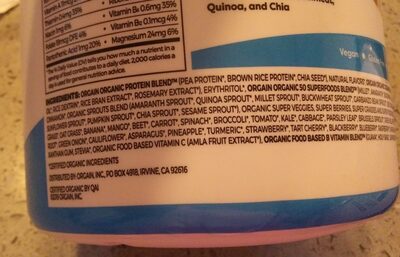
Ingredients list
Ingredient information
Allergens
Ingredients analysis
No ingredients containing palm oil.
Unrecognized: en:orgain-protein-blend, en:brown-rice-protein, en:orgain-creamer-base, en:rice-dextrin, en:orgain-50-superfoods-blend, en:sprouts-blend, en:amaranth-sprout, en:quinoa-sprout, en:millet-sprout, en:garbanzo-bean-sprout, en:lentil-sprout, en:adzuki-sprout, en:flax-sprout, en:sunflower-sprout, en:pumpkin-sprout, en:chia-sprout, en:sesame-sprout, en:super-veggies, en:super-berries, en:super-grasses-and-super-foods-blend, en:wheat-grass, en:barley-grass, en:oat-grass, en:tart-cherry, en:stevia, en:food-based-vitamin-c, en:amla-fruit-extract, en:food-based-b-vitamin-blend, en:holy-basil
No non-vegan ingredients.
Unrecognized: en:brown-rice-protein, en:rice-dextrin, en:amaranth-sprout, en:quinoa-sprout, en:millet-sprout, en:garbanzo-bean-sprout, en:lentil-sprout, en:adzuki-sprout, en:flax-sprout, en:sunflower-sprout, en:pumpkin-sprout, en:chia-sprout, en:sesame-sprout, en:super-veggies, en:super-berries, en:super-grasses-and-super-foods-blend, en:wheat-grass, en:barley-grass, en:oat-grass, en:tart-cherry, en:stevia, en:amla-fruit-extract, en:holy-basil
No non-vegetarian ingredients.
Unrecognized: en:brown-rice-protein, en:rice-dextrin, en:amaranth-sprout, en:quinoa-sprout, en:millet-sprout, en:garbanzo-bean-sprout, en:lentil-sprout, en:adzuki-sprout, en:flax-sprout, en:sunflower-sprout, en:pumpkin-sprout, en:chia-sprout, en:sesame-sprout, en:super-veggies, en:super-berries, en:super-grasses-and-super-foods-blend, en:wheat-grass, en:barley-grass, en:oat-grass, en:tart-cherry, en:stevia, en:amla-fruit-extract, en:holy-basil
Food Processing
NOVA group
 Ultra-processed food and drink products
Elements that indicate the product is in NOVA group 4
How NOVA works
Additives
E1400 - DextrinCarrierEmulsifierStabiliserThickener
Dextrins are a group of low-molecular-weight carbohydrates produced by the hydrolysis of starch or glycogen. Dextrins are mixtures of polymers of D-glucose units linked by α-(1→4) or α-(1→6) glycosidic bonds. Dextrins can be produced from starch using enzymes like amylases, as during digestion in the human body and during malting and mashing, or by applying dry heat under acidic conditions (pyrolysis or roasting). The latter process is used industrially, and also occurs on the surface of bread during the baking process, contributing to flavor, color and crispness. Dextrins produced by heat are also known as pyrodextrins. The starch hydrolyses during roasting under acidic conditions, and short-chained starch parts partially rebranch with α-(1,6) bonds to the degraded starch molecule. See also Maillard Reaction. Dextrins are white, yellow, or brown powders that are partially or fully water-soluble, yielding optically active solutions of low viscosity. Most of them can be detected with iodine solution, giving a red coloration; one distinguishes erythrodextrin (dextrin that colours red) and achrodextrin (giving no colour). White and yellow dextrins from starch roasted with little or no acid are called British gum.
E392 - Extracts of rosemary
No additive description is available yet.
E412 - Guar gumEmulsifierStabiliserThickener
Guar gum (E412) is a natural food additive derived from guar beans.
This white, odorless powder is valued for its remarkable thickening and stabilizing properties, making it a common ingredient in various food products, including sauces, dressings, and ice creams.
When used in moderation, guar gum is considered safe for consumption, with no known adverse health effects.
E414 - Acacia gumCarrierEmulsifierStabiliserThickener
Gum arabic, also known as acacia gum, arabic gum, gum acacia, acacia, Senegal gum and Indian gum, and by other names, is a natural gum consisting of the hardened sap of various species of the acacia tree. Originally, gum arabic was collected from Acacia nilotica which was called the "gum arabic tree"; in the present day, gum arabic is collected from acacia species, predominantly Acacia senegal and Vachellia (Acacia) seyal; the term "gum arabic" does not indicate a particular botanical source. In a few cases so‐called "gum arabic" may not even have been collected from Acacia species, but may originate from Combretum, Albizia or some other genus. Producers harvest the gum commercially from wild trees, mostly in Sudan (80%) and throughout the Sahel, from Senegal to Somalia—though it is historically cultivated in Arabia and West Asia. Gum arabic is a complex mixture of glycoproteins and polysaccharides. It is the original source of the sugars arabinose and ribose, both of which were first discovered and isolated from it, and are named after it. Gum arabic is soluble in water. It is edible, and used primarily in the food industry as a stabilizer, with EU E number E414. Gum arabic is a key ingredient in traditional lithography and is used in printing, paint production, glue, cosmetics and various industrial applications, including viscosity control in inks and in textile industries, though less expensive materials compete with it for many of these roles. While gum arabic is now produced throughout the African Sahel, it is still harvested and used in the Middle East.
E415 - Xanthan gumEmulsifierStabiliserThickener
Xanthan gum (E415) is a natural polysaccharide derived from fermented sugars, often used in the food industry as a thickening and stabilizing agent.
This versatile food additive enhances texture and prevents ingredient separation in a wide range of products, including salad dressings, sauces, and gluten-free baked goods.
It is considered safe for consumption even at high intake amounts.
E968 - ErythritolHumectantSweetener
Erythritol ((2R,3S)-butane-1,2,3,4-tetrol) is a sugar alcohol (or polyol) that has been approved for use as a food additive in the United States and throughout much of the world. It was discovered in 1848 by Scottish chemist John Stenhouse. It occurs naturally in some fruit and fermented foods. At the industrial level, it is produced from glucose by fermentation with a yeast, Moniliella pollinis. Erythritol is 60–70% as sweet as sucrose (table sugar) yet it is almost noncaloric, does not affect blood sugar, does not cause tooth decay, and is partially absorbed by the body, excreted in urine and feces. Under U.S. Food and Drug Administration (FDA) labeling requirements, it has a caloric value of 0.2 kilocalories per gram (95% less than sugar and other carbohydrates), though nutritional labeling varies from country to country. Some countries, such as Japan and the United States, label it as zero-calorie; the European Union labels it 0 kcal/g.
Environment
Green-Score, origins bonus, and transportation impact are shown for Worldwide .
Green Score
Overall grade
 Unknown environmental impact
About Green-Score
Current scope
Green-Score availability
Bonuses and maluses
Declared origins
Packaging impact
Packaging
Packaging impact
Data precision
Transportation
Declared origins
Data Source
Product data comes from Open Food Facts. Food Benchmark also adds translations, category comparisons and explanatory calculations.
The database is licensed under ODbL 1.0, individual contents under DbCL 1.0, and product photos under CC BY-SA 3.0.
Product added on October 9, 2019 at 10:56:55 PM UTC by openfoodfacts-contributors .
Last edit on March 18, 2026 at 12:03:10 AM UTC by municorn-calorie-counter-app .
Product page also edited by eatshalal, inf, ire2006, jusdekiwi, kiliweb, municorn-calorie-counter-app, naruyoko, openfoodfacts-contributors, org-database-usda, roboto-app, segundo, yuka.sY2b0xO6T85zoF3NwEKvlhccD4TypB_pbS7usm639vqhE7nnbt9Ys5HFOas, yuka.sY2b0xO6T85zoF3NwEKvlmt8XML6szboLBbWmVSww42TC5jWY4soxNOlA6s, yuka.sY2b0xO6T85zoF3NwEKvlnNIdeiBs2jePBHugUiOme63CabPUYhW5K3AKag.
Source List
- database-usda