
Cucina, peppercorn ranch dressing
Labels
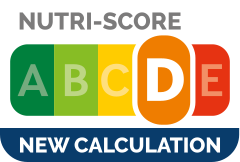 Poor nutritional quality
 Ultra-processed food and drink products
 Green-Score not computed
Health
Nutrition
Label
Poor nutritional qualityNutrient levels
Fat in moderate quantity (3.33%)
Saturated fat in low quantity (0.67%)
Sugars in moderate quantity (10%)
Salt in high quantity (2.67%)
Nutrition facts
| Nutrition facts | As sold for 100 g / 100 ml |
|---|---|
| Energy | 347 kcal (83 kcal) |
| FAT | 3.33 g |
| Saturated fat | 0.67 g |
| Trans fat | 0 g |
| Cholesterol | 0.01 mg |
| Carbohydrates | 13.33 g |
| Sugars | 10 g |
| Dietary fiber | 0 g |
| Proteins | 0 g |
| Salt | 2.67 mg |
| Sodium | 1.07 mg |
| Vitamins | |
| Vitamin A | 0 IU |
| Vitamin C | 0 mg |
| Minerals | |
| Calcium | 0.01 mg |
| Iron | 0 mg |
| Fruits, vegetables and legumes | ? |
Nutrition facts (Detailed data)
| Nutrition facts | As sold for 100 g / 100 ml | As sold Per serving (legacy) |
|---|---|---|
| Energy | 347 kcal (83 kcal) | 104 kcal (25 kcal) |
| FAT | 3.33 g | 1 g |
| Saturated fat | 0.67 g | 0.2 g |
| Trans fat | 0 g | 0 g |
| Cholesterol | 0.01 mg | 0 mg |
| Carbohydrates | 13.33 g | 4 g |
| Sugars | 10 g | 3 g |
| Dietary fiber | 0 g | 0 g |
| Proteins | 0 g | 0 g |
| Salt | 2.67 mg | 0.8 mg |
| Sodium | 1.07 mg | 0.32 mg |
| Vitamins | ||
| Vitamin A | 0 IU | 0 IU |
| Vitamin C | 0 mg | 0 mg |
| Minerals | ||
| Calcium | 0.01 mg | 0 mg |
| Iron | 0 mg | 0 mg |
| Fruits, vegetables and legumes | ? | ? |
Serving size
Estimated Activity Time
Approximate time needed to burn the energy in 100 g / 100 ml: 1,452 kJ. Reference adult weight: 70 kg. Energy density: Moderate.
Ingredients
Ingredients list
Ingredient information
Allergens
Ingredients analysis
No ingredients containing palm oil.
Unrecognized: en:natural-buttermilk-flavor, en:a-natural-food-fiber
Contains non-vegan ingredients.
Unrecognized: en:natural-buttermilk-flavor, en:a-natural-food-fiber
Vegetarian status unknown
Unrecognized: en:natural-buttermilk-flavor, en:a-natural-food-fiber
Food Processing
NOVA group
Ultra-processed food and drink productsElements that indicate the product is in NOVA group 4
How NOVA works
Additives
E171 - Titanium dioxideColour
Titanium dioxide, also known as titanium(IV) oxide or titania, is the naturally occurring oxide of titanium, chemical formula TiO2. When used as a pigment, it is called titanium white, Pigment White 6 (PW6), or CI 77891. Generally, it is sourced from ilmenite, rutile and anatase. It has a wide range of applications, including paint, sunscreen and food coloring. When used as a food coloring, it has E number E171. World production in 2014 exceeded 9 million metric tons. It has been estimated that titanium dioxide is used in two-thirds of all pigments, and the oxide has been valued at $13.2 billion.
E202 - Potassium sorbatePreservative
Potassium sorbate (E202) is a synthetic food preservative commonly used to extend the shelf life of various food products.
It works by inhibiting the growth of molds, yeast, and some bacteria, preventing spoilage. When added to foods, it helps maintain their freshness and quality.
Some studies have shown that when combined with nitrites, potassium sorbate have genotoxic activity in vitro. However, potassium sorbate is generally recognized as safe (GRAS) by regulatory authorities.
E211 - Sodium benzoatePreservative
SODIUM BENZOATE is a substance which has the chemical formula NaC7H5O2
E330 - Citric acidAntioxidantSequestrant
Citric acid is a natural organic acid found in citrus fruits such as lemons, oranges, and limes.
It is widely used in the food industry as a flavor enhancer, acidulant, and preservative due to its tart and refreshing taste.
Citric acid is safe for consumption when used in moderation and is considered a generally recognized as safe (GRAS) food additive by regulatory agencies worldwide.
E385 - Calcium disodium ethylenediaminetetraacetateAntioxidantPreservativeSequestrant
No additive description is available yet.
E415 - Xanthan gumEmulsifierStabiliserThickener
Xanthan gum (E415) is a natural polysaccharide derived from fermented sugars, often used in the food industry as a thickening and stabilizing agent.
This versatile food additive enhances texture and prevents ingredient separation in a wide range of products, including salad dressings, sauces, and gluten-free baked goods.
It is considered safe for consumption even at high intake amounts.
E621 - Monosodium glutamateFlavour Enhancer
Monosodium glutamate (MSG), or E621, is the sodium salt of glutamic acid, an amino acid found naturally in many foods.
It is widely used as a flavor enhancer to provide an "umami" or savory taste to a variety of processed foods, including soups, snack chips, and frozen meals.
MSG is generally recognized as safe (GRAS) by food authorities. However, some people report sensitivity to MSG, experiencing short-term symptoms like headaches and flushing, though scientific studies have not shown a consistent link.
Environment
Green-Score, origins bonus, and transportation impact are shown for Worldwide .
Green Score
Overall grade
Unknown environmental impactAbout Green-Score
Current scope
Green-Score availability
Bonuses and maluses
Declared origins
Packaging impact
Packaging
Packaging impact
Data precision
Transportation
Declared origins
Forest footprint
Forest footprint
Ingredients linked to forest pressure
| Ingredient | Type | Percent in product | Forest footprint |
|---|---|---|---|
| EGG Yolk | Oeufs Importés | 0.05 % | 0.00 |
Data Source
Data presented on this page is sourced from the Open Food Facts database. This platform does not alter the original dataset; its purpose is solely to enhance data visualization and user accessibility.
Product added on March 9, 2017 at 10:58:05 AM UTC by usda-ndb-import .
Last edit on April 22, 2020 at 4:51:53 PM UTC by org-database-usda .
Product page also edited by usda-ndb-import, org-database-usda.
Source List
- usda-ndb
- database-usda