

Takis fuego
Health
Nutrition
Nutri-Score
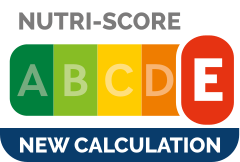 Lower nutritional quality
Nutrient levels
Fat in high quantity (26.7%)
Saturated fat in high quantity (8.33%)
Sugars in low quantity (3.33%)
Salt in high quantity (3.92%)
Nutrition facts
| Nutrition facts | As sold for 100 g / 100 ml | Compared to: Crisps |
|---|---|---|
| Energy | 2060 kJ (493 kcal) | 2,109.358 kJ (505 kcal) (-2%) |
| Fat | 26.7 g | 27.516 g (-3%) |
| Saturated fat | 8.33 g | 3.521 g (+137%) |
| Monounsaturated fat | 8.33 g | 11.495 g (-28%) |
| Polyunsaturated fat | 10 g | 8.9 g (+12%) |
| Trans fat | 0 g | 0.026 g (-100%) |
| Carbohydrates | 56.7 g | 55.478 g (+2%) |
| Sugars | 3.33 g | 2.382 g (+40%) |
| Dietary fiber | 6.67 g | ? |
| Proteins | 6.67 g | 6.214 g (+7%) |
| Salt | 3.92 mg | 1.35 g (-100%) |
| Sodium | 1.57 mg | 0.539 g (-100%) |
| Fruits, vegetables and legumes | ? | ? |
Nutrition facts (Detailed data)
| Nutrition facts | As sold for 100 g / 100 ml | As sold Per serving (legacy) |
|---|---|---|
| Energy | 2060 kJ (493 kcal) | 619 kJ (148 kcal) |
| Fat | 26.7 g | 8 g |
| Saturated fat | 8.33 g | 2.5 g |
| Monounsaturated fat | 8.33 g | 2.5 g |
| Polyunsaturated fat | 10 g | 3 g |
| Trans fat | 0 g | 0 g |
| Carbohydrates | 56.7 g | 17 g |
| Sugars | 3.33 g | 1 g |
| Dietary fiber | 6.67 g | 2 g |
| Proteins | 6.67 g | 2 g |
| Salt | 3.92 mg | 1.175 mg |
| Sodium | 1.57 mg | 0.47 mg |
| Fruits, vegetables and legumes | ? | ? |
Serving size
Ingredients
Ingredients list
Ingredient information
Added sugars
Allergens
Traces
Ingredients analysis
Palm oil content unknown
Vegan status unknown
Unrecognized: es:saborizantes-naturales-identicos-al-natural, es:colorantes-artificiales, es:laca-rojo-no, es:40-y-laca-amarillo-no, es:6, en:extract, es:inosinato-y-guanilato-de-sodio-y-no-mas-de-2-de-dioxido-de-silicio-como-antiglomerante, es:antioxidante-tbhq
Vegetarian status unknown
Unrecognized: es:saborizantes-naturales-identicos-al-natural, es:colorantes-artificiales, es:laca-rojo-no, es:40-y-laca-amarillo-no, es:6, en:extract, es:inosinato-y-guanilato-de-sodio-y-no-mas-de-2-de-dioxido-de-silicio-como-antiglomerante, es:antioxidante-tbhq
Food Processing
NOVA group
 Ultra-processed food and drink products
Elements that indicate the product is in NOVA group 4
How NOVA works
Additives
E262 - Sodium acetatesPreservativeSequestrant
SODIUM ACETATE, also abbreviated NaOAc,[8] is the sodium salt of acetic acid.
E262ii - Sodium diacetatePreservativeSequestrant
No additive description is available yet.
E330 - Citric acidAntioxidantSequestrant
Citric acid is a natural organic acid found in citrus fruits such as lemons, oranges, and limes.
It is widely used in the food industry as a flavor enhancer, acidulant, and preservative due to its tart and refreshing taste.
Citric acid is safe for consumption when used in moderation and is considered a generally recognized as safe (GRAS) food additive by regulatory agencies worldwide.
E500 - Sodium carbonatesStabiliserThickener
Sodium carbonates (E500) are compounds commonly used in food preparation as leavening agents, helping baked goods rise by releasing carbon dioxide when they interact with acids.
Often found in baking soda, they regulate the pH of food, preventing it from becoming too acidic or too alkaline. In the culinary world, sodium carbonates can also enhance the texture and structure of foods, such as noodles, by modifying the gluten network.
Generally recognized as safe, sodium carbonates are non-toxic when consumed in typical amounts found in food.
E500ii - Sodium hydrogen carbonateStabiliserThickener
Sodium hydrogen carbonate, also known as E500ii, is a food additive commonly used as a leavening agent.
When added to recipes, it releases carbon dioxide gas upon exposure to heat or acids, causing dough to rise and resulting in a light, fluffy texture in baked goods.
It is generally recognized as safe (GRAS) by regulatory authorities when used in appropriate quantities and poses no significant health risks when consumed in typical food applications.
E621 - Monosodium glutamate EFSA overexposure risk: highFlavour Enhancer
Monosodium glutamate (MSG), or E621, is the sodium salt of glutamic acid, an amino acid found naturally in many foods.
It is widely used as a flavor enhancer to provide an "umami" or savory taste to a variety of processed foods, including soups, snack chips, and frozen meals.
MSG is generally recognized as safe (GRAS) by food authorities. However, some people report sensitivity to MSG, experiencing short-term symptoms like headaches and flushing, though scientific studies have not shown a consistent link.
Environment
Green-Score, origins bonus, and transportation impact are shown for Worldwide .
Green Score
Overall grade
 Unknown environmental impact
About Green-Score
Current scope
Green-Score availability
Bonuses and maluses
Origins of ingredients
Packaging impact
Packaging
Packaging impact
Packaging components
| Shape | Material | Recycling | Impact |
|---|---|---|---|
| BAG | Plastic | Unknown | Unknown |
Declared packaging
Transportation
Manufacturing locations
Origins of ingredients
Origins breakdown
| Origin | Percent of ingredients | Impact |
|---|---|---|
| Mexico | 100 % | High |
| Chile | 0 % | High |
Data Source
Product data comes from Open Food Facts. Food Benchmark also adds translations, category comparisons and explanatory calculations.
The database is licensed under ODbL 1.0, individual contents under DbCL 1.0, and product photos under CC BY-SA 3.0.
Product added on November 29, 2018 at 3:01:21 PM UTC by kiliweb .
Last edit on April 24, 2024 at 1:47:18 AM UTC by roboto-app .
Product page also edited by allergies-app-chakib, ecoscore-impact-estimator, kiliweb, openfoodfacts-contributors, openfoodfactsmx4, packbot, roboto-app, tacite, yuka.WFlRTkNya2tvOVlsaC9NdTRSUFlwZUpRemE2aUFHcTdkN1FESVE9PQ, yuka.sY2b0xO6T85zoF3NwEKvlkZgVf3RjDXWazrRph3Ux92iCMKxcM9sxIHhGqo, yuka.sY2b0xO6T85zoF3NwEKvlnUfcYbGhxTnEADQsl3Q6fmzf473RMN-y5alNag.