
Whey Gold Standard (4,5 KG) Optimum Nutrition P?
Labels
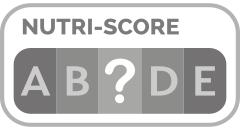 Not computed
 Ultra-processed food and drink products
 Green-Score not computed
Health
Nutrition
Nutrition facts
| Nutrition facts | As sold for 100 g / 100 ml |
|---|---|
| Energy | ~ 1,591.9 kJ (378 kcal) |
| FAT | 4.2 g |
| Saturated fat | 1.4 g |
| Cholesterol | 0.06 g |
| Carbohydrates | 5.5 g |
| Sugars | 3.3 g |
| Dietary fiber | ? |
| Proteins | 79 g |
| Salt | ~ 0.24 g |
| Sodium | 0.09 g |
| Minerals | |
| Potassium | 0.5 g |
| Calcium | 0.08 g |
| Fruits, vegetables and legumes | ~ 0 % |
Nutrition facts (Detailed data)
| Nutrition facts | As sold for 100 g / 100 ml | As sold Per 100 g (packaging) | As sold Per serving (30 g) (packaging) | As sold Per 100 g (estimate) |
|---|---|---|---|---|
| Energy | ~ 1,591.9 kJ (378 kcal) | ? (378 kcal) | ? (120 kcal) | ? |
| FAT | 4.2 g | 4.2 g | 1.5 g | ? |
| Saturated fat | 1.4 g | 1.4 g | 1 g | ? |
| Cholesterol | 0.06 g | 0.06 g | 0.06 g | ? |
| Carbohydrates | 5.5 g | 5.5 g | 3 g | ? |
| Sugars | 3.3 g | 3.3 g | 2 g | ? |
| Added sugars | ~ 0 g | ? | ? | ~ 0 g |
| Dietary fiber | ? | ? | ? | ? |
| Proteins | 79 g | 79 g | 24 g | ? |
| Salt | ~ 0.24 g | ? | 0.33 g | ? |
| Sodium | 0.09 g | 0.09 g | 0.13 g | ? |
| Minerals | ||||
| Potassium | 0.5 g | ? | 0.15 g | ? |
| Calcium | 0.08 g | 0.08 g | 0.14 g | ? |
| Fruits, vegetables and legumes | ~ 0 % | ? | ? | ~ 0 % |
Serving size
Estimated Activity Time
Approximate time needed to burn the energy in 100 g / 100 ml: 1,592 kJ. Reference adult weight: 70 kg. Energy density: Moderate.
Ingredients
Ingredients image

Ingredients list
Ingredient information
Allergens
Ingredients analysis
No ingredients containing palm oil.
Vegan status unknown
Unrecognized: fr:melange-de-allc-cl-proteines, fr:concentre-de-proteines-de-lactoserum0, fr:isolat-de-proteines-de-lactoserum-hydrolyse-0-arome, fr:issu-du-lait
Vegetarian status unknown
Unrecognized: fr:melange-de-allc-cl-proteines, fr:concentre-de-proteines-de-lactoserum0, fr:isolat-de-proteines-de-lactoserum-hydrolyse-0-arome, fr:issu-du-lait
Food Processing
NOVA group
Ultra-processed food and drink productsElements that indicate the product is in NOVA group 4
How NOVA works
Additives
E1100 - Alpha-Amylase
An amylase () is an enzyme that catalyses the hydrolysis of starch into sugars. Amylase is present in the saliva of humans and some other mammals, where it begins the chemical process of digestion. Foods that contain large amounts of starch but little sugar, such as rice and potatoes, may acquire a slightly sweet taste as they are chewed because amylase degrades some of their starch into sugar. The pancreas and salivary gland make amylase (alpha amylase) to hydrolyse dietary starch into disaccharides and trisaccharides which are converted by other enzymes to glucose to supply the body with energy. Plants and some bacteria also produce amylase. As diastase, amylase was the first enzyme to be discovered and isolated (by Anselme Payen in 1833). Specific amylase proteins are designated by different Greek letters. All amylases are glycoside hydrolases and act on α-1,4-glycosidic bonds.
E1101 - ProteaseStabiliser
A protease (also called a peptidase or proteinase) is an enzyme that performs proteolysis: protein catabolism by hydrolysis of peptide bonds. Proteases have evolved multiple times, and different classes of protease can perform the same reaction by completely different catalytic mechanisms. Proteases can be found in Animalia, Plantae, Fungi, Bacteria, Archaea and viruses.
E1104 - lipase
A LIPASE is any enzyme that catalyzes the hydrolysis of fats (lipids). Lipases serve important roles in human practices as ancient as yogurt and cheese fermentation. Lipases are generally animal sourced, but can also be sourced microbially.
E162 - Beetroot redColour
Betanin, or Beetroot Red, is a red glycosidic food dye obtained from beets; its aglycone, obtained by hydrolyzing away the glucose molecule, is betanidin. As a food additive, its E number is E162. The color of betanin depends on pH; between four and five it is bright bluish-red, becoming blue-violet as the pH increases. Once the pH reaches alkaline levels betanin degrades by hydrolysis, resulting in a yellow-brown color. Betanin is a betalain pigment, together with isobetanin, probetanin, and neobetanin. Other pigments contained in beet are indicaxanthin and vulgaxanthins.
E296 - Malic acid
MALIC ACID is an organic compound with the molecular formula C4H6O5. Malic acid has two stereoisomeric forms (L- and D-enantiomers), though only the L-isomer exists naturally.
E322 - LecithinsAntioxidantEmulsifier
Lecithins are natural compounds commonly used in the food industry as emulsifiers and stabilizers.
Extracted from sources like soybeans and eggs, lecithins consist of phospholipids that enhance the mixing of oil and water, ensuring smooth textures in various products like chocolates, dressings, and baked goods.
They do not present any known health risks.
E322i - LecithinAntioxidantEmulsifier
Lecithins are natural compounds commonly used in the food industry as emulsifiers and stabilizers.
Extracted from sources like soybeans and eggs, lecithins consist of phospholipids that enhance the mixing of oil and water, ensuring smooth textures in various products like chocolates, dressings, and baked goods.
They do not present any known health risks.
E330 - Citric acidAntioxidantSequestrant
Citric acid is a natural organic acid found in citrus fruits such as lemons, oranges, and limes.
It is widely used in the food industry as a flavor enhancer, acidulant, and preservative due to its tart and refreshing taste.
Citric acid is safe for consumption when used in moderation and is considered a generally recognized as safe (GRAS) food additive by regulatory agencies worldwide.
E950 - Acesulfame kSweetener
Acesulfame potassium ( AY-see-SUL-faym), also known as acesulfame K (K is the symbol for potassium) or Ace K, is a calorie-free sugar substitute (artificial sweetener) often marketed under the trade names Sunett and Sweet One. In the European Union, it is known under the E number (additive code) E950. It was discovered accidentally in 1967 by German chemist Karl Clauss at Hoechst AG (now Nutrinova). In chemical structure, acesulfame potassium is the potassium salt of 6-methyl-1,2,3-oxathiazine-4(3H)-one 2,2-dioxide. It is a white crystalline powder with molecular formula C4H4KNO4S and a molecular weight of 201.24 g/mol.
E955 - SucraloseSweetener
Sucralose is an artificial sweetener and sugar substitute. The majority of ingested sucralose is not broken down by the body, so it is noncaloric. In the European Union, it is also known under the E number E955. It is produced by chlorination of sucrose. Sucralose is about 320 to 1,000 times sweeter than sucrose, three times as sweet as both aspartame and acesulfame potassium, and twice as sweet as sodium saccharin. Evidence of benefit is lacking for long-term weight loss with some data supporting weight gain and heart disease risks.It is stable under heat and over a broad range of pH conditions. Therefore, it can be used in baking or in products that require a long shelf life. The commercial success of sucralose-based products stems from its favorable comparison to other low-calorie sweeteners in terms of taste, stability, and safety. Common brand names of sucralose-based sweeteners are Splenda, Zerocal, Sukrana, SucraPlus, Candys, Cukren, and Nevella. Canderel Yellow also contains sucralose, but the original Canderel and Green Canderel do not.
Environment
Green-Score, origins bonus, and transportation impact are shown for Worldwide .
Green Score
Overall grade
Unknown environmental impactAbout Green-Score
Current scope
Green-Score availability
Bonuses and maluses
Declared origins
Packaging impact
Packaging
Packaging impact
Data precision
Transportation
Declared origins
Data Source
Data presented on this page is sourced from the Open Food Facts database. This platform does not alter the original dataset; its purpose is solely to enhance data visualization and user accessibility.
Product added on January 18, 2018 at 11:00:06 PM UTC by kiliweb .
Last edit on March 16, 2026 at 11:47:40 PM UTC by macrofactor .
Product page also edited by kiliweb, macrofactor, openfoodfacts-contributors, yuka.ZUs4RkZyVllvZGszbWNFNHpoUEpwOE4ybjUrb2JVMjVFdXhBSUE9PQ.