

Caribbean original rum cake with walnuts rum
Labels
 Not computed
 Ultra-processed food and drink products
 Not computed
Health
Nutrition
Nutrition label
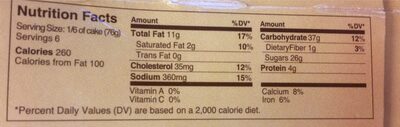
Nutrition facts
| Nutrition facts | As sold for 100 g / 100 ml |
|---|---|
| Energy | ~ 1,381.5 kJ (333 kcal) |
| FAT | 12 g |
| Saturated fat | 2.6 g |
| Carbohydrates | 49 g |
| Sugars | 35 g |
| Dietary fiber | 1.8 g |
| Proteins | 5.3 g |
| Salt | 0.96 g |
| Sodium | 0.38 g |
| Minerals | |
| Fruits, vegetables and legumes | ~ 0 % |
Nutrition facts (Detailed data)
| Nutrition facts | As sold for 100 g / 100 ml | As sold Per 100 g (packaging) | As sold Per 100 g (estimate) |
|---|---|---|---|
| Energy | ~ 1,381.5 kJ (333 kcal) | ? (333 kcal) | ? |
| FAT | 12 g | 12 g | ? |
| Saturated fat | 2.6 g | 2.6 g | ? |
| Carbohydrates | 49 g | 49 g | ? |
| Sugars | 35 g | 35 g | ? |
| Added sugars | ~ 51.72 g | ? | ~ 51.72 g |
| Dietary fiber | 1.8 g | 1.8 g | ? |
| Proteins | 5.3 g | 5.3 g | ? |
| Salt | 0.96 g | 0.96 g | ? |
| Sodium | 0.38 g | 0.38 g | ? |
| Minerals | |||
| Fruits, vegetables and legumes | ~ 0 % | ? | ~ 0 % |
Estimated Activity Time
Approximate time needed to burn the energy in 100 g / 100 ml: 1,382 kJ. Reference adult weight: 70 kg. Energy density: Moderate.
Ingredients
Ingredients image

Ingredients list
Ingredient information
Allergens
Ingredients analysis
No ingredients containing palm oil.
Unrecognized: en:tl-mononitrate-riboflavin, en:es, en:emulsi, en:propylene-col-mix-of-mono-and-diglycerides, en:anc-tortuga-gold-rum, en:baking-soda-sodium-a-pyophosphate, en:sodium-aluminur-phosphate, en:textulizers, en:cara-color, en:aflificial, en:presen-ative, en:aruficial-color, en:fd-c-yel-5, en:contains-less-than-half-of-1-alcohol, en:allergens, en:coconu-product-is-made-in-a-factoty-where-nuts-are-handled, en:characierizing-ngredfnis, en:following-charadefizing-ing, en:cake-contain-natural-and-arbficial-flavoting-coconut-cake-contains-coconut-flakes-and-natural-and-artifi-ilavoring-pineapple-cake-contains-natural-and-arffcial-flavoring-key-lime-cake-contains-lime, en:natural-and-artificial-flavoring-chocolate-cake-contains-dutched-cocoa-powder, en:coffee-cake-contains-coffee-concentrates-from-jamaica-coffee-bear-orange-cake-contains-natural-and-artificial-flavoring-maple-cake-contains-maple-syup, en:cinnamon-raisin-cake-contains-cinnamon
Contains non-vegan ingredients.
Unrecognized: en:tl-mononitrate-riboflavin, en:es, en:propylene-col-mix-of-mono-and-diglycerides, en:anc-tortuga-gold-rum, en:baking-soda-sodium-a-pyophosphate, en:sodium-aluminur-phosphate, en:cara-color, en:aflificial, en:presen-ative, en:fd-c-yel-5, en:contains-less-than-half-of-1-alcohol, en:coconu-product-is-made-in-a-factoty-where-nuts-are-handled, en:following-charadefizing-ing, en:natural-and-artificial-flavoring-chocolate-cake-contains-dutched-cocoa-powder, en:coffee-cake-contains-coffee-concentrates-from-jamaica-coffee-bear-orange-cake-contains-natural-and-artificial-flavoring-maple-cake-contains-maple-syup, en:cinnamon-raisin-cake-contains-cinnamon
Vegetarian status unknown
Unrecognized: en:tl-mononitrate-riboflavin, en:es, en:propylene-col-mix-of-mono-and-diglycerides, en:anc-tortuga-gold-rum, en:baking-soda-sodium-a-pyophosphate, en:sodium-aluminur-phosphate, en:cara-color, en:aflificial, en:presen-ative, en:fd-c-yel-5, en:contains-less-than-half-of-1-alcohol, en:coconu-product-is-made-in-a-factoty-where-nuts-are-handled, en:following-charadefizing-ing, en:natural-and-artificial-flavoring-chocolate-cake-contains-dutched-cocoa-powder, en:coffee-cake-contains-coffee-concentrates-from-jamaica-coffee-bear-orange-cake-contains-natural-and-artificial-flavoring-maple-cake-contains-maple-syup, en:cinnamon-raisin-cake-contains-cinnamon
Food Processing
NOVA group
Ultra-processed food and drink productsElements that indicate the product is in NOVA group 4
How NOVA works
Additives
E200 - Sorbic acidPreservative
SORBIC ACID, or 2,4-hexadienoic acid, is a natural organic compound used as a food preservative. It has the chemical formula CH3(CH)4CO2H.
E341 - Calcium phosphatesEmulsifierHumectantSequestrantStabiliserThickener
Calcium phosphate is a family of materials and minerals containing calcium ions (Ca2+) together with inorganic phosphate anions. Some so-called calcium phosphates contain oxide and hydroxide as well. They are white solids of nutritious value.
E341i - Monocalcium phosphateEmulsifierHumectantSequestrantStabiliserThickener
No additive description is available yet.
E341ii - Dicalcium phosphateEmulsifierHumectantSequestrantStabiliserThickener
No additive description is available yet.
E401 - sodium alginateCarrierEmulsifierHumectantSequestrantStabiliserThickener
No additive description is available yet.
E412 - Guar gumEmulsifierStabiliserThickener
Guar gum (E412) is a natural food additive derived from guar beans.
This white, odorless powder is valued for its remarkable thickening and stabilizing properties, making it a common ingredient in various food products, including sauces, dressings, and ice creams.
When used in moderation, guar gum is considered safe for consumption, with no known adverse health effects.
E414 - Acacia gumCarrierEmulsifierStabiliserThickener
Gum arabic, also known as acacia gum, arabic gum, gum acacia, acacia, Senegal gum and Indian gum, and by other names, is a natural gum consisting of the hardened sap of various species of the acacia tree. Originally, gum arabic was collected from Acacia nilotica which was called the "gum arabic tree"; in the present day, gum arabic is collected from acacia species, predominantly Acacia senegal and Vachellia (Acacia) seyal; the term "gum arabic" does not indicate a particular botanical source. In a few cases so‐called "gum arabic" may not even have been collected from Acacia species, but may originate from Combretum, Albizia or some other genus. Producers harvest the gum commercially from wild trees, mostly in Sudan (80%) and throughout the Sahel, from Senegal to Somalia—though it is historically cultivated in Arabia and West Asia. Gum arabic is a complex mixture of glycoproteins and polysaccharides. It is the original source of the sugars arabinose and ribose, both of which were first discovered and isolated from it, and are named after it. Gum arabic is soluble in water. It is edible, and used primarily in the food industry as a stabilizer, with EU E number E414. Gum arabic is a key ingredient in traditional lithography and is used in printing, paint production, glue, cosmetics and various industrial applications, including viscosity control in inks and in textile industries, though less expensive materials compete with it for many of these roles. While gum arabic is now produced throughout the African Sahel, it is still harvested and used in the Middle East.
E415 - Xanthan gumEmulsifierStabiliserThickener
Xanthan gum (E415) is a natural polysaccharide derived from fermented sugars, often used in the food industry as a thickening and stabilizing agent.
This versatile food additive enhances texture and prevents ingredient separation in a wide range of products, including salad dressings, sauces, and gluten-free baked goods.
It is considered safe for consumption even at high intake amounts.
E471 - Mono- and diglycerides of fatty acidsEmulsifierStabiliser
Mono- and diglycerides of fatty acids (E471), are food additives commonly used as emulsifiers in various processed foods.
These compounds consist of glycerol molecules linked to one or two fatty acid chains, which help stabilize and blend water and oil-based ingredients. E471 enhances the texture and shelf life of products like margarine, baked goods, and ice cream, ensuring a smooth and consistent texture.
It is generally considered safe for consumption within established regulatory limits.
Environment
Environmental score label
Not computedCarbon footprint
No carbon footprint data is available for this product.
Packaging
No packaging information provided.
Transportation and origins
Origins of ingredients
No origin information provided.
Manufacturing places
No manufacturing place information provided.
Environmental labels
No environmental labels identified.
Data Source
Data presented on this page is sourced from the Open Food Facts database. This platform does not alter the original dataset; its purpose is solely to enhance data visualization and user accessibility.
Product added on November 10, 2017 at 12:03:39 PM UTC by kiliweb .
Last edit on March 17, 2026 at 5:04:00 AM UTC by new-nutrition-bot .
Product page also edited by autorotate-bot, chevalstar, kiliweb, new-nutrition-bot, openfoodfacts-contributors, yuka.U2FBdVRhZ0ZqNkVGc3NSdnpndVAxTTFhNk0rbVFsaTFFTFl1SVE9PQ, yuka.sY2b0xO6T85zoF3NwEKvlk15SfvvnhPjJjrnu2S5w9WJHsbSYY1RzIXaGKo, yuka.sY2b0xO6T85zoF3NwEKvlmlhSvnxmhPGNjXgpVGu2tqKNcbVOthj4NXXNas.