
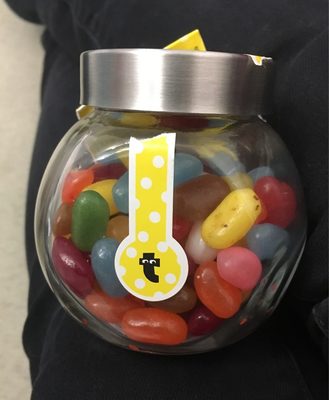
Candy beans
Labels
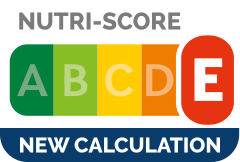 Bad nutritional quality
 Ultra-processed food and drink products
 Not computed
Health
Nutrition
Label
Bad nutritional qualityNutrient levels
Fat in low quantity (0%)
Saturated fat in low quantity (0%)
Sugars in high quantity (77%)
Salt in low quantity (0.06%)
Nutrition label
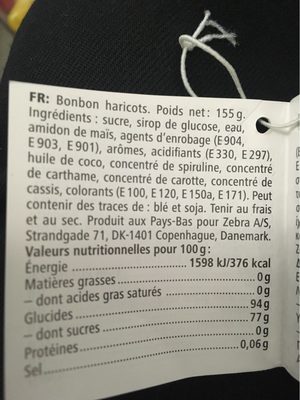
Nutrition facts
| Nutrition facts | As sold for 100 g / 100 ml |
|---|---|
| Energy | ~ 1,598 kJ (376 kcal) |
| FAT | 0 g |
| Saturated fat | 0 g |
| Carbohydrates | 94 g |
| Sugars | 77 g |
| Dietary fiber | 0 g |
| Proteins | 0 g |
| Salt | 0.06 g |
| Sodium | 0.02 g |
| Minerals | |
| Fruits, vegetables and legumes | ~ 0.07 % |
Nutrition facts (Detailed data)
| Nutrition facts | As sold for 100 g / 100 ml | As sold Per 100 g (packaging) | As sold Per 100 g (estimate) |
|---|---|---|---|
| Energy | ~ 1,598 kJ (376 kcal) | ? (376 kcal) | ? |
| FAT | 0 g | 0 g | ? |
| Saturated fat | 0 g | 0 g | ? |
| Carbohydrates | 94 g | 94 g | ? |
| Sugars | 77 g | 77 g | ? |
| Added sugars | ~ 76.92 g | ? | ~ 76.92 g |
| Dietary fiber | 0 g | 0 g | ? |
| Proteins | 0 g | 0 g | ? |
| Salt | 0.06 g | 0.06 g | ? |
| Sodium | 0.02 g | 0.02 g | ? |
| Minerals | |||
| Fruits, vegetables and legumes | ~ 0.07 % | ? | ~ 0.07 % |
Estimated Activity Time
Approximate time needed to burn the energy in 100 g / 100 ml: 1,598 kJ. Reference adult weight: 70 kg. Energy density: Moderate.
Ingredients
Ingredients image

Ingredients list
Ingredient information
Traces
Ingredients analysis
No ingredients containing palm oil.
Contains non-vegan ingredients.
Contains non-vegetarian ingredients.
Food Processing
NOVA group
Ultra-processed food and drink productsElements that indicate the product is in NOVA group 4
How NOVA works
Additives
E100 - CurcuminColour
No additive description is available yet.
E120 - CochinealColour
Cochineal extract or carmine (E120) is a natural red colorant derived from the dried bodies of the female cochineal insect.
It is widely used to impart a pink, red, or purple hue to various food and beverage products, including yogurts, ice creams, confectionery, and fruit juices.
Although it is a natural additive, E120 is known to cause severe allergic reactions, including anaphylaxis, in some individuals. It is also not suitable for vegetarians or vegans due to its insect origin.
E150a - Plain caramelColour
Caramel color or caramel coloring is a water-soluble food coloring.
E171 - Titanium dioxideColour
Titanium dioxide, also known as titanium(IV) oxide or titania, is the naturally occurring oxide of titanium, chemical formula TiO2. When used as a pigment, it is called titanium white, Pigment White 6 (PW6), or CI 77891. Generally, it is sourced from ilmenite, rutile and anatase. It has a wide range of applications, including paint, sunscreen and food coloring. When used as a food coloring, it has E number E171. World production in 2014 exceeded 9 million metric tons. It has been estimated that titanium dioxide is used in two-thirds of all pigments, and the oxide has been valued at $13.2 billion.
E297 - Fumaric acid
Fumaric acid or trans-butenedioic acid is the chemical compound with the formula HO2CCH=CHCO2H. It is produced in eukaryotic organisms from succinate in complex 2 of the electron transport chain via the enzyme succinate dehydrogenase. It is one of two isomeric unsaturated dicarboxylic acids, the other being maleic acid. In fumaric acid the carboxylic acid groups are trans (E) and in maleic acid they are cis (Z). Fumaric acid has a fruit-like taste. The salts and esters are known as fumarates. Fumarate can also refer to the C4H2O2−4 ion (in solution).
E330 - Citric acidAntioxidantSequestrant
Citric acid is a natural organic acid found in citrus fruits such as lemons, oranges, and limes.
It is widely used in the food industry as a flavor enhancer, acidulant, and preservative due to its tart and refreshing taste.
Citric acid is safe for consumption when used in moderation and is considered a generally recognized as safe (GRAS) food additive by regulatory agencies worldwide.
E901 - white and yellow beeswaxCarrierEmulsifierStabiliserThickener
Beeswax (cera alba) is a natural wax produced by honey bees of the genus Apis. The wax is formed into "scales" by eight wax-producing glands in the abdominal segments of worker bees, which discard it in or at the hive. The hive workers collect and use it to form cells for honey storage and larval and pupal protection within the beehive. Chemically, beeswax consists mainly of esters of fatty acids and various long-chain alcohols. Beeswax has long-standing applications in human food and flavoring. For example, it is used as a glazing agent or as a light/heat source. It is edible, in the sense of having similar negligible toxicity to plant waxes, and is approved for food use in most countries and the European Union under the E number E901. However, the wax monoesters in beeswax are poorly hydrolysed in the guts of humans and other mammals, so they have insignificant nutritional value. Some birds, such as honeyguides, can digest beeswax. Beeswax is the main diet of wax moth larvae.
E903 - Carnauba waxCarrier
Carnauba (; Portuguese: carnaúba [kaʁnɐˈubɐ]), also called Brazil wax and palm wax, is a wax of the leaves of the palm Copernicia prunifera (Synonym: Copernicia cerifera), a plant native to and grown only in the northeastern Brazilian states of Piauí, Ceará, Maranhão, Bahia, and Rio Grande do Norte. It is known as "queen of waxes" and in its pure state, usually comes in the form of hard yellow-brown flakes. It is obtained from the leaves of the carnauba palm by collecting and drying them, beating them to loosen the wax, then refining and bleaching the wax.
E904 - Shellac
Shellac is a resin secreted by the female lac bug, on trees in the forests of India and Thailand. It is processed and sold as dry flakes (pictured) and dissolved in alcohol to make liquid shellac, which is used as a brush-on colorant, food glaze and wood finish. Shellac functions as a tough natural primer, sanding sealant, tannin-blocker, odour-blocker, stain, and high-gloss varnish. Shellac was once used in electrical applications as it possesses good insulation qualities and it seals out moisture. Phonograph and 78 rpm gramophone records were made of it until they were replaced by vinyl long-playing records from the 1950s onwards. From the time it replaced oil and wax finishes in the 19th century, shellac was one of the dominant wood finishes in the western world until it was largely replaced by nitrocellulose lacquer in the 1920s and 1930s.
Environment
Environmental score label
Not computedCarbon footprint
No carbon footprint data is available for this product.
Packaging
No packaging information provided.
Transportation and origins
Origins of ingredients
No origin information provided.
Manufacturing places
No manufacturing place information provided.
Environmental labels
No environmental labels identified.
Data Source
Data presented on this page is sourced from the Open Food Facts database. This platform does not alter the original dataset; its purpose is solely to enhance data visualization and user accessibility.
Product added on February 1, 2018 at 9:22:15 PM UTC by kiliweb .
Last edit on March 17, 2026 at 1:34:00 PM UTC by new-nutrition-bot .
Product page also edited by acuario, elcoco, kiliweb, musarana, new-nutrition-bot, openfoodfacts-contributors, roboto-app, thaialagata, yuka.Ylo4bEcvMWFyUDBLd2M4UTRobnAxTmwvMzdHaVZEcXpLN29ZSVE9PQ.