
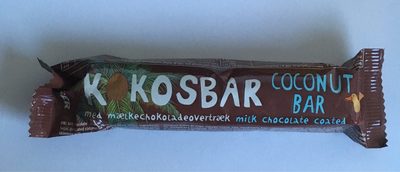
Coconut bar milk chocolate coated
Labels
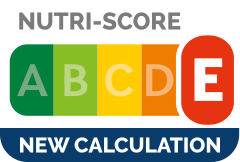 Bad nutritional quality
 Ultra-processed food and drink products
 Not computed
Health
Nutrition
Label
Bad nutritional qualityNutrient levels
Fat in high quantity (25%)
Saturated fat in high quantity (19%)
Sugars in high quantity (49%)
Salt in low quantity (0.14%)
Nutrition facts
| Nutrition facts | As sold for 100 g / 100 ml |
|---|---|
| Energy | ~ 1,917.8 kJ (476 kcal) |
| FAT | 25 g |
| Saturated fat | 19 g |
| Carbohydrates | 54 g |
| Sugars | 49 g |
| Dietary fiber | ~ 3.08 g |
| Proteins | 4.4 g |
| Salt | 0.14 g |
| Sodium | 0.06 g |
| Minerals | |
| Fruits, vegetables and legumes | ~ 22 % |
Nutrition facts (Detailed data)
| Nutrition facts | As sold for 100 g / 100 ml | As sold Per 100 g (packaging) | As sold Per 100 g (estimate) |
|---|---|---|---|
| Energy | ~ 1,917.8 kJ (476 kcal) | ? (476 kcal) | ~ 1,743.44 kJ (414 kcal) |
| FAT | 25 g | 25 g | ~ 19.19 g |
| Saturated fat | 19 g | 19 g | ~ 12.84 g |
| Cholesterol | ~ 0 g | ? | ~ 0 g |
| Carbohydrates | 54 g | 54 g | ~ 66.7 g |
| Sugars | 49 g | 49 g | ~ 66.26 g |
| Added sugars | ~ 64 g | ? | ~ 64 g |
| Sucrose | ~ 65.15 g | ? | ~ 65.15 g |
| Glucose | ~ 0.07 g | ? | ~ 0.07 g |
| Fructose | ~ 0.03 g | ? | ~ 0.03 g |
| Galactose | ~ 0 g | ? | ~ 0 g |
| Lactose | ~ 0.93 g | ? | ~ 0.93 g |
| Maltose | ~ 0.03 g | ? | ~ 0.03 g |
| Starch | ~ 0.4 g | ? | ~ 0.4 g |
| Polyols | ~ 0 g | ? | ~ 0 g |
| Dietary fiber | ~ 3.08 g | ? | ~ 3.08 g |
| Proteins | 4.4 g | 4.4 g | ~ 2.07 g |
| Salt | 0.14 g | 0.14 g | ~ 0.07 g |
| Sodium | 0.06 g | 0.06 g | ~ 0.03 g |
| Alcohol | ~ 0 % vol | ? | ~ 0 % vol |
| Vitamins | |||
| Vitamin A | ~ 0 g | ? | ~ 0 g |
| Beta-carotene | ~ 0 g | ? | ~ 0 g |
| Vitamin D | ~ 0 g | ? | ~ 0 g |
| Vitamin E | ~ 0 g | ? | ~ 0 g |
| Vitamin C | ~ 0 g | ? | ~ 0 g |
| Vitamin B1 | ~ 0 g | ? | ~ 0 g |
| Vitamin B2 | ~ 0 g | ? | ~ 0 g |
| Vitamin PP | ~ 0 g | ? | ~ 0 g |
| Vitamin B6 | ~ 0 g | ? | ~ 0 g |
| Vitamin B9 | ~ 0 g | ? | ~ 0 g |
| Vitamin B12 | ~ 0 g | ? | ~ 0 g |
| Pantothenic acid | ~ 0 g | ? | ~ 0 g |
| Minerals | |||
| Potassium | ~ 0.18 g | ? | ~ 0.18 g |
| Calcium | ~ 0.03 g | ? | ~ 0.03 g |
| Phosphorus | ~ 0.06 g | ? | ~ 0.06 g |
| Iron | ~ 0 g | ? | ~ 0 g |
| Magnesium | ~ 0.02 g | ? | ~ 0.02 g |
| Zinc | ~ 0 g | ? | ~ 0 g |
| Copper | ~ 0 g | ? | ~ 0 g |
| Manganese | ~ 0 g | ? | ~ 0 g |
| Selenium | ~ 0 g | ? | ~ 0 g |
| Iodine | ~ 9 g | ? | ~ 9 g |
| Fruits, vegetables and legumes | ~ 22 % | ? | ~ 22 % |
| Phylloquinone | ~ 0 g | ? | ~ 0 g |
| Water | ~ 7.73 g | ? | ~ 7.73 g |
Estimated Activity Time
Approximate time needed to burn the energy in 100 g / 100 ml: 1,918 kJ. Reference adult weight: 70 kg. Energy density: Moderate.
Ingredients
Ingredients image
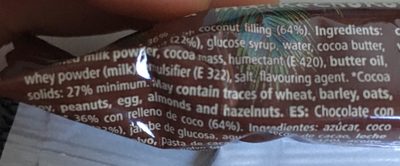
Ingredients list
Ingredient information
Allergens
Traces
Ingredients analysis
No ingredients containing palm oil.
Contains non-vegan ingredients.
Unrecognized: en:flavouring-agent, en:cocoa-solides
Vegetarian status unknown
Unrecognized: en:flavouring-agent, en:cocoa-solides
Food Processing
NOVA group
Ultra-processed food and drink productsElements that indicate the product is in NOVA group 4
How NOVA works
Additives
E322 - LecithinsAntioxidantEmulsifier
Lecithins are natural compounds commonly used in the food industry as emulsifiers and stabilizers.
Extracted from sources like soybeans and eggs, lecithins consist of phospholipids that enhance the mixing of oil and water, ensuring smooth textures in various products like chocolates, dressings, and baked goods.
They do not present any known health risks.
E420 - SorbitolHumectantSequestrantStabiliserSweetenerThickener
Sorbitol (), less commonly known as glucitol (), is a sugar alcohol with a sweet taste which the human body metabolizes slowly. It can be obtained by reduction of glucose, which changes the aldehyde group to a hydroxyl group. Most sorbitol is made from corn syrup, but it is also found in nature, for example in apples, pears, peaches, and prunes. It is converted to fructose by sorbitol-6-phosphate 2-dehydrogenase. Sorbitol is an isomer of mannitol, another sugar alcohol; the two differ only in the orientation of the hydroxyl group on carbon 2. While similar, the two sugar alcohols have very different sources in nature, melting points, and uses.
Environment
Carbon footprint
Data Source
Data presented on this page is sourced from the Open Food Facts database. This platform does not alter the original dataset; its purpose is solely to enhance data visualization and user accessibility.
Product added on December 12, 2017 at 7:44:28 AM UTC by kiliweb .
Last edit on March 17, 2026 at 6:06:59 AM UTC by new-nutrition-bot .
Product page also edited by chevalstar, kiliweb, musarana, new-nutrition-bot, openfoodfacts-contributors, thaialagata, yuka.ZXB3Q1R2d0hpT2dWbk14aC9RdmxvdEZ2MmNhUWNXK1dOK0VTSVE9PQ.