

CANOLA OIL COOKING SPRAY
Labels
 Good nutritional quality
 Ultra-processed food and drink products
 Moderate environmental impact
Health
Nutrition
Label
Good nutritional qualityNutrient levels
Fat in low quantity (0%)
Saturated fat in low quantity (0%)
Sugars in low quantity (0%)
Salt in low quantity (0%)
Nutrition label

Nutrition facts
| Nutrition facts | As sold for 100 g / 100 ml |
|---|---|
| Energy | 0 kcal (0 kcal) |
| FAT | 0 g |
| Saturated fat | 0 g |
| Carbohydrates | 0 g |
| Sugars | 0 g |
| Added sugars | 0 g |
| Starch | 0 g |
| Dietary fiber | 0 g |
| Proteins | 0 g |
| Salt | 0 g |
| Sodium | 0 g |
| Vitamins | |
| Vitamin A | 0 mcg |
| Vitamin E | 0 mg |
| Vitamin K | 0 mcg |
| Vitamin C | 0 mg |
| Vitamin B1 | 0 mg |
| Vitamin B2 | 0 mg |
| Vitamin B6 | 0 mcg |
| Vitamin B9 | 0 mcg |
| Vitamin B12 | 0 mcg |
| Minerals | |
| Phosphorus | 0 mg |
| Iron | 0 mg |
| Magnesium | 0 mg |
| Zinc | 0 mg |
| Copper | 0 mg |
| Manganese | 0 mg |
| Selenium | 0 mcg |
| Caffeine | 0 mg |
| Fruits, vegetables and legumes | ? |
| Choline | 0 mg |
Nutrition facts (Detailed data)
| Nutrition facts | As sold for 100 g / 100 ml | As sold Per serving (legacy) |
|---|---|---|
| Energy | 0 kcal (0 kcal) | ? |
| FAT | 0 g | ? |
| Saturated fat | 0 g | ? |
| Carbohydrates | 0 g | ? |
| Sugars | 0 g | ? |
| Added sugars | 0 g | ? |
| Starch | 0 g | ? |
| Dietary fiber | 0 g | ? |
| Proteins | 0 g | ? |
| Salt | 0 g | ? |
| Sodium | 0 g | ? |
| Vitamins | ||
| Vitamin A | 0 mcg | ? |
| Vitamin E | 0 mg | ? |
| Vitamin K | 0 mcg | ? |
| Vitamin C | 0 mg | ? |
| Vitamin B1 | 0 mg | ? |
| Vitamin B2 | 0 mg | ? |
| Vitamin B6 | 0 mcg | ? |
| Vitamin B9 | 0 mcg | ? |
| Vitamin B12 | 0 mcg | ? |
| Minerals | ||
| Phosphorus | 0 mg | ? |
| Iron | 0 mg | ? |
| Magnesium | 0 mg | ? |
| Zinc | 0 mg | ? |
| Copper | 0 mg | ? |
| Manganese | 0 mg | ? |
| Selenium | 0 mcg | ? |
| Caffeine | 0 mg | ? |
| Fruits, vegetables and legumes | ? | ? |
| Choline | 0 mg | ? |
Ingredients
Ingredients image
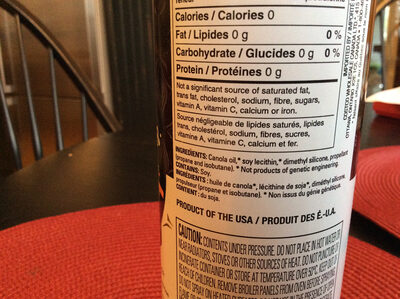
Ingredients list
Ingredient information
Allergens
Ingredients analysis
No ingredients containing palm oil.
Unrecognized: en:dimethyl-silicone
Vegan status unknown
Unrecognized: en:dimethyl-silicone
Vegetarian status unknown
Unrecognized: en:dimethyl-silicone
Food Processing
NOVA group
Ultra-processed food and drink productsElements that indicate the product is in NOVA group 4
How NOVA works
Additives
E322 - LecithinsAntioxidantEmulsifier
Lecithins are natural compounds commonly used in the food industry as emulsifiers and stabilizers.
Extracted from sources like soybeans and eggs, lecithins consist of phospholipids that enhance the mixing of oil and water, ensuring smooth textures in various products like chocolates, dressings, and baked goods.
They do not present any known health risks.
E322i - LecithinAntioxidantEmulsifier
Lecithins are natural compounds commonly used in the food industry as emulsifiers and stabilizers.
Extracted from sources like soybeans and eggs, lecithins consist of phospholipids that enhance the mixing of oil and water, ensuring smooth textures in various products like chocolates, dressings, and baked goods.
They do not present any known health risks.
E943b - Isobutane
No additive description is available yet.
E944 - Propane
Propane () is a three-carbon alkane with the molecular formula C3H8. It is a gas at standard temperature and pressure, but compressible to a transportable liquid. A by-product of natural gas processing and petroleum refining, it is commonly used as a fuel. Propane is one of a group of liquefied petroleum gases (LP gases). The others include butane, propylene, butadiene, butylene, isobutylene, and mixtures thereof.
Environment
Green-Score, origins bonus, and transportation impact are shown for Worldwide .
Green Score
Overall grade
Moderate environmental impactAbout Green-Score
Current scope
Life cycle analysis
Average impact of the category
 Rapeseed oil • Score: 72/100
Life-cycle reference
Overall environmental impact by stage (PEF)
The overall environmental impact figure (PEF) comes from ADEME's Agribalyse database, for the category: Rapeseed oil. Source: ADEME Agribalyse Database.
| Stage | Impact |
|---|---|
| Agriculture | 0.0 % |
| Processing | 77.7 % |
| Packaging | 11.7 % |
| Transportation | 9.1 % |
| Distribution | 1.5 % |
| Consumption | 0.0 % |
Bonuses and maluses
Declared origins
Packaging impact
Green-Score for this product
Green-Score for this product
Final score: 52/100Final score breakdown
Carbon footprint
Carbon footprint
Climate impact by stage (CO2e)
The carbon emission figure comes from ADEME's Agribalyse database, for the category: Rapeseed oil. Source: ADEME Agribalyse Database.
| Stage | Impact |
|---|---|
| Agriculture | 0.0 % |
| Processing | 77.0 % |
| Packaging | 7.8 % |
| Transportation | 14.5 % |
| Distribution | 0.7 % |
| Consumption | 0.0 % |
Packaging
Packaging impact
Data precision
Transportation
Manufacturing locations
Declared origins
Data Source
Data presented on this page is sourced from the Open Food Facts database. This platform does not alter the original dataset; its purpose is solely to enhance data visualization and user accessibility.
Product added on February 24, 2019 at 1:13:55 AM UTC by openfoodfacts-contributors .
Last edit on September 21, 2025 at 2:59:15 PM UTC by municorn-calorie-counter-app .
Product page also edited by chancewash, inf, kiliweb, municorn-calorie-counter-app, openfoodfacts-contributors, org-label-non-gmo-project, roboto-app, scanada, wap53, yuka.MLcaIIHSBt4DHdzg744k_ymdN_34GfBYO2Ypog, yuka.sY2b0xO6T85zoF3NwEKvlmV5SPjZrRn0K03SumeW2tOEEa3DY88v6JblKqg.
Source List
- label-non-gmo-project