

印尼撈麵
Health
Nutrition
Nutrition label

Nutrition facts
| Nutrition facts | As sold for 100 g / 100 ml | Compared to: Instant noodles |
|---|---|---|
| Energy | ~ 1944.70588235294 kJ (470 kcal) | 1,157.664 kJ (278 kcal) (+68%) |
| Fat | 18.8235294117647 g | 10.058 g (+87%) |
| Saturated fat | 8.23529411764706 g | 4.313 g (+91%) |
| Carbohydrates | 62.3529411764706 g | 38.567 g (+62%) |
| Sugars | 7.05882352941176 g | 2.429 g (+191%) |
| Starch | 0 g | 14.637 g (-100%) |
| Dietary fiber | 3.52941176470588 g | ? |
| Proteins | 9.41176470588235 g | 6.082 g (+55%) |
| Salt | 2.29411764705882 g | 2.359 g (-3%) |
| Sodium | 0.964705882352941 g | 0.943 g (+2%) |
| Potassium | 0.214117647058824 g | 214.724 mg (~0%) |
| Calcium | 0.0270588235294118 g | 32.833 mg (-18%) |
| Iron | 0.00470588235294118 g | 1.859 mg (+153%) |
| Fruits, vegetables and legumes | ~ 0.00244954427083144 % | ? |
| Choline | 0 g | 0 g |
Nutrition facts (Detailed data)
| Nutrition facts | As sold for 100 g / 100 ml | As sold Per serving (85 g) (packaging) | As sold Per 100 g (estimate) |
|---|---|---|---|
| Energy | ~ 1944.70588235294 kJ (470 kcal) | ? (400 kcal) | ? |
| Fat | 18.8235294117647 g | 16 g | ? |
| Saturated fat | 8.23529411764706 g | 7 g | ? |
| Carbohydrates | 62.3529411764706 g | 53 g | ? |
| Sugars | 7.05882352941176 g | 6 g | ? |
| Starch | 0 g | 0 g | ? |
| Dietary fiber | 3.52941176470588 g | 3 g | ? |
| Proteins | 9.41176470588235 g | 8 g | ? |
| Salt | 2.29411764705882 g | 1.95 g | ? |
| Sodium | 0.964705882352941 g | 0.82 g | ? |
| Potassium | 0.214117647058824 g | 0.182 g | ? |
| Calcium | 0.0270588235294118 g | 0.023 g | ? |
| Iron | 0.00470588235294118 g | 0.004 g | ? |
| Fruits, vegetables and legumes | ~ 0.00244954427083144 % | ? | ~ 0.00244954427083144 % |
| Choline | 0 g | 0 g | ? |
Serving size
Ingredients
Ingredients image
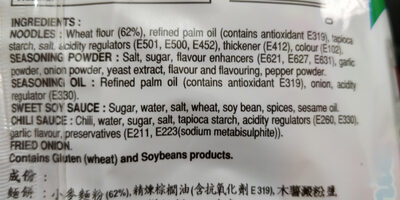
Ingredients list
Ingredient information
Added sugars
Allergens
Ingredients analysis
Contains ingredients containing palm oil.
Vegan status unknown
Unrecognized: en:artificial-chicken-flavor, en:artificial-chicken-flavor
Vegetarian status unknown
Unrecognized: en:artificial-chicken-flavor, en:artificial-chicken-flavor
Food Processing
NOVA group
 Ultra-processed food and drink products
Elements that indicate the product is in NOVA group 4
How NOVA works
Additives
E150c - Ammonia caramel EFSA overexposure risk: moderateColour
No additive description is available yet.
E412 - Guar gumEmulsifierStabiliserThickener
Guar gum (E412) is a natural food additive derived from guar beans.
This white, odorless powder is valued for its remarkable thickening and stabilizing properties, making it a common ingredient in various food products, including sauces, dressings, and ice creams.
When used in moderation, guar gum is considered safe for consumption, with no known adverse health effects.
E452 - Polyphosphates EFSA overexposure risk: highEmulsifierHumectantSequestrantStabiliserThickener
No additive description is available yet.
E452vi - Sodium tripolyphosphateEmulsifierHumectantSequestrantStabiliserThickener
No additive description is available yet.
E500 - Sodium carbonatesStabiliserThickener
Sodium carbonates (E500) are compounds commonly used in food preparation as leavening agents, helping baked goods rise by releasing carbon dioxide when they interact with acids.
Often found in baking soda, they regulate the pH of food, preventing it from becoming too acidic or too alkaline. In the culinary world, sodium carbonates can also enhance the texture and structure of foods, such as noodles, by modifying the gluten network.
Generally recognized as safe, sodium carbonates are non-toxic when consumed in typical amounts found in food.
E500i - Sodium carbonateStabiliserThickener
No additive description is available yet.
E501 - Potassium carbonatesStabiliser
Potassium carbonate (K2CO3) is a white salt, which is soluble in water (insoluble in ethanol) and forms a strongly alkaline solution. It can be made as the product of potassium hydroxide's absorbent reaction with carbon dioxide. It is deliquescent, often appearing a damp or wet solid. Potassium carbonate is used in the production of soap and glass.
E501i - Potassium carbonateStabiliser
No additive description is available yet.
E621 - Monosodium glutamate EFSA overexposure risk: highFlavour Enhancer
Monosodium glutamate (MSG), or E621, is the sodium salt of glutamic acid, an amino acid found naturally in many foods.
It is widely used as a flavor enhancer to provide an "umami" or savory taste to a variety of processed foods, including soups, snack chips, and frozen meals.
MSG is generally recognized as safe (GRAS) by food authorities. However, some people report sensitivity to MSG, experiencing short-term symptoms like headaches and flushing, though scientific studies have not shown a consistent link.
E627 - Disodium guanylate
Disodium guanylate, also known as sodium 5'-guanylate and disodium 5'-guanylate, is a natural sodium salt of the flavor enhancing nucleotide guanosine monophosphate (GMP). Disodium guanylate is a food additive with the E number E627. It is commonly used in conjunction with glutamic acid. As it is a fairly expensive additive, it is not used independently of glutamic acid; if disodium guanylate is present in a list of ingredients but MSG does not appear to be, it is likely that glutamic acid is provided as part of another ingredient such as a processed soy protein complex. It is often added to foods in conjunction with disodium inosinate; the combination is known as disodium 5'-ribonucleotides. Disodium guanylate is produced from dried seaweed and is often added to instant noodles, potato chips and other snacks, savory rice, tinned vegetables, cured meats, and packaged soup.
E631 - Disodium inosinate
Disodium inosinate (E631) is the disodium salt of inosinic acid with the chemical formula C10H11N4Na2O8P. It is used as a food additive and often found in instant noodles, potato chips, and a variety of other snacks. Although it can be obtained from bacterial fermentation of sugars, it is often commercially prepared from animal sources.
Environment
Green-Score, origins bonus, and transportation impact are shown for Worldwide .
Green Score
Overall grade
 Moderate environmental impact
About Green-Score
Current scope
Life cycle analysis
Average impact of the category
 Asian noodles, flavoured, dehydrated • Score: 88/100
Life-cycle reference
Overall environmental impact by stage (PEF)
The overall environmental impact figure (PEF) comes from ADEME's Agribalyse database, for the category: Asian noodles, flavoured, dehydrated. Source: ADEME Agribalyse Database.
| Stage | Impact |
|---|---|
| Agriculture | 47.9 % |
| Processing | 24.5 % |
| Packaging | 19.1 % |
| Transportation | 6.5 % |
| Distribution | 2.3 % |
| Consumption | 0.0 % |
Bonuses and maluses
Declared origins
Threatened species risk
Packaging impact
Green-Score for this product
Green-Score for this product
Final score: 58/100Final score breakdown
Carbon footprint
Carbon footprint
Climate impact by stage (CO2e)
The carbon emission figure comes from ADEME's Agribalyse database, for the category: Asian noodles, flavoured, dehydrated. Source: ADEME Agribalyse Database.
| Stage | Impact |
|---|---|
| Agriculture | 42.6 % |
| Processing | 14.8 % |
| Packaging | 30.5 % |
| Transportation | 10.8 % |
| Distribution | 1.2 % |
| Consumption | 0.0 % |
Packaging
Packaging impact
Packaging components
| Shape | Material | Recycling | Impact |
|---|---|---|---|
| 1 Grouping Package | Plastic | Unknown | High |
| 5 BAG | Plastic | Unknown | High |
| 10 Packet | Unknown | Discard | High |
Data precision
Transportation
Declared origins
Forest footprint
Forest footprint
Deforestation risk details
Data Source
Product data comes from Open Food Facts. Food Benchmark also adds translations, category comparisons and explanatory calculations.
The database is licensed under ODbL 1.0, individual contents under DbCL 1.0, and product photos under CC BY-SA 3.0.
Product added on June 26, 2018 at 1:49:00 AM UTC by kiliweb .
Last edit on March 18, 2026 at 12:44:26 AM UTC by macrofactor .
Product page also edited by adamthewebman, ayaanqui, fakhar, farfadet, foodless, guezguez-majed, halal-app-chakib, hanafidesar, kiliweb, macrofactor, municorn-calorie-counter-app, new-nutrition-bot, openfoodfacts-contributors, roboto-app, scanbot, thomassth, vaiton, yuka.V3BrOUxZay9nS1ZhbnYwZS9qbk53dFJ0bU02WWZuR3lGZlVTSWc9PQ, yuka.sY2b0xO6T85zoF3NwEKvlhB9S_vxsj3GLBvUyU-U-OioDrXYest2wY3TMKg.