
Market pantry, reduced fat style grated parmesan topping
Labels
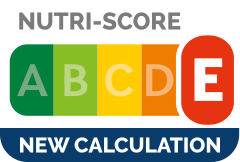 Bad nutritional quality
 Ultra-processed food and drink products
 Very high environmental impact
Health
Nutrition
Label
Bad nutritional qualityNutrient levels
Fat in moderate quantity (20%)
Saturated fat in high quantity (10%)
Sugars in low quantity (0%)
Salt in high quantity (4%)
Nutrition facts
| Nutrition facts | As sold for 100 g / 100 ml |
|---|---|
| Energy | 1,674 kcal (400 kcal) |
| FAT | 20 g |
| Saturated fat | 10 g |
| Trans fat | 0 g |
| Cholesterol | 0.1 mg |
| Carbohydrates | 40 g |
| Sugars | 0 g |
| Dietary fiber | 0 g |
| Proteins | 20 g |
| Salt | 4 mg |
| Sodium | 1.6 mg |
| Vitamins | |
| Vitamin A | 0 IU |
| Vitamin C | 0 mg |
| Minerals | |
| Calcium | 0.8 mg |
| Iron | 0 mg |
| Fruits, vegetables and legumes | ? |
Nutrition facts (Detailed data)
| Nutrition facts | As sold for 100 g / 100 ml | As sold Per serving (legacy) |
|---|---|---|
| Energy | 1,674 kcal (400 kcal) | 83.7 kcal (20 kcal) |
| FAT | 20 g | 1 g |
| Saturated fat | 10 g | 0.5 g |
| Trans fat | 0 g | 0 g |
| Cholesterol | 0.1 mg | 0.01 mg |
| Carbohydrates | 40 g | 2 g |
| Sugars | 0 g | 0 g |
| Dietary fiber | 0 g | 0 g |
| Proteins | 20 g | 1 g |
| Salt | 4 mg | 0.2 mg |
| Sodium | 1.6 mg | 0.08 mg |
| Vitamins | ||
| Vitamin A | 0 IU | 0 IU |
| Vitamin C | 0 mg | 0 mg |
| Minerals | ||
| Calcium | 0.8 mg | 0.04 mg |
| Iron | 0 mg | 0 mg |
| Fruits, vegetables and legumes | ? | ? |
Serving size
Estimated Activity Time
Approximate time needed to burn the energy in 100 g / 100 ml: 7,004 kJ. Reference adult weight: 70 kg. Energy density: High.
Ingredients
Ingredients list
Ingredient information
Allergens
Ingredients analysis
Contains ingredients containing palm oil.
Contains non-vegan ingredients.
Unrecognized: en:contains-less-than-2-of-each-of-the-following
Vegetarian status unknown
Unrecognized: en:contains-less-than-2-of-each-of-the-following
Food Processing
NOVA group
Ultra-processed food and drink productsElements that indicate the product is in NOVA group 4
How NOVA works
Additives
E202 - Potassium sorbatePreservative
Potassium sorbate (E202) is a synthetic food preservative commonly used to extend the shelf life of various food products.
It works by inhibiting the growth of molds, yeast, and some bacteria, preventing spoilage. When added to foods, it helps maintain their freshness and quality.
Some studies have shown that when combined with nitrites, potassium sorbate have genotoxic activity in vitro. However, potassium sorbate is generally recognized as safe (GRAS) by regulatory authorities.
E270 - Lactic acid
LACTIC ACID is an organic compound with the formula CH3CH(OH)CO2H. In the form of its conjugate base called lactate (this is thus different and kept as a separate ingredient). Lactic acid is chiral, consisting of two optical isomers. One is known as L-(+)-lactic acid or (S)-lactic acid and the other, its mirror image, is D-(−)-lactic acid or (R)-lactic acid in food the L-variant is used
E460 - CelluloseCarrierEmulsifierHumectantStabiliserThickener
CELLULOSE is an organic compound with the formula (C6H10O5)n, a polysaccharide consisting of a linear chain of several hundred to many thousands of linked D-glucose units. Cellulose is used as emulsifier, thickener and stabilizer in processed foods. Cellulose powder is, for example, used in processed cheese to prevent caking inside the package.
E460ii - Powdered celluloseCarrierEmulsifierHumectantStabiliserThickener
No additive description is available yet.
Environment
Green-Score, origins bonus, and transportation impact are shown for Worldwide .
Green Score
Overall grade
Very high environmental impactAbout Green-Score
Current scope
Life cycle analysis
Average impact of the category
 Camembert cheese, from cow's milk • Score: 55/100
Life-cycle reference
Overall environmental impact by stage (PEF)
The overall environmental impact figure (PEF) comes from ADEME's Agribalyse database, for the category: Camembert cheese, from cow's milk. Source: ADEME Agribalyse Database.
| Stage | Impact |
|---|---|
| Agriculture | 84.1 % |
| Processing | 5.7 % |
| Packaging | 4.5 % |
| Transportation | 3.4 % |
| Distribution | 1.8 % |
| Consumption | 0.5 % |
Bonuses and maluses
Declared origins
Threatened species risk
Packaging impact
Green-Score for this product
Green-Score for this product
Final score: 25/100Final score breakdown
Carbon footprint
Carbon footprint
Climate impact by stage (CO2e)
The carbon emission figure comes from ADEME's Agribalyse database, for the category: Camembert cheese, from cow's milk. Source: ADEME Agribalyse Database.
| Stage | Impact |
|---|---|
| Agriculture | 85.0 % |
| Processing | 5.1 % |
| Packaging | 5.1 % |
| Transportation | 4.1 % |
| Distribution | 0.7 % |
| Consumption | 0.1 % |
Packaging
Packaging impact
Data precision
Transportation
Declared origins
Data Source
Data presented on this page is sourced from the Open Food Facts database. This platform does not alter the original dataset; its purpose is solely to enhance data visualization and user accessibility.
Product added on March 9, 2017 at 12:19:49 PM UTC by usda-ndb-import .
Last edit on April 22, 2020 at 5:49:49 PM UTC by org-database-usda .
Product page also edited by org-database-usda, usda-ndb-import.
Source List
- usda-ndb
- database-usda