

Pancakes & Sausage on a Stick Blueberry
Health
Nutrition
Nutri-Score
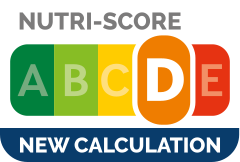 Lower nutritional quality
Nutri-Score data warning
Nutrient levels
Fat in moderate quantity (9%)
Saturated fat in moderate quantity (2.5%)
Sugars in moderate quantity (9%)
Salt in moderate quantity (1.18%)
Nutrition label

Nutrition facts
| Nutrition facts | As sold for 100 g / 100 ml | Compared to: Meals |
|---|---|---|
| Energy | ~ 851 kJ (271 kcal) | 676.934 kJ (163 kcal) (+26%) |
| Fat | 9 g | 6.487 g (+39%) |
| Saturated fat | 2.5 g | 2.086 g (+20%) |
| Trans fat | ? | 0.025 g |
| Cholesterol | 0.02 g | 15.603 mg (+28%) |
| Carbohydrates | 24 g | 16.207 g (+48%) |
| Sugars | 9 g | 2.304 g (+291%) |
| Added sugars | 14.2857142857143 g | 0.49 g (+2815%) |
| Starch | 0 g | 9.661 g (-100%) |
| Dietary fiber | 1 g | ? |
| Proteins | 6 g | 6.769 g (-11%) |
| Salt | 1.175 g | 0.948 g (+24%) |
| Sodium | 0.47 g | 0.379 g (+24%) |
| Vitamin D | 0.000008 g | 0.19 µg (+4111%) |
| Potassium | 0.07 g | 216.358 mg (-68%) |
| Calcium | 0.02 g | 46.123 mg (-57%) |
| Iron | 0.00171428571428571 g | 0.884 mg (+94%) |
| Fruits, vegetables and legumes | ~ 0 % | ? |
| Choline | 0 g | 0 g |
Nutrition facts (Detailed data)
| Nutrition facts | As sold for 100 g / 100 ml | As sold Per 100 g (packaging) | As sold Per serving (71 g) (packaging) | As sold Per 100 g (estimate) |
|---|---|---|---|---|
| Energy | ~ 851 kJ (271 kcal) | ? (271 kcal) | ? (190 kcal) | ? |
| Fat | 9 g | 9 g | 9 g | ? |
| Saturated fat | 2.5 g | 2.5 g | 4 g | ? |
| Trans fat | ? | ? | ? | ? |
| Cholesterol | 0.02 g | 0.02 g | 0.025 g | ? |
| Carbohydrates | 24 g | 24 g | 24 g | ? |
| Sugars | 9 g | 9 g | 9 g | ? |
| Added sugars | 14.2857142857143 g | 14.2857142857143 g | ? | ~ 8.47330729166666 g |
| Starch | 0 g | 0 g | ? | ? |
| Dietary fiber | 1 g | 1 g | 1 g | ? |
| Proteins | 6 g | 6 g | 6 g | ? |
| Salt | 1.175 g | 1.175 g | ? | ? |
| Sodium | 0.47 g | 0.47 g | 0.41 g | ? |
| Vitamin D | 0.000008 g | 0.000008 g | ? | ? |
| Potassium | 0.07 g | 0.07 g | 0.06 g | ? |
| Calcium | 0.02 g | 0.02 g | 0.02 g | ? |
| Iron | 0.00171428571428571 g | 1.71428571428571 mg | 0.0006 g | ? |
| Fruits, vegetables and legumes | ~ 0 % | ? | ? | ~ 0 % |
| Choline | 0 g | 0 g | ? | ? |
Serving size
Ingredients
Ingredients image

Ingredients list
Ingredient information
Added sugars
Allergens
Ingredients analysis
Palm oil content unknown
Contains non-vegan ingredients.
Unrecognized: en:to-promote-color-retention
Contains non-vegetarian ingredients.
Unrecognized: en:to-promote-color-retention
Food Processing
NOVA group
 Ultra-processed food and drink products
Elements that indicate the product is in NOVA group 4
How NOVA works
Additives
E150c - Ammonia caramel EFSA overexposure risk: moderateColour
No additive description is available yet.
E250 - Sodium nitrite EFSA overexposure risk: highPreservative
Sodium nitrite (E250) is a salt used for curing and preserving meat products.
It plays a critical role in preventing the growth of Clostridium botulinum, the bacterium responsible for botulism, in cured meats like bacon, ham, and sausages. It also provides the characteristic pink color and flavor.
However, nitrites can react with amines in the stomach to form nitrosamines, which are potent carcinogens. High intake of processed meats containing nitrites is associated with an increased risk of colorectal cancer. Regulatory bodies have set strict limits on its use in food.
E262 - Sodium acetatesPreservativeSequestrant
SODIUM ACETATE, also abbreviated NaOAc,[8] is the sodium salt of acetic acid.
E262ii - Sodium diacetatePreservativeSequestrant
No additive description is available yet.
E320 - Butylated hydroxyanisole (bha)Antioxidant
Butylated hydroxyanisole (BHA) is an antioxidant consisting of a mixture of two isomeric organic compounds, 2-tert-butyl-4-hydroxyanisole and 3-tert-butyl-4-hydroxyanisole. It is prepared from 4-methoxyphenol and isobutylene. It is a waxy solid used as a food additive with the E number E320. The primary use for BHA is as an antioxidant and preservative in food, food packaging, animal feed, cosmetics, rubber, and petroleum products. BHA also is commonly used in medicines, such as isotretinoin, lovastatin, and simvastatin, among others.
E321 - Butylated hydroxytolueneAntioxidant
Butylated hydroxytoluene (BHT), also known as dibutylhydroxytoluene, is a lipophilic organic compound, chemically a derivative of phenol, that is useful for its antioxidant properties. European and U.S. regulations allow small amounts to be used as a food additive. In addition to this use, BHT is widely used to prevent oxidation in fluids (e.g. fuel, oil) and other materials where free radicals must be controlled.
E322 - LecithinsAntioxidantEmulsifier
Lecithins are natural compounds commonly used in the food industry as emulsifiers and stabilizers.
Extracted from sources like soybeans and eggs, lecithins consist of phospholipids that enhance the mixing of oil and water, ensuring smooth textures in various products like chocolates, dressings, and baked goods.
They do not present any known health risks.
E322i - LecithinAntioxidantEmulsifier
Lecithins are natural compounds commonly used in the food industry as emulsifiers and stabilizers.
Extracted from sources like soybeans and eggs, lecithins consist of phospholipids that enhance the mixing of oil and water, ensuring smooth textures in various products like chocolates, dressings, and baked goods.
They do not present any known health risks.
E330 - Citric acidAntioxidantSequestrant
Citric acid is a natural organic acid found in citrus fruits such as lemons, oranges, and limes.
It is widely used in the food industry as a flavor enhancer, acidulant, and preservative due to its tart and refreshing taste.
Citric acid is safe for consumption when used in moderation and is considered a generally recognized as safe (GRAS) food additive by regulatory agencies worldwide.
E341 - Calcium phosphates EFSA overexposure risk: highEmulsifierHumectantSequestrantStabiliserThickener
Calcium phosphate is a family of materials and minerals containing calcium ions (Ca2+) together with inorganic phosphate anions. Some so-called calcium phosphates contain oxide and hydroxide as well. They are white solids of nutritious value.
E341i - Monocalcium phosphateEmulsifierHumectantSequestrantStabiliserThickener
No additive description is available yet.
E481 - Sodium stearoyl-2-lactylate EFSA overexposure risk: highEmulsifierStabiliser
Sodium stearoyl-2-lactylate (sodium stearoyl lactylate or SSL) is a versatile, FDA approved food additive used to improve the mix tolerance and volume of processed foods. It is one type of a commercially available lactylate. SSL is non-toxic, biodegradable, and typically manufactured using biorenewable feedstocks. Because SSL is a safe and highly effective food additive, it is used in a wide variety of products ranging from baked goods and desserts to pet foods.As described by the Food Chemicals Codex 7th edition, SSL is a cream-colored powder or brittle solid. SSL is currently manufactured by the esterification of stearic acid with lactic acid and partially neutralized with either food-grade soda ash (sodium carbonate) or caustic soda (concentrated sodium hydroxide). Commercial grade SSL is a mixture of sodium salts of stearoyl lactylic acids and minor proportions of other sodium salts of related acids. The HLB for SSL is 10-12. SSL is slightly hygroscopic, soluble in ethanol and in hot oil or fat, and dispersible in warm water. These properties are the reason that SSL is an excellent emulsifier for fat-in-water emulsions and can also function as a humectant.
E500 - Sodium carbonatesStabiliserThickener
Sodium carbonates (E500) are compounds commonly used in food preparation as leavening agents, helping baked goods rise by releasing carbon dioxide when they interact with acids.
Often found in baking soda, they regulate the pH of food, preventing it from becoming too acidic or too alkaline. In the culinary world, sodium carbonates can also enhance the texture and structure of foods, such as noodles, by modifying the gluten network.
Generally recognized as safe, sodium carbonates are non-toxic when consumed in typical amounts found in food.
E500ii - Sodium hydrogen carbonateStabiliserThickener
Sodium hydrogen carbonate, also known as E500ii, is a food additive commonly used as a leavening agent.
When added to recipes, it releases carbon dioxide gas upon exposure to heat or acids, causing dough to rise and resulting in a light, fluffy texture in baked goods.
It is generally recognized as safe (GRAS) by regulatory authorities when used in appropriate quantities and poses no significant health risks when consumed in typical food applications.
E541 - Sodium aluminium phosphateEmulsifierStabiliserThickener
Sodium aluminium phosphate (SAlP) describes the inorganic compounds consisting of sodium salts of aluminium phosphates. The most common SAlP has the formulas NaH14Al3(PO4)8·4H2O and Na3H15Al2(PO4)8. These materials are prepared by combining alumina, phosphoric acid, and sodium hydroxide.In addition to the usual hydrate, an anhydrous SAlP is also known, Na3H15Al2(PO4)8 (CAS#10279-59-1), referred to as 8:2:3, reflecting the ratio of phosphate to aluminium to sodium. Additionally an SAlP of ill-defined stoichiometry is used (NaxAly(PO4)z (CAS# 7785-88-8).The acidic sodium aluminium phosphates are used as acids for baking powders for the chemical leavening of baked goods. Upon heating, SAlP combines with the baking soda to give carbon dioxide. Most of its action occurs at baking temperatures, rather than when the dough or batter is mixed at room temperature. SAlPs are advantageous because they impart a neutral flavor. As a food additive, it has the E number E541. Basic sodium aluminium phosphates are also known, e.g., Na15Al3(PO4)8. These species are useful in cheese making.
Environment
Green-Score, origins bonus, and transportation impact are shown for Worldwide .
Green Score
Overall grade
 Unknown environmental impact
About Green-Score
Current scope
Green-Score availability
Bonuses and maluses
Declared origins
Packaging impact
Packaging
Packaging impact
Packaging components
| Shape | Material | Recycling | Impact |
|---|---|---|---|
| BOX | Unknown | Unknown | High |
Declared packaging
Data precision
Transportation
Declared origins
Forest footprint
Forest footprint
Ingredients linked to forest pressure
| Ingredient | Type | Percent in product | Forest footprint |
|---|---|---|---|
| EGG | Oeufs Importés | 0.93 % | 0.00 |
Data Source
Product data comes from Open Food Facts. Food Benchmark also adds translations, category comparisons and explanatory calculations.
The database is licensed under ODbL 1.0, individual contents under DbCL 1.0, and product photos under CC BY-SA 3.0.
Product added on February 3, 2019 at 8:37:24 PM UTC by waistline-app .
Last edit on March 17, 2026 at 10:20:38 PM UTC by municorn-calorie-counter-app .
Product page also edited by ater, foodiq, foodless, inf, macrofactor, municorn-calorie-counter-app, org-database-usda, roboto-app, swipe-studio, waistline.90248b04-0e4a-49ad-ae87-a70ff2ab2eed, yuka.K79hEMe3HpF5PvHfz7IGgWC0MtnyAsEJA0Ynog.
Source List
- database-usda