

Saputo, stella, goat cheese
Health
Nutrition
Nutri-Score
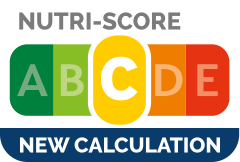 Average nutritional quality
Nutri-Score data warning
Nutrient levels
Fat in high quantity (21.4%)
Saturated fat in high quantity (14.3%)
Sugars in low quantity (3.57%)
Salt in moderate quantity (0.715%)
Nutrition facts
| Nutrition facts | As sold for 100 g / 100 ml | Compared to: Goat cheeses |
|---|---|---|
| Energy | 1197 kcal (286 kcal) | 1,238.119 kJ (298 kcal) |
| Energy from fat | 209 kcal | ? |
| Fat | 21.43 g | 24.246 g (-12%) |
| Saturated fat | 14.29 g | 16.67 g (-14%) |
| Trans fat | 0 g | 0.118 g (-100%) |
| Cholesterol | 0.089 mg | 9.431 mg (-99%) |
| Carbohydrates | 10.71 g | 1.748 g (+513%) |
| Sugars | 3.57 g | 0.988 g (+261%) |
| Dietary fiber | 0 g | ? |
| Proteins | 17.86 g | 17.782 g (~0%) |
| Salt | 0.715 mg | 1.325 g (-100%) |
| Sodium | 0.286 mg | 0.529 g (-100%) |
| Vitamin A | 0.0003213 IU | 12.494 µg |
| Vitamin C | 0 mg | ? |
| Calcium | 0.143 mg | 159.576 mg (-100%) |
| Iron | 0 mg | 0.069 mg (-100%) |
| Fruits, vegetables and legumes | ? | ? |
Nutrition facts (Detailed data)
| Nutrition facts | As sold for 100 g / 100 ml | As sold Per serving (legacy) |
|---|---|---|
| Energy | 1197 kcal (286 kcal) | 335 kcal (80 kcal) |
| Energy from fat | 209 kcal | 58.5 kcal |
| Fat | 21.43 g | 6 g |
| Saturated fat | 14.29 g | 4 g |
| Trans fat | 0 g | 0 g |
| Cholesterol | 0.089 mg | 0.0249 mg |
| Carbohydrates | 10.71 g | 3 g |
| Sugars | 3.57 g | 1 g |
| Dietary fiber | 0 g | 0 g |
| Proteins | 17.86 g | 5 g |
| Salt | 0.715 mg | 0.2 mg |
| Sodium | 0.286 mg | 0.0801 mg |
| Vitamin A | 0.0003213 IU | 0.00009 IU |
| Vitamin C | 0 mg | 0 mg |
| Calcium | 0.143 mg | 0.04 mg |
| Iron | 0 mg | 0 mg |
| Fruits, vegetables and legumes | ? | ? |
Serving size
Ingredients
Ingredients list
Ingredient information
Allergens
Ingredients analysis
Palm oil content unknown
Unrecognized: en:goat-cheese-crumbles
Contains non-vegan ingredients.
Unrecognized: en:goat-cheese-crumbles
Vegetarian status unknown
Unrecognized: en:goat-cheese-crumbles
Food Processing
NOVA group
 Ultra-processed food and drink products
Elements that indicate the product is in NOVA group 4
How NOVA works
Additives
E235 - NatamycinPreservative
NATAMYCIN is used in the food industry as a preservative.
E460 - CelluloseCarrierEmulsifierHumectantStabiliserThickener
CELLULOSE is an organic compound with the formula (C6H10O5)n, a polysaccharide consisting of a linear chain of several hundred to many thousands of linked D-glucose units. Cellulose is used as emulsifier, thickener and stabilizer in processed foods. Cellulose powder is, for example, used in processed cheese to prevent caking inside the package.
E460ii - Powdered celluloseCarrierEmulsifierHumectantStabiliserThickener
No additive description is available yet.
Environment
Green-Score, origins bonus, and transportation impact are shown for Worldwide .
Green Score
Overall grade
 Very high environmental impact
About Green-Score
Current scope
Life cycle analysis
Average impact of the category
 Soft-ripened cheese, from goat's milk, from pasteurised milk • Score: 28/100
Life-cycle reference
Overall environmental impact by stage (PEF)
The overall environmental impact figure (PEF) comes from ADEME's Agribalyse database, for the category: Soft-ripened cheese, from goat's milk, from pasteurised milk. Source: ADEME Agribalyse Database.
| Stage | Impact |
|---|---|
| Agriculture | 92.8 % |
| Processing | 2.8 % |
| Packaging | 1.9 % |
| Transportation | 1.5 % |
| Distribution | 0.8 % |
| Consumption | 0.2 % |
Bonuses and maluses
Declared origins
Packaging impact
Green-Score for this product
Green-Score for this product
Final score: 8/100Final score breakdown
Carbon footprint
Carbon footprint
Climate impact by stage (CO2e)
The carbon emission figure comes from ADEME's Agribalyse database, for the category: Soft-ripened cheese, from goat's milk, from pasteurised milk. Source: ADEME Agribalyse Database.
| Stage | Impact |
|---|---|
| Agriculture | 89.3 % |
| Processing | 3.9 % |
| Packaging | 3.5 % |
| Transportation | 2.8 % |
| Distribution | 0.5 % |
| Consumption | 0.1 % |
Packaging
Packaging impact
Declared packaging
Data precision
Transportation
Declared origins
Data Source
Product data comes from Open Food Facts. Food Benchmark also adds translations, category comparisons and explanatory calculations.
The database is licensed under ODbL 1.0, individual contents under DbCL 1.0, and product photos under CC BY-SA 3.0.
Product added on July 18, 2015 at 2:56:23 AM UTC by bdwyer .
Last edit on April 22, 2020 at 6:29:51 PM UTC by org-database-usda .
Product page also edited by bdwyer, teolemon, usda-ndb-import, org-database-usda.
Source List
- usda-ndb
- database-usda