

Garden Spinach Herb Wrap
Labels
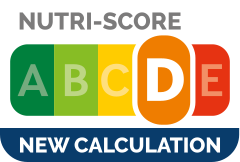 Poor nutritional quality
 Ultra-processed food and drink products
 Not computed
Health
Nutrition
Serving Size
Nutri-Score label
Poor nutritional qualityNutrient levels for 100 g
Fat in moderate quantity (?)
What you need to know
A high consumption of fat, especially saturated fats, can raise cholesterol, which increases the risk of heart diseases.
Recommendation: Limit the consumption of fat and saturated fat
Choose products with lower fat and saturated fat content.
Saturated fat in moderate quantity (?)
What you need to know
A high consumption of fat, especially saturated fats, can raise cholesterol, which increases the risk of heart diseases.
Recommendation: Limit the consumption of fat and saturated fat
Choose products with lower fat and saturated fat content.
Sugars in low quantity (?)
What you need to know
A high consumption of sugar can cause weight gain and tooth decay. It also augments the risk of type 2 diabetes and cardio-vascular diseases.
Recommendation: Limit the consumption of sugar and sugary drinks
Sugary drinks should be limited as much as possible. Choose products with lower sugar content.
Salt in high quantity (?)
What you need to know
A high consumption of salt (or sodium) can cause raised blood pressure, which can increase the risk of heart disease and stroke.
Recommendation: Limit the consumption of salt and salted food
Reduce the quantity of salt used when cooking. Limit the consumption of salty snacks.
Nutrition Facts
| Nutrition Facts | As sold for 100 g / 100 ml | Per serving 1 portion (71 g) |
|---|---|---|
| Energy | ? | ? |
| Fat | ? | ? |
| Saturated fat | ? | ? |
| Carbohydrates | ? | ? |
| Sugars | ? | ? |
| Dietary fiber | ? | ? |
| Proteins | ? | ? |
| Salt | ? | ? |
| Sodium | ? | ? |
Ingredients
Ingredients List
Ingredient Information
Food Processing
NOVA Group label
Ultra-processed food and drink productsElements that indicate the product is in the NOVA group 4:
- Additives: E102 - Tartrazine
- Additives: E133 - Brilliant blue FCF
- Additives: E450 - Diphosphates
- Ingredients: Flavouring
The NOVA classification assigns food products into 4 groups based on their degree of processing:
- Unprocessed or minimally processed foods
- Processed culinary ingredients
- Processed foods
- Ultra-processed food and drink products
Ingredients analysis
Palm oil free
No ingredients containing palm oil.
Vegan
Vegan status unknown
Unrecognized ingredients: en:interesterified
Vegetarian
Vegetarian status unknown
Unrecognized ingredients: en:interesterified
Additives
E102 - TartrazineColour
Tartrazine (E102) is a synthetic lemon-yellow azo dye used as a food coloring.
It is found in a wide range of products such as soft drinks, desserts, candies, and snack foods to give them a vibrant yellow appearance.
While approved by many regulatory agencies, tartrazine has been linked to allergic reactions, such as hives, in a small portion of the population. Some studies have also suggested a link to increased hyperactivity in children, particularly when consumed with other additives like benzoates.
E133 - Brilliant blue FCFColour
BRILLIANT BLUE FCF (Blue 1) is an organic compound classified as a blue triarylmethane dye, reflecting its chemical structure. Known under various commercial names, it is a colorant for foods and other substances.
E200 - Sorbic acidPreservative
SORBIC ACID, or 2,4-hexadienoic acid, is a natural organic compound used as a food preservative. It has the chemical formula CH3(CH)4CO2H.
E282 - calcium propionatePreservative
CALCIUM PROPIONATE has the formula Ca(C2H5COO)2. Calcium propionate is used as a preservative in a wide variety of products, including but not limited to:bread, other baked goods, processed meat, whey, and other dairy products.
E297 - Fumaric acid
Fumaric acid or trans-butenedioic acid is the chemical compound with the formula HO2CCH=CHCO2H. It is produced in eukaryotic organisms from succinate in complex 2 of the electron transport chain via the enzyme succinate dehydrogenase. It is one of two isomeric unsaturated dicarboxylic acids, the other being maleic acid. In fumaric acid the carboxylic acid groups are trans (E) and in maleic acid they are cis (Z). Fumaric acid has a fruit-like taste. The salts and esters are known as fumarates. Fumarate can also refer to the C4H2O2−4 ion (in solution).
E450 - DiphosphatesEmulsifierHumectantSequestrantStabiliserThickener
Diphosphates (E450) are food additives often utilized to modify the texture of products, acting as leavening agents in baking and preventing the coagulation of canned food.
These salts can stabilize whipped cream and are also found in powdered products to maintain their flow properties. They are commonly present in baked goods, processed meats, and soft drinks.
Derived from phosphoric acid, they're part of our daily phosphate intake, which often surpasses recommended levels due to the prevalence of phosphates in processed foods and drinks.
Excessive phosphate consumption is linked to health issues, such as impaired kidney function and weakened bone health. Though diphosphates are generally regarded as safe when consumed within established acceptable daily intakes, it's imperative to monitor overall phosphate consumption to maintain optimal health.
E450i - Disodium diphosphateEmulsifierHumectantSequestrantStabiliserThickener
No additive description is available yet.
E500 - Sodium carbonatesStabiliserThickener
Sodium carbonates (E500) are compounds commonly used in food preparation as leavening agents, helping baked goods rise by releasing carbon dioxide when they interact with acids.
Often found in baking soda, they regulate the pH of food, preventing it from becoming too acidic or too alkaline. In the culinary world, sodium carbonates can also enhance the texture and structure of foods, such as noodles, by modifying the gluten network.
Generally recognized as safe, sodium carbonates are non-toxic when consumed in typical amounts found in food.
E500ii - Sodium hydrogen carbonateStabiliserThickener
Sodium hydrogen carbonate, also known as E500ii, is a food additive commonly used as a leavening agent.
When added to recipes, it releases carbon dioxide gas upon exposure to heat or acids, causing dough to rise and resulting in a light, fluffy texture in baked goods.
It is generally recognized as safe (GRAS) by regulatory authorities when used in appropriate quantities and poses no significant health risks when consumed in typical food applications.
Environment
Environmental score label
Not computedCarbon footprint
No carbon footprint data is available for this product.
Packaging
No packaging information provided.
Transportation and origins
Origins of ingredients
No origin information provided.
Manufacturing places
No manufacturing place information provided.
Environmental labels
No environmental labels identified.
Data Source
Product added on March 9, 2017 at 12:56:34 PM UTC by usda-ndb-import .
Last edit on March 6, 2026 at 3:12:44 AM UTC by macrofactor .
Product page also edited by foodless, goobersmash, inf, kiliweb, macrofactor, municorn-calorie-counter-app, new-nutrition-bot, org-database-usda, roboto-app, usda-ndb-import, workspace99, yuka.L48fNtiVO9QNOciJz4ktxha8NczuL-FoN2Uiow, yuka.sY2b0xO6T85zoF3NwEKvlhNKaoHfvS3kCQ3ttUqB_YmuFpDRYPJb3KH3Kqg.
Source List
- usda-ndb
- database-usda