
Multi-Grain Bread
Labels
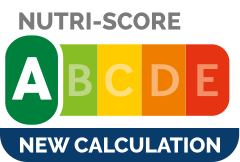 Very good nutritional quality
 Ultra-processed food and drink products
 Not computed
Health
Nutrition
Label
Very good nutritional qualityNutrient levels
Fat in moderate quantity (3.49%)
Saturated fat in low quantity (0%)
Sugars in moderate quantity (9.3%)
Salt in moderate quantity (0.873%)
Nutrition facts
| Nutrition facts | As sold for 100 g / 100 ml |
|---|---|
| Energy | ~ 1,191.91 kJ (256 kcal) |
| FAT | 3.49 g |
| Saturated fat | 0 g |
| Monounsaturated FAT | 0 g |
| Polyunsaturated FAT | 2.33 g |
| Trans fat | 0 g |
| Cholesterol | 0 g |
| Carbohydrates | 46.51 g |
| Sugars | 9.3 g |
| Dietary fiber | 9.3 g |
| Proteins | 11.63 g |
| Salt | 0.87 g |
| Sodium | 0.35 g |
| Vitamins | |
| Vitamin A | 0 g |
| Vitamin C | 0 g |
| Vitamin PP | 0 g |
| Minerals | |
| Calcium | 0.09 g |
| Iron | 0 g |
| Fruits, vegetables and legumes | ~ 0 % |
Nutrition facts (Detailed data)
| Nutrition facts | As sold for 100 g / 100 ml | As sold Per 100 g (packaging) | As sold Per 100 g (estimate) |
|---|---|---|---|
| Energy | ~ 1,191.91 kJ (256 kcal) | ? (256 kcal) | ? |
| FAT | 3.49 g | 3.49 g | ? |
| Saturated fat | 0 g | 0 g | ? |
| Monounsaturated FAT | 0 g | 0 g | ? |
| Polyunsaturated FAT | 2.33 g | 2.33 g | ? |
| Trans fat | 0 g | 0 g | ? |
| Cholesterol | 0 g | 0 g | ? |
| Carbohydrates | 46.51 g | 46.51 g | ? |
| Sugars | 9.3 g | 9.3 g | ? |
| Added sugars | ~ 4.66 g | ? | ~ 4.66 g |
| Dietary fiber | 9.3 g | 9.3 g | ? |
| Proteins | 11.63 g | 11.63 g | ? |
| Salt | 0.87 g | 0.87 g | ? |
| Sodium | 0.35 g | 0.35 g | ? |
| Vitamins | |||
| Vitamin A | 0 g | 0 g | ? |
| Vitamin C | 0 g | 0 g | ? |
| Vitamin PP | 0 g | 0 g | ? |
| Minerals | |||
| Calcium | 0.09 g | 0.09 g | ? |
| Iron | 0 g | 0 g | ? |
| Fruits, vegetables and legumes | ~ 0 % | ? | ~ 0 % |
Serving size
Estimated Activity Time
Approximate time needed to burn the energy in 100 g / 100 ml: 1,192 kJ. Reference adult weight: 70 kg. Energy density: Moderate.
Ingredients
Ingredients list
Ingredient information
Allergens
Ingredients analysis
Palm oil content unknown
Contains non-vegan ingredients.
Unrecognized: en:cellulose-fiber, en:black, en:filberts
Vegetarian status unknown
Unrecognized: en:cellulose-fiber, en:black, en:filberts
Food Processing
NOVA group
Ultra-processed food and drink productsElements that indicate the product is in NOVA group 4
How NOVA works
Additives
E282 - calcium propionatePreservative
CALCIUM PROPIONATE has the formula Ca(C2H5COO)2. Calcium propionate is used as a preservative in a wide variety of products, including but not limited to:bread, other baked goods, processed meat, whey, and other dairy products.
E322 - LecithinsAntioxidantEmulsifier
Lecithins are natural compounds commonly used in the food industry as emulsifiers and stabilizers.
Extracted from sources like soybeans and eggs, lecithins consist of phospholipids that enhance the mixing of oil and water, ensuring smooth textures in various products like chocolates, dressings, and baked goods.
They do not present any known health risks.
E322i - LecithinAntioxidantEmulsifier
Lecithins are natural compounds commonly used in the food industry as emulsifiers and stabilizers.
Extracted from sources like soybeans and eggs, lecithins consist of phospholipids that enhance the mixing of oil and water, ensuring smooth textures in various products like chocolates, dressings, and baked goods.
They do not present any known health risks.
E330 - Citric acidAntioxidantSequestrant
Citric acid is a natural organic acid found in citrus fruits such as lemons, oranges, and limes.
It is widely used in the food industry as a flavor enhancer, acidulant, and preservative due to its tart and refreshing taste.
Citric acid is safe for consumption when used in moderation and is considered a generally recognized as safe (GRAS) food additive by regulatory agencies worldwide.
E471 - Mono- and diglycerides of fatty acidsEmulsifierStabiliser
Mono- and diglycerides of fatty acids (E471), are food additives commonly used as emulsifiers in various processed foods.
These compounds consist of glycerol molecules linked to one or two fatty acid chains, which help stabilize and blend water and oil-based ingredients. E471 enhances the texture and shelf life of products like margarine, baked goods, and ice cream, ensuring a smooth and consistent texture.
It is generally considered safe for consumption within established regulatory limits.
E472e - Mono- and diacetyltartaric acid esters of mono- and diglycerides of fatty acidsEmulsifierSequestrantStabiliser
No additive description is available yet.
E481 - Sodium stearoyl-2-lactylateEmulsifierStabiliser
Sodium stearoyl-2-lactylate (sodium stearoyl lactylate or SSL) is a versatile, FDA approved food additive used to improve the mix tolerance and volume of processed foods. It is one type of a commercially available lactylate. SSL is non-toxic, biodegradable, and typically manufactured using biorenewable feedstocks. Because SSL is a safe and highly effective food additive, it is used in a wide variety of products ranging from baked goods and desserts to pet foods.As described by the Food Chemicals Codex 7th edition, SSL is a cream-colored powder or brittle solid. SSL is currently manufactured by the esterification of stearic acid with lactic acid and partially neutralized with either food-grade soda ash (sodium carbonate) or caustic soda (concentrated sodium hydroxide). Commercial grade SSL is a mixture of sodium salts of stearoyl lactylic acids and minor proportions of other sodium salts of related acids. The HLB for SSL is 10-12. SSL is slightly hygroscopic, soluble in ethanol and in hot oil or fat, and dispersible in warm water. These properties are the reason that SSL is an excellent emulsifier for fat-in-water emulsions and can also function as a humectant.
Environment
Environmental score label
Not computedCarbon footprint
No carbon footprint data is available for this product.
Packaging
No packaging information provided.
Transportation and origins
Origins of ingredients
No origin information provided.
Manufacturing places
No manufacturing place information provided.
Environmental labels
No environmental labels identified.
Data Source
Data presented on this page is sourced from the Open Food Facts database. This platform does not alter the original dataset; its purpose is solely to enhance data visualization and user accessibility.
Product added on March 9, 2017 at 9:55:25 PM UTC by usda-ndb-import .
Last edit on February 26, 2026 at 6:07:18 PM UTC by new-nutrition-bot .
Product page also edited by new-nutrition-bot, org-database-usda, usda-ndb-import.
Source List
- usda-ndb
- database-usda