
Ginger Evans, Premium Muffin Mix, Banana Nut
Labels
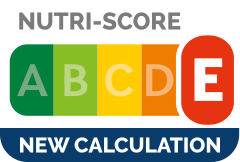 Bad nutritional quality
 Ultra-processed food and drink products
 Green-Score not computed
Health
Nutrition
Label
Bad nutritional qualityNutrient levels
Fat in moderate quantity (14.3%)
Saturated fat in moderate quantity (2.86%)
Sugars in high quantity (37.1%)
Salt in moderate quantity (1.43%)
Nutrition facts
| Nutrition facts | As sold for 100 g / 100 ml |
|---|---|
| Energy | 1,795 kcal (429 kcal) |
| FAT | 14.29 g |
| Saturated fat | 2.86 g |
| Monounsaturated FAT | 4.29 g |
| Polyunsaturated FAT | 5.71 g |
| Trans fat | 0 g |
| Cholesterol | 0 mg |
| Carbohydrates | 68.57 g |
| Sugars | 37.14 g |
| Dietary fiber | 2.9 g |
| Proteins | 5.71 g |
| Salt | 1.43 mg |
| Sodium | 0.57 mg |
| Vitamins | |
| Vitamin A | 0 IU |
| Vitamin C | 0 mg |
| Minerals | |
| Potassium | 0.16 mg |
| Calcium | 0 mg |
| Iron | 0 mg |
| Fruits, vegetables and legumes | ? |
Nutrition facts (Detailed data)
| Nutrition facts | As sold for 100 g / 100 ml | As sold Per serving (legacy) |
|---|---|---|
| Energy | 1,795 kcal (429 kcal) | 628 kcal (150 kcal) |
| FAT | 14.29 g | 5 g |
| Saturated fat | 2.86 g | 1 g |
| Monounsaturated FAT | 4.29 g | 1.5 g |
| Polyunsaturated FAT | 5.71 g | 2 g |
| Trans fat | 0 g | 0 g |
| Cholesterol | 0 mg | 0 mg |
| Carbohydrates | 68.57 g | 24 g |
| Sugars | 37.14 g | 13 g |
| Dietary fiber | 2.9 g | 1.01 g |
| Proteins | 5.71 g | 2 g |
| Salt | 1.43 mg | 0.5 mg |
| Sodium | 0.57 mg | 0.2 mg |
| Vitamins | ||
| Vitamin A | 0 IU | 0 IU |
| Vitamin C | 0 mg | 0 mg |
| Minerals | ||
| Potassium | 0.16 mg | 0.05 mg |
| Calcium | 0 mg | 0 mg |
| Iron | 0 mg | 0 mg |
| Fruits, vegetables and legumes | ? | ? |
Serving size
Estimated Activity Time
Approximate time needed to burn the energy in 100 g / 100 ml: 7,510 kJ. Reference adult weight: 70 kg. Energy density: High.
Ingredients
Ingredients list
Ingredient information
Allergens
Ingredients analysis
Contains ingredients containing palm oil.
Vegan status unknown
Unrecognized: en:iron, en:contains-one-and-more-of-the-following, en:walnuts-with-preservative, en:contains-2-and-less-of-each-of-the-following
Vegetarian status unknown
Unrecognized: en:iron, en:contains-one-and-more-of-the-following, en:walnuts-with-preservative, en:contains-2-and-less-of-each-of-the-following
Food Processing
NOVA group
Ultra-processed food and drink productsElements that indicate the product is in NOVA group 4
How NOVA works
Additives
E150 - Caramel
CARAMEL is a medium to dark-orange confectionery product made by heating a variety of sugars.
E319 - Tertiary-butylhydroquinone (tbhq)Antioxidant
tert-Butylhydroquinone (TBHQ, tertiary butylhydroquinone) is a synthetic aromatic organic compound which is a type of phenol. It is a derivative of hydroquinone, substituted with a tert-butyl group.
E321 - Butylated hydroxytolueneAntioxidant
Butylated hydroxytoluene (BHT), also known as dibutylhydroxytoluene, is a lipophilic organic compound, chemically a derivative of phenol, that is useful for its antioxidant properties. European and U.S. regulations allow small amounts to be used as a food additive. In addition to this use, BHT is widely used to prevent oxidation in fluids (e.g. fuel, oil) and other materials where free radicals must be controlled.
E415 - Xanthan gumEmulsifierStabiliserThickener
Xanthan gum (E415) is a natural polysaccharide derived from fermented sugars, often used in the food industry as a thickening and stabilizing agent.
This versatile food additive enhances texture and prevents ingredient separation in a wide range of products, including salad dressings, sauces, and gluten-free baked goods.
It is considered safe for consumption even at high intake amounts.
E466 - Sodium carboxy methyl celluloseEmulsifierHumectantStabiliserThickener
Carboxymethyl cellulose (CMC) or cellulose gum or tylose powder is a cellulose derivative with carboxymethyl groups (-CH2-COOH) bound to some of the hydroxyl groups of the glucopyranose monomers that make up the cellulose backbone. It is often used as its sodium salt, sodium carboxymethyl cellulose.
E500 - Sodium carbonatesStabiliserThickener
Sodium carbonates (E500) are compounds commonly used in food preparation as leavening agents, helping baked goods rise by releasing carbon dioxide when they interact with acids.
Often found in baking soda, they regulate the pH of food, preventing it from becoming too acidic or too alkaline. In the culinary world, sodium carbonates can also enhance the texture and structure of foods, such as noodles, by modifying the gluten network.
Generally recognized as safe, sodium carbonates are non-toxic when consumed in typical amounts found in food.
E500ii - Sodium hydrogen carbonateStabiliserThickener
Sodium hydrogen carbonate, also known as E500ii, is a food additive commonly used as a leavening agent.
When added to recipes, it releases carbon dioxide gas upon exposure to heat or acids, causing dough to rise and resulting in a light, fluffy texture in baked goods.
It is generally recognized as safe (GRAS) by regulatory authorities when used in appropriate quantities and poses no significant health risks when consumed in typical food applications.
E541 - Sodium aluminium phosphateEmulsifierStabiliserThickener
Sodium aluminium phosphate (SAlP) describes the inorganic compounds consisting of sodium salts of aluminium phosphates. The most common SAlP has the formulas NaH14Al3(PO4)8·4H2O and Na3H15Al2(PO4)8. These materials are prepared by combining alumina, phosphoric acid, and sodium hydroxide.In addition to the usual hydrate, an anhydrous SAlP is also known, Na3H15Al2(PO4)8 (CAS#10279-59-1), referred to as 8:2:3, reflecting the ratio of phosphate to aluminium to sodium. Additionally an SAlP of ill-defined stoichiometry is used (NaxAly(PO4)z (CAS# 7785-88-8).The acidic sodium aluminium phosphates are used as acids for baking powders for the chemical leavening of baked goods. Upon heating, SAlP combines with the baking soda to give carbon dioxide. Most of its action occurs at baking temperatures, rather than when the dough or batter is mixed at room temperature. SAlPs are advantageous because they impart a neutral flavor. As a food additive, it has the E number E541. Basic sodium aluminium phosphates are also known, e.g., Na15Al3(PO4)8. These species are useful in cheese making.
Environment
Green-Score, origins bonus, and transportation impact are shown for Worldwide .
Green Score
Overall grade
Unknown environmental impactAbout Green-Score
Current scope
Green-Score availability
Bonuses and maluses
Declared origins
Threatened species risk
Packaging impact
Packaging
Packaging impact
Data precision
Transportation
Declared origins
Data Source
Data presented on this page is sourced from the Open Food Facts database. This platform does not alter the original dataset; its purpose is solely to enhance data visualization and user accessibility.
Product added on March 9, 2017 at 4:57:04 PM UTC by usda-ndb-import .
Last edit on April 22, 2020 at 9:13:45 PM UTC by org-database-usda .
Product page also edited by usda-ndb-import, org-database-usda.
Source List
- usda-ndb
- database-usda