

Linguine with Pesto & Tomatoes
Health
Nutrition
Nutri-Score
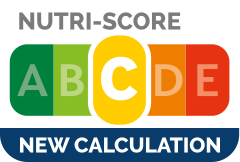 Average nutritional quality
Nutri-Score data warning
Nutrient levels
Fat in moderate quantity (8.06%)
Saturated fat in moderate quantity (1.61%)
Sugars in low quantity (0.806%)
Salt in moderate quantity (0.665%)
Nutrition label

Nutrition facts
| Nutrition facts | As sold for 100 g / 100 ml | Compared to: Milk chocolate biscuits |
|---|---|---|
| Energy | ~ 701.612903225806 kJ (161 kcal) | 2,100.114 kJ (502 kcal) (-67%) |
| Fat | 8.06451612903226 g | 24.29 g (-67%) |
| Saturated fat | 1.61290322580645 g | 13.454 g (-88%) |
| Cholesterol | 0.0241935483870968 g | 14.969 mg (+62%) |
| Carbohydrates | 17.741935483871 g | 62.76 g (-72%) |
| Sugars | 0.806451612903226 g | 34.875 g (-98%) |
| Added sugars | 0 g | 27.055 g (-100%) |
| Starch | 0 g | 22.952 g (-100%) |
| Dietary fiber | 2.41935483870968 g | ? |
| Proteins | 4.83870967741935 g | 6.711 g (-28%) |
| Salt | 0.665322580645161 g | 0.524 g (+27%) |
| Sodium | 0.266129032258065 g | 0.209 g (+27%) |
| Vitamin A | 0 g | 34.318 µg (-100%) |
| Vitamin E | 0 g | 1.823 mg (-100%) |
| Vitamin K | 0 g | 0 µg |
| Vitamin C | 0 g | ? |
| Potassium | 0.112903225806452 g | 300.276 mg (-62%) |
| Calcium | 0.0483870967741935 g | 100.399 mg (-52%) |
| Phosphorus | 0 g | 177.294 mg (-100%) |
| Iron | 0 g | 1.965 mg (-100%) |
| Magnesium | 0 g | 49.895 mg (-100%) |
| Zinc | 0 g | 1.182 mg (-100%) |
| Copper | 0 g | 0.204 mg (-100%) |
| Manganese | 0 g | 0.969 mg (-100%) |
| Selenium | 0 g | 8.354 µg (-100%) |
| Caffeine | 0 g | 0 mg |
| Fruits, vegetables and legumes | ~ 0 % | ? |
| Choline | 0 g | 0 g |
Nutrition facts (Detailed data)
| Nutrition facts | As sold for 100 g / 100 ml | As sold Per serving (124 g) (packaging) | As sold Per 100 g (estimate) |
|---|---|---|---|
| Energy | ~ 701.612903225806 kJ (161 kcal) | ? (200 kcal) | ~ 1561.0462324723 kJ (366 kcal) |
| Fat | 8.06451612903226 g | 10 g | ~ 2.72634171859078 g |
| Saturated fat | 1.61290322580645 g | 2 g | ~ 0.772556013024372 g |
| Cholesterol | 0.0241935483870968 g | 0.03 g | ~ 0.00027467379362687 g |
| Carbohydrates | 17.741935483871 g | 22 g | ~ 92.7819779537035 g |
| Sugars | 0.806451612903226 g | 1 g | ~ 88.0954104713772 g |
| Added sugars | 0 g | 0 g | ~ 88.567104505456 g |
| Starch | 0 g | 0 g | ~ 4.67878311820652 g |
| Dietary fiber | 2.41935483870968 g | 3 g | ~ 0.0659476902173912 g |
| Proteins | 4.83870967741935 g | 6 g | ~ 0.574719072424849 g |
| Salt | 0.665322580645161 g | 0.825 g | ~ 0.0101222953630531 g |
| Sodium | 0.266129032258065 g | 0.33 g | ~ 0.00401363487160726 g |
| Vitamin A | 0 g | 0 g | ~ 0.00000047919318489407 g |
| Vitamin E | 0 g | 0 g | ~ 0.000264503580176312 g |
| Vitamin K | 0 g | 0 g | ? |
| Vitamin C | 0 g | 0 g | ~ 0.0000576797817064371 g |
| Potassium | 0.112903225806452 g | 0.14 g | ~ 0.0261725460964701 g |
| Calcium | 0.0483870967741935 g | 0.06 g | ~ 0.0107089139415907 g |
| Phosphorus | 0 g | 0 g | ~ 0.0116331103780996 g |
| Iron | 0 g | 0 g | ~ 0.000164885372576506 g |
| Magnesium | 0 g | 0 g | ~ 0.00387890032478001 g |
| Zinc | 0 g | 0 g | ~ 0.000122664935899818 g |
| Copper | 0 g | 0 g | ~ 0.0000167991734794948 g |
| Manganese | 0 g | 0 g | ~ 0.000066048795525924 g |
| Selenium | 0 g | 0 g | ~ 0.00000459476327315621 g |
| Caffeine | 0 g | 0 g | ? |
| Fruits, vegetables and legumes | ~ 0 % | ? | ~ 0 % |
| Choline | 0 g | 0 g | ? |
Serving size
Ingredients
Ingredients image

Ingredients list
Ingredient information
Added sugars
Allergens
Traces
Ingredients analysis
Contains ingredients containing palm oil.
Contains non-vegan ingredients.
Unrecognized: fr:acide-pantothenique-riboflavine, fr:glycerol-beurre, fr:huile-de-colza-sel
No non-vegetarian ingredients.
Unrecognized: fr:acide-pantothenique-riboflavine, fr:glycerol-beurre, fr:huile-de-colza-sel
Food Processing
NOVA group
 Ultra-processed food and drink products
Elements that indicate the product is in NOVA group 4
How NOVA works
Additives
E322 - LecithinsAntioxidantEmulsifier
Lecithins are natural compounds commonly used in the food industry as emulsifiers and stabilizers.
Extracted from sources like soybeans and eggs, lecithins consist of phospholipids that enhance the mixing of oil and water, ensuring smooth textures in various products like chocolates, dressings, and baked goods.
They do not present any known health risks.
E322i - LecithinAntioxidantEmulsifier
Lecithins are natural compounds commonly used in the food industry as emulsifiers and stabilizers.
Extracted from sources like soybeans and eggs, lecithins consist of phospholipids that enhance the mixing of oil and water, ensuring smooth textures in various products like chocolates, dressings, and baked goods.
They do not present any known health risks.
E334 - L(+)-tartaric acidAntioxidantSequestrant
TARTARIC ACID is a white, crystalline organic acid that occurs naturally in many fruits, most notably in grapes, but also in bananas, tamarinds, and citrus
E422 - GlycerolHumectantThickener
Glycerol (; also called glycerine or glycerin; see spelling differences) is a simple polyol compound. It is a colorless, odorless, viscous liquid that is sweet-tasting and non-toxic. The glycerol backbone is found in all lipids known as triglycerides. It is widely used in the food industry as a sweetener and humectant and in pharmaceutical formulations. Glycerol has three hydroxyl groups that are responsible for its solubility in water and its hygroscopic nature.
E471 - Mono- and diglycerides of fatty acidsEmulsifierStabiliser
Mono- and diglycerides of fatty acids (E471), are food additives commonly used as emulsifiers in various processed foods.
These compounds consist of glycerol molecules linked to one or two fatty acid chains, which help stabilize and blend water and oil-based ingredients. E471 enhances the texture and shelf life of products like margarine, baked goods, and ice cream, ensuring a smooth and consistent texture.
It is generally considered safe for consumption within established regulatory limits.
E491 - Sorbitan monostearate EFSA overexposure risk: highEmulsifier
Sorbitan monostearate is an ester of sorbitan (a sorbitol derivative) and stearic acid and is sometimes referred to as a synthetic wax. It is primarily used as an emulsifier to keep water and oils mixed. Sorbitan monostearate is used in the manufacture of food and healthcare products and is a non-ionic surfactant with emulsifying, dispersing, and wetting properties. It is also employed to create synthetic fibers, metal machining fluid, and brighteners in the leather industry, and as an emulsifier in coatings, pesticides, and various applications in the plastics, food and cosmetics industries. Sorbitans are also known as "Spans". Sorbitan monostearate has been approved by the European Union for use as a food additive (emulsifier) (E number: E 491)
E500 - Sodium carbonatesStabiliserThickener
Sodium carbonates (E500) are compounds commonly used in food preparation as leavening agents, helping baked goods rise by releasing carbon dioxide when they interact with acids.
Often found in baking soda, they regulate the pH of food, preventing it from becoming too acidic or too alkaline. In the culinary world, sodium carbonates can also enhance the texture and structure of foods, such as noodles, by modifying the gluten network.
Generally recognized as safe, sodium carbonates are non-toxic when consumed in typical amounts found in food.
E500ii - Sodium hydrogen carbonateStabiliserThickener
Sodium hydrogen carbonate, also known as E500ii, is a food additive commonly used as a leavening agent.
When added to recipes, it releases carbon dioxide gas upon exposure to heat or acids, causing dough to rise and resulting in a light, fluffy texture in baked goods.
It is generally recognized as safe (GRAS) by regulatory authorities when used in appropriate quantities and poses no significant health risks when consumed in typical food applications.
E503 - Ammonium carbonates
AMMONIUM BICARBONATE is an inorganic compound with formula (NH4)HCO3, simplified to NH5CO3. Ammonium bicarbonate is used in the food industry as a raising agent for flat baked goods, such as cookies and crackers, and in China in steamed buns and Chinese almond cookies. It was commonly used in the home before modern day baking powder was made available.
Environment
Green-Score, origins bonus, and transportation impact are shown for Worldwide .
Green Score
Overall grade
 Very high environmental impact
About Green-Score
Current scope
Life cycle analysis
Average impact of the category
 Biscuit (cookie), with chocolate, prepacked • Score: 53/100
Life-cycle reference
Overall environmental impact by stage (PEF)
The overall environmental impact figure (PEF) comes from ADEME's Agribalyse database, for the category: Biscuit (cookie), with chocolate, prepacked. Source: ADEME Agribalyse Database.
| Stage | Impact |
|---|---|
| Agriculture | 75.7 % |
| Processing | 7.8 % |
| Packaging | 11.4 % |
| Transportation | 4.1 % |
| Distribution | 1.1 % |
| Consumption | 0.0 % |
Bonuses and maluses
Declared origins
Threatened species risk
Packaging impact
Green-Score for this product
Green-Score for this product
Final score: 28/100Final score breakdown
Carbon footprint
Carbon footprint
Climate impact by stage (CO2e)
The carbon emission figure comes from ADEME's Agribalyse database, for the category: Biscuit (cookie), with chocolate, prepacked. Source: ADEME Agribalyse Database.
| Stage | Impact |
|---|---|
| Agriculture | 79.6 % |
| Processing | 3.1 % |
| Packaging | 13.2 % |
| Transportation | 3.8 % |
| Distribution | 0.4 % |
| Consumption | 0.0 % |
Packaging
Packaging impact
Packaging components
| Shape | Material | Recycling | Impact |
|---|---|---|---|
| POT | Plastic | Unknown | High |
Declared packaging
Transportation
Declared origins
Forest footprint
Forest footprint
Deforestation risk details
Data Source
Product data comes from Open Food Facts. Food Benchmark also adds translations, category comparisons and explanatory calculations.
The database is licensed under ODbL 1.0, individual contents under DbCL 1.0, and product photos under CC BY-SA 3.0.
Product added on August 8, 2018 at 3:13:43 PM UTC by kiliweb .
Last edit on March 17, 2026 at 10:59:03 AM UTC by new-nutrition-bot .
Product page also edited by beniben, kiliweb, macrofactor, municorn-calorie-counter-app, new-nutrition-bot, nom, openfoodfacts-contributors, packbot, scanbot, stef2024, yuka.KKsfN4aIDtcZIPTM1asx5yG-CcjjCtVjSC9Wow, yuka.VDRkZkRxMVFoUFl0cWMwUzd4cnYwWUpYMWI3eGQxT1BBdVlYSWc9PQ.