

mini bagels cinnamon raisin
Labels
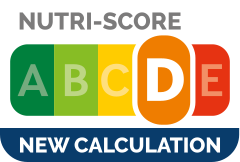 Poor nutritional quality
 Ultra-processed food and drink products
 Not computed
Health
Nutrition
Poor nutritional qualityNutrient levels
Fat in low quantity (1.16%)
Saturated fat in low quantity (0%)
Sugars in high quantity (13.9%)
Salt in moderate quantity (1%)
Physical activities
Approximate time needed to burn the energy in 100 g / 100 ml: 1,169 kJ. Reference adult weight: 70 kg. Energy density: Moderate.
Nutrition facts
| Nutrition facts | As sold for 100 g / 100 ml |
|---|---|
| Energy | ~ 1,168.6 kJ (282 kcal) |
| FAT | 1.16 g |
| Saturated fat | 0 g |
| Monounsaturated FAT | 0 g |
| Polyunsaturated FAT | 0.58 g |
| Trans fat | 0 g |
| Cholesterol | 0 g |
| Carbohydrates | 56.98 g |
| Sugars | 13.95 g |
| Added sugars | 8.24 g |
| Starch | 0 g |
| Dietary fiber | 2.33 g |
| Proteins | 8.14 g |
| Salt | 1 g |
| Sodium | 0.4 g |
| Vitamins | |
| Vitamin A | 0 g |
| Vitamin E | 0 g |
| Vitamin K | 0 g |
| Vitamin C | 0 g |
| Vitamin PP | 0 g |
| Minerals | |
| Potassium | 0.12 g |
| Calcium | 0.04 g |
| Phosphorus | 0 g |
| Iron | 0 g |
| Magnesium | 0 g |
| Zinc | 0 g |
| Copper | 0 g |
| Manganese | 0 g |
| Selenium | 0 g |
| Caffeine | 0 g |
| Fruits, vegetables and legumes | ~ 6.98 % |
| Choline | 0 g |
Nutrition facts (Detailed data)
| Nutrition facts | As sold for 100 g / 100 ml | As sold Per 100 g (packaging) | As sold Per 100 g (estimate) |
|---|---|---|---|
| Energy | ~ 1,168.6 kJ (282 kcal) | ? (282 kcal) | ? |
| FAT | 1.16 g | 1.16 g | ? |
| Saturated fat | 0 g | 0 g | ? |
| Monounsaturated FAT | 0 g | 0 g | ? |
| Polyunsaturated FAT | 0.58 g | 0.58 g | ? |
| Trans fat | 0 g | 0 g | ? |
| Cholesterol | 0 g | 0 g | ? |
| Carbohydrates | 56.98 g | 56.98 g | ? |
| Sugars | 13.95 g | 13.95 g | ? |
| Added sugars | 8.24 g | 8.24 g | ~ 7.09 g |
| Starch | 0 g | 0 g | ? |
| Dietary fiber | 2.33 g | 2.33 g | ? |
| Proteins | 8.14 g | 8.14 g | ? |
| Salt | 1 g | 1 g | ? |
| Sodium | 0.4 g | 0.4 g | ? |
| Vitamins | |||
| Vitamin A | 0 g | 0 g | ? |
| Vitamin E | 0 g | 0 g | ? |
| Vitamin K | 0 g | 0 g | ? |
| Vitamin C | 0 g | 0 g | ? |
| Vitamin PP | 0 g | 0 g | ? |
| Minerals | |||
| Potassium | 0.12 g | 0.12 g | ? |
| Calcium | 0.04 g | 0.04 g | ? |
| Phosphorus | 0 g | 0 g | ? |
| Iron | 0 g | 3.18 mg | ? |
| Magnesium | 0 g | 0 g | ? |
| Zinc | 0 g | 0 g | ? |
| Copper | 0 g | 0 g | ? |
| Manganese | 0 g | 0 g | ? |
| Selenium | 0 g | 0 g | ? |
| Caffeine | 0 g | 0 g | ? |
| Fruits, vegetables and legumes | ~ 6.98 % | ? | ~ 6.98 % |
| Choline | 0 g | 0 g | ? |
Serving size
Ingredients list
Ingredient information
Allergens
NOVA group
Ultra-processed food and drink productsElements that indicate the product is in NOVA group 4
How NOVA works
Ingredients analysis
No ingredients containing palm oil.
Vegan status unknown
Unrecognized: en:monoglycerides
Vegetarian status unknown
Unrecognized: en:monoglycerides
Additives
E150c - Ammonia caramelColour
No additive description is available yet.
E282 - calcium propionatePreservative
CALCIUM PROPIONATE has the formula Ca(C2H5COO)2. Calcium propionate is used as a preservative in a wide variety of products, including but not limited to:bread, other baked goods, processed meat, whey, and other dairy products.
E322 - LecithinsAntioxidantEmulsifier
Lecithins are natural compounds commonly used in the food industry as emulsifiers and stabilizers.
Extracted from sources like soybeans and eggs, lecithins consist of phospholipids that enhance the mixing of oil and water, ensuring smooth textures in various products like chocolates, dressings, and baked goods.
They do not present any known health risks.
E322i - LecithinAntioxidantEmulsifier
Lecithins are natural compounds commonly used in the food industry as emulsifiers and stabilizers.
Extracted from sources like soybeans and eggs, lecithins consist of phospholipids that enhance the mixing of oil and water, ensuring smooth textures in various products like chocolates, dressings, and baked goods.
They do not present any known health risks.
E330 - Citric acidAntioxidantSequestrant
Citric acid is a natural organic acid found in citrus fruits such as lemons, oranges, and limes.
It is widely used in the food industry as a flavor enhancer, acidulant, and preservative due to its tart and refreshing taste.
Citric acid is safe for consumption when used in moderation and is considered a generally recognized as safe (GRAS) food additive by regulatory agencies worldwide.
E415 - Xanthan gumEmulsifierStabiliserThickener
Xanthan gum (E415) is a natural polysaccharide derived from fermented sugars, often used in the food industry as a thickening and stabilizing agent.
This versatile food additive enhances texture and prevents ingredient separation in a wide range of products, including salad dressings, sauces, and gluten-free baked goods.
It is considered safe for consumption even at high intake amounts.
E466 - Sodium carboxy methyl celluloseEmulsifierHumectantStabiliserThickener
Carboxymethyl cellulose (CMC) or cellulose gum or tylose powder is a cellulose derivative with carboxymethyl groups (-CH2-COOH) bound to some of the hydroxyl groups of the glucopyranose monomers that make up the cellulose backbone. It is often used as its sodium salt, sodium carboxymethyl cellulose.
Environment
Environmental score label
Not computedCarbon footprint
No carbon footprint data is available for this product.
Packaging
No packaging information provided.
Transportation and origins
Origins of ingredients
No origin information provided.
Manufacturing places
No manufacturing place information provided.
Environmental labels
No environmental labels identified.
Data Source
Product added on March 9, 2017 at 2:01:38 PM UTC by usda-ndb-import .
Last edit on March 17, 2026 at 4:52:06 PM UTC by municorn-calorie-counter-app .
Product page also edited by kiliweb, municorn-calorie-counter-app, org-database-usda, tmbe7, usda-ndb-import, wolfgang8741, yuka.sY2b0xO6T85zoF3NwEKvllZ8aN7ZjzPBOgz5gk6N3NivIJW5ON0iyYTbGas.
Source List
- usda-ndb
- database-usda