ProductsRaley'sRaley's, cable car, root beer
NO_IMAGE
Barcode 0046567000312
Raley's

Raley's, cable car, root beer

BARCODE:0046567000312
CATEGORIES:Beverages, Carbonated Drinks, Sodas
COUNTRIES:United States

Labels

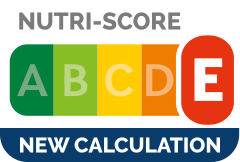
Nutri-Score
Nutri-ScoreBad nutritional quality
NOVA Group
NOVA GroupUltra-processed food and drink products
Green-Score
N/ANot applicable for the category

Health

Nutrition

Label

EBad nutritional quality

Nutrient levels

Fat in low quantity (0%)
What you need to know • A high consumption of fat, especially saturated fats, can raise cholesterol, which increases the risk of heart diseases. Recommendation: Limit the consumption of fat and saturated fat • Choose products with lower fat and saturated fat content. Source: National Health Service UK (NHS) - Fat: the facts
Sugars in high quantity (12.9%)
What you need to know • A high consumption of sugar can cause weight gain and tooth decay. It also augments the risk of type 2 diabetes and cardio-vascular diseases. Recommendation: Limit the consumption of sugar and sugary drinks • Sugary drinks (such as sodas, fruit beverages, and fruit juices and nectars) should be limited as much as possible (no more than 1 glass a day). • Choose products with lower sugar content and reduce the consumption of products with added sugars. Source: National Health Service UK (NHS) - Sugar: the facts
Salt in low quantity (0.025%)
What you need to know • A high consumption of salt (or sodium) can cause raised blood pressure, which can increase the risk of heart disease and stroke. • Many people who have high blood pressure do not know it, as there are often no symptoms. • Most people consume too much salt (on average 9 to 12 grams per day), around twice the recommended maximum level of intake. Recommendation: Limit the consumption of salt and salted food • Reduce the quantity of salt used when cooking, and don't salt again at the table. • Limit the consumption of salty snacks and choose products with lower salt content. Source: World Health Organization (WHO) - Fact sheet - Salt reduction Source: National Health Service UK (NHS) - Salt: the facts

Nutrition facts

Nutrition factsAs sold for 100 g / 100 ml
Energy209 kcal (50 kcal)
FAT0 g
Saturated fat?
Carbohydrates12.92 g
Sugars12.92 g
Dietary fiber?
Proteins0 g
Salt0.03 mg
Sodium0.01 mg
Minerals
Fruits, vegetables and legumes?

Nutrition facts (Detailed data)

Nutrition factsAs sold for 100 g / 100 mlAs sold Per serving (legacy)
Energy209 kcal (50 kcal)502 kcal (120 kcal)
FAT0 g0 g
Saturated fat??
Carbohydrates12.92 g31 g
Sugars12.92 g31 g
Dietary fiber??
Proteins0 g0 g
Salt0.03 mg0.06 mg
Sodium0.01 mg0.02 mg
Minerals
Fruits, vegetables and legumes??

Serving size

8 OZA (240 ml)

Estimated Activity Time

Approximate time needed to burn the energy in 100 g / 100 ml: 874 kJ. Reference adult weight: 70 kg. Energy density: High.

Walking
51 min (~5,099 steps)
Swimming
31 min
Bicycling
24 min
Running
18 min

Ingredients

Ingredients list

Carbonated water, high fructose corn syrup, caramel color, potassium benzoate (a preservative), natural and artificial flavor, citric acid

Ingredient information

Carbonated Water
58.33% (estimate)
High Fructose Corn Syrup
20.83% (estimate)
E150a
10.42% (estimate)
E212
5.21% (estimate)
Preservative
5.21% (estimate)
Natural And Artificial Flavouring
2.5% (estimate)
E330
2.71% (estimate)

Ingredients analysis

Palm oil free
Yes

No ingredients containing palm oil.

Vegan
Unknown

Vegan status unknown

Vegetarian
Unknown

Vegetarian status unknown


Food Processing

NOVA group

4Ultra-processed food and drink products

Elements that indicate the product is in NOVA group 4

Additives
E150c - Ammonia caramel
Ingredients
Flavouring
Ingredients
Glucose
Ingredients
High Fructose Corn Syrup
Ingredients
Fructose

How NOVA works

The NOVA classification assigns food products into 4 groups based on their degree of processing: 1. Unprocessed or minimally processed foods 2. Processed culinary ingredients 3. Processed foods 4. Ultra-processed food and drink products

Additives

E150c - Ammonia caramelColour

No additive description is available yet.

E212 - Potassium benzoatePreservative

Potassium benzoate (E212), the potassium salt of benzoic acid, is a food preservative that inhibits the growth of mold, yeast and some bacteria. It works best in low-pH products, below 4.5, where it exists as benzoic acid. Acidic foods and beverages such as fruit juice (citric acid), sparkling drinks (carbonic acid), soft drinks (phosphoric acid), pickles (vinegar), and frogurt toppings may be preserved with potassium benzoate. It is approved for use in most countries including Canada, the U.S., and the EU, where it is designated by the E number E212. Potassium benzoate is also used in the whistle in many fireworks.

E330 - Citric acidAntioxidantSequestrant

Citric acid is a natural organic acid found in citrus fruits such as lemons, oranges, and limes.

It is widely used in the food industry as a flavor enhancer, acidulant, and preservative due to its tart and refreshing taste.

Citric acid is safe for consumption when used in moderation and is considered a generally recognized as safe (GRAS) food additive by regulatory agencies worldwide.

Environment

Green-Score, origins bonus, and transportation impact are shown for Worldwide .

Green Score

Overall grade

N/ANot applicable for the category

About Green-Score

The Green-Score is an experimental score that summarizes the environmental impacts of food products.

Current scope

The Green-Score was initially developed for France and it is being extended to other European countries. The Green-Score formula is subject to change as it is regularly improved to make it more precise and better suited to each country. Select a country to include the full impact of transportation in the final score.

Green-Score availability

The Green-Score is not yet applicable for this category, but support is being added.

Bonuses and maluses

Declared origins

Origins of ingredients are missing for this product. Ingredients need to be completed before the transportation bonus can be computed precisely.

Packaging impact

Packaging with a high impact Malus: -15 The information about the packaging of this product is not filled in.

Packaging

Packaging impact

Packaging with a high impact Malus: -15 The information about the packaging of this product is not filled in.

Data precision

The packaging information is not sufficiently precise to compute the most accurate packaging impact. Exact shapes and materials of all packaging components help improve the Green-Score.

Transportation

Declared origins

Origins of ingredients are missing for this product. Ingredients need to be completed before the transportation bonus can be computed precisely.

Data Source

Data presented on this page is sourced from the Open Food Facts database. This platform does not alter the original dataset; its purpose is solely to enhance data visualization and user accessibility.

Product added on March 9, 2017 at 2:37:56 PM UTC by usda-ndb-import .

Last edit on April 22, 2020 at 7:36:07 PM UTC by org-database-usda .

Product page also edited by org-database-usda, usda-ndb-import.

Source List