
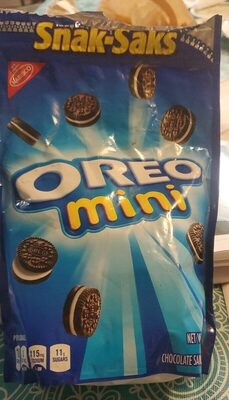
OREO minis
Health
Nutrition
Nutri-Score
 Lower nutritional quality
Nutri-Score data warning
Nutrient levels
Fat in high quantity (20.7%)
Saturated fat in high quantity (6.9%)
Sugars in high quantity (41.4%)
Salt in moderate quantity (0.991%)
Nutrition label

Nutrition facts
| Nutrition facts | As sold for 100 g / 100 ml | Compared to: Chocolate sandwich cookies |
|---|---|---|
| Energy | ~ 2082.75862068966 kJ (482 kcal) | 2,017.783 kJ (483 kcal) (+3%) |
| Fat | 20.6896551724138 g | 20.735 g (~0%) |
| Saturated fat | 6.89655172413793 g | 9.073 g (-24%) |
| Carbohydrates | 72.4137931034483 g | 67.566 g (+7%) |
| Sugars | 41.3793103448276 g | 35.956 g (+15%) |
| Added sugars | 130.796670630202 g | 25.986 g (+403%) |
| Starch | 0 g | 20.934 g (-100%) |
| Dietary fiber | 3.44827586206897 g | ? |
| Proteins | 3.44827586206897 g | 5.012 g (-31%) |
| Salt | 0.991379310344828 g | 0.778 g (+27%) |
| Sodium | 0.396551724137931 g | 0.312 g (+27%) |
| Vitamin A | 0 g | ? |
| Vitamin D | ? | 0.142 µg |
| Vitamin E | 0 g | 3.472 mg (-100%) |
| Vitamin K | 0 g | ? |
| Vitamin C | 0 g | ? |
| Potassium | 0.137931034482759 g | 231.701 mg (-40%) |
| Calcium | 0.0344827586206897 g | 26.004 mg (+33%) |
| Phosphorus | 0 g | ? |
| Iron | 0.014268727705113 g | 2.693 mg (+430%) |
| Magnesium | 0 g | 42.032 mg (-100%) |
| Zinc | 0 g | 0.873 mg (-100%) |
| Copper | 0 g | 0.224 mg (-100%) |
| Manganese | 0 g | 0.86 mg (-100%) |
| Selenium | 0 g | 6.477 µg (-100%) |
| Caffeine | 0 g | ? |
| Fruits, vegetables and legumes | ~ 0 % | ? |
| Choline | 0 g | 0 g |
Nutrition facts (Detailed data)
| Nutrition facts | As sold for 100 g / 100 ml | As sold Per serving (29 g) (packaging) | As sold Per 100 g (estimate) |
|---|---|---|---|
| Energy | ~ 2082.75862068966 kJ (482 kcal) | ? (140 kcal) | ? |
| Fat | 20.6896551724138 g | 6 g | ? |
| Saturated fat | 6.89655172413793 g | 2 g | ? |
| Carbohydrates | 72.4137931034483 g | 21 g | ? |
| Sugars | 41.3793103448276 g | 12 g | ? |
| Added sugars | 130.796670630202 g | 37.9310344827586 g | ~ 18 g |
| Starch | 0 g | 0 g | ? |
| Dietary fiber | 3.44827586206897 g | 1 g | ? |
| Proteins | 3.44827586206897 g | 1 g | ? |
| Salt | 0.991379310344828 g | 0.2875 g | ? |
| Sodium | 0.396551724137931 g | 0.115 g | ? |
| Vitamin A | 0 g | 0 g | ? |
| Vitamin D | ? | ? | ? |
| Vitamin E | 0 g | 0 g | ? |
| Vitamin K | 0 g | 0 g | ? |
| Vitamin C | 0 g | 0 g | ? |
| Potassium | 0.137931034482759 g | 0.04 g | ? |
| Calcium | 0.0344827586206897 g | 0.01 g | ? |
| Phosphorus | 0 g | 0 g | ? |
| Iron | 0.014268727705113 g | 0.00413793103448276 g | ? |
| Magnesium | 0 g | 0 g | ? |
| Zinc | 0 g | 0 g | ? |
| Copper | 0 g | 0 g | ? |
| Manganese | 0 g | 0 g | ? |
| Selenium | 0 g | 0 g | ? |
| Caffeine | 0 g | 0 g | ? |
| Fruits, vegetables and legumes | ~ 0 % | ? | ~ 0 % |
| Choline | 0 g | 0 g | ? |
Serving size
Ingredients
Ingredients image

Ingredients list
Ingredient information
Added sugars
Allergens
Ingredients analysis
Contains ingredients containing palm oil.
Vegan status unknown
Vegetarian status unknown
Food Processing
NOVA group
 Ultra-processed food and drink products
Elements that indicate the product is in NOVA group 4
How NOVA works
Additives
E322 - LecithinsAntioxidantEmulsifier
Lecithins are natural compounds commonly used in the food industry as emulsifiers and stabilizers.
Extracted from sources like soybeans and eggs, lecithins consist of phospholipids that enhance the mixing of oil and water, ensuring smooth textures in various products like chocolates, dressings, and baked goods.
They do not present any known health risks.
E322i - LecithinAntioxidantEmulsifier
Lecithins are natural compounds commonly used in the food industry as emulsifiers and stabilizers.
Extracted from sources like soybeans and eggs, lecithins consist of phospholipids that enhance the mixing of oil and water, ensuring smooth textures in various products like chocolates, dressings, and baked goods.
They do not present any known health risks.
E341 - Calcium phosphates EFSA overexposure risk: highEmulsifierHumectantSequestrantStabiliserThickener
Calcium phosphate is a family of materials and minerals containing calcium ions (Ca2+) together with inorganic phosphate anions. Some so-called calcium phosphates contain oxide and hydroxide as well. They are white solids of nutritious value.
E500 - Sodium carbonatesStabiliserThickener
Sodium carbonates (E500) are compounds commonly used in food preparation as leavening agents, helping baked goods rise by releasing carbon dioxide when they interact with acids.
Often found in baking soda, they regulate the pH of food, preventing it from becoming too acidic or too alkaline. In the culinary world, sodium carbonates can also enhance the texture and structure of foods, such as noodles, by modifying the gluten network.
Generally recognized as safe, sodium carbonates are non-toxic when consumed in typical amounts found in food.
E500ii - Sodium hydrogen carbonateStabiliserThickener
Sodium hydrogen carbonate, also known as E500ii, is a food additive commonly used as a leavening agent.
When added to recipes, it releases carbon dioxide gas upon exposure to heat or acids, causing dough to rise and resulting in a light, fluffy texture in baked goods.
It is generally recognized as safe (GRAS) by regulatory authorities when used in appropriate quantities and poses no significant health risks when consumed in typical food applications.
Environment
Green-Score, origins bonus, and transportation impact are shown for Worldwide .
Green Score
Overall grade
 Very high environmental impact
About Green-Score
Current scope
Life cycle analysis
Average impact of the category
 Biscuit (cookie), snack with dairy or vanilla filling • Score: 53/100
Life-cycle reference
Overall environmental impact by stage (PEF)
The overall environmental impact figure (PEF) comes from ADEME's Agribalyse database, for the category: Biscuit (cookie), snack with dairy or vanilla filling. Source: ADEME Agribalyse Database.
| Stage | Impact |
|---|---|
| Agriculture | 75.7 % |
| Processing | 7.8 % |
| Packaging | 11.4 % |
| Transportation | 4.1 % |
| Distribution | 1.1 % |
| Consumption | 0.0 % |
Bonuses and maluses
Declared origins
Threatened species risk
Packaging impact
Green-Score for this product
Green-Score for this product
Final score: 23/100Final score breakdown
Carbon footprint
Carbon footprint
Climate impact by stage (CO2e)
The carbon emission figure comes from ADEME's Agribalyse database, for the category: Biscuit (cookie), snack with dairy or vanilla filling. Source: ADEME Agribalyse Database.
| Stage | Impact |
|---|---|
| Agriculture | 79.6 % |
| Processing | 3.1 % |
| Packaging | 13.2 % |
| Transportation | 3.8 % |
| Distribution | 0.4 % |
| Consumption | 0.0 % |
Packaging
Packaging impact
Data precision
Transportation
Declared origins
Forest footprint
Forest footprint
Deforestation risk details
Data Source
Product data comes from Open Food Facts. Food Benchmark also adds translations, category comparisons and explanatory calculations.
The database is licensed under ODbL 1.0, individual contents under DbCL 1.0, and product photos under CC BY-SA 3.0.
Product added on May 4, 2015 at 8:17:32 AM UTC by openfoodfacts-contributors .
Last edit on March 17, 2026 at 10:22:31 PM UTC by new-nutrition-bot .
Product page also edited by desan, ecoscore-impact-estimator, fix-missing-lang-bot, foodless, geodata, inf, kiliweb, macrofactor, municorn-calorie-counter-app, new-nutrition-bot, openfoodfacts-contributors, org-database-usda, roboto-app, shankspony, teolemon, upcbot, yuka.UzZZZk41UWUvdFl1b3MwWi94RGYxdElwNGNXVmZVeTJDdXNxSVE9PQ, yuka.sY2b0xO6T85zoF3NwEKvlkZZbvqBhC_hC0bgi2uHnoyLdoPTPYh5z7eqHqo.
Source List
- database-usda