

Haribo Goldbears
Health
Nutrition
Nutri-Score
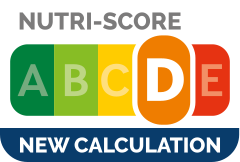 Lower nutritional quality
Nutri-Score data warning
Nutrient levels
Fat in low quantity (0%)
Sugars in high quantity (46.7%)
Salt in low quantity (0.0417%)
Nutrition facts
| Nutrition facts | As sold for 100 g / 100 ml | Compared to: Gummy bears |
|---|---|---|
| Energy | 1390 kcal (333 kcal) | 1,414.779 kJ (334 kcal) |
| Fat | 0 g | 0.296 g (-100%) |
| Saturated fat | ? | 0.1 g |
| Carbohydrates | 76.7 g | 77.859 g (-1%) |
| Sugars | 46.7 g | 49.402 g (-5%) |
| Added sugars | 46.7 g | 60.573 g (-23%) |
| Dietary fiber | ? | ? |
| Proteins | 6.67 g | 4.491 g (+49%) |
| Salt | 0.0417 g | 0.113 g (-63%) |
| Sodium | 0.0167 g | 0.045 g (-63%) |
| Fruits, vegetables and legumes | ? | ? |
Nutrition facts (Detailed data)
| Nutrition facts | As sold for 100 g / 100 ml | As sold Per serving (legacy) |
|---|---|---|
| Energy | 1390 kcal (333 kcal) | 418 kcal (99 kcal) |
| Fat | 0 g | 0 g |
| Saturated fat | ? | ? |
| Carbohydrates | 76.7 g | 23.01 g |
| Sugars | 46.7 g | 14.01 g |
| Added sugars | 46.7 g | 14.01 g |
| Dietary fiber | ? | ? |
| Proteins | 6.67 g | 2.001 g |
| Salt | 0.0417 g | 0.012525 g |
| Sodium | 0.0167 g | 0.00501 g |
| Fruits, vegetables and legumes | ? | ? |
Serving size
Ingredients
Ingredients image

Ingredients list
Ingredient information
Added sugars
Allergens
Ingredients analysis
No ingredients containing palm oil.
Contains non-vegan ingredients.
Unrecognized: en:artificial
Contains non-vegetarian ingredients.
Unrecognized: en:artificial
Food Processing
NOVA group
 Ultra-processed food and drink products
Elements that indicate the product is in NOVA group 4
How NOVA works
Additives
E102 - TartrazineColour
Tartrazine (E102) is a synthetic lemon-yellow azo dye used as a food coloring.
It is found in a wide range of products such as soft drinks, desserts, candies, and snack foods to give them a vibrant yellow appearance.
While approved by many regulatory agencies, tartrazine has been linked to allergic reactions, such as hives, in a small portion of the population. Some studies have also suggested a link to increased hyperactivity in children, particularly when consumed with other additives like benzoates.
E129 - Allura red EFSA overexposure risk: noColour
Allura Red AC is a red azo dye that goes by several names, including FD&C Red 40. It is used as a food dye and has the E number E129. It is usually supplied as its red sodium salt, but can also be used as the calcium and potassium salts. These salts are soluble in water. In solution, its maximum absorbance lies at about 504 nm.
E133 - Brilliant blue FCF EFSA overexposure risk: moderateColour
BRILLIANT BLUE FCF (Blue 1) is an organic compound classified as a blue triarylmethane dye, reflecting its chemical structure. Known under various commercial names, it is a colorant for foods and other substances.
E330 - Citric acidAntioxidantSequestrant
Citric acid is a natural organic acid found in citrus fruits such as lemons, oranges, and limes.
It is widely used in the food industry as a flavor enhancer, acidulant, and preservative due to its tart and refreshing taste.
Citric acid is safe for consumption when used in moderation and is considered a generally recognized as safe (GRAS) food additive by regulatory agencies worldwide.
E428 - Gelatine
No additive description is available yet.
E901 - white and yellow beeswaxCarrierEmulsifierStabiliserThickener
Beeswax (cera alba) is a natural wax produced by honey bees of the genus Apis. The wax is formed into "scales" by eight wax-producing glands in the abdominal segments of worker bees, which discard it in or at the hive. The hive workers collect and use it to form cells for honey storage and larval and pupal protection within the beehive. Chemically, beeswax consists mainly of esters of fatty acids and various long-chain alcohols. Beeswax has long-standing applications in human food and flavoring. For example, it is used as a glazing agent or as a light/heat source. It is edible, in the sense of having similar negligible toxicity to plant waxes, and is approved for food use in most countries and the European Union under the E number E901. However, the wax monoesters in beeswax are poorly hydrolysed in the guts of humans and other mammals, so they have insignificant nutritional value. Some birds, such as honeyguides, can digest beeswax. Beeswax is the main diet of wax moth larvae.
Environment
Green-Score, origins bonus, and transportation impact are shown for Worldwide .
Green Score
Overall grade
 Low environmental impact
About Green-Score
Current scope
Life cycle analysis
Average impact of the category
 Jelly candy • Score: 89/100
Life-cycle reference
Overall environmental impact by stage (PEF)
The overall environmental impact figure (PEF) comes from ADEME's Agribalyse database, for the category: Jelly candy. Source: ADEME Agribalyse Database.
| Stage | Impact |
|---|---|
| Agriculture | 51.7 % |
| Processing | 31.0 % |
| Packaging | 7.7 % |
| Transportation | 7.3 % |
| Distribution | 2.3 % |
| Consumption | 0.0 % |
Bonuses and maluses
Declared origins
Packaging impact
Green-Score for this product
Green-Score for this product
Final score: 69/100Final score breakdown
Carbon footprint
Carbon footprint
Climate impact by stage (CO2e)
The carbon emission figure comes from ADEME's Agribalyse database, for the category: Jelly candy. Source: ADEME Agribalyse Database.
| Stage | Impact |
|---|---|
| Agriculture | 36.7 % |
| Processing | 38.2 % |
| Packaging | 11.9 % |
| Transportation | 12.0 % |
| Distribution | 1.1 % |
| Consumption | 0.0 % |
Packaging
Packaging impact
Data precision
Transportation
Declared origins
Forest footprint
Forest footprint
Deforestation risk details
Data Source
Product data comes from Open Food Facts. Food Benchmark also adds translations, category comparisons and explanatory calculations.
The database is licensed under ODbL 1.0, individual contents under DbCL 1.0, and product photos under CC BY-SA 3.0.
Product added on March 9, 2017 at 11:16:05 AM UTC by usda-ndb-import .
Last edit on December 5, 2025 at 7:39:28 AM UTC by buyrapp .
Product page also edited by bredowmax, buyrapp, foodless, inf, macrofactor, openfoodfacts-contributors, org-database-usda, roboto-app, usda-ndb-import.
Source List
- usda-ndb
- database-usda