
Applehead the Original Apple Candy
Labels
 Not computed
 Ultra-processed food and drink products
 Not computed
Health
Nutrition
Nutrition label
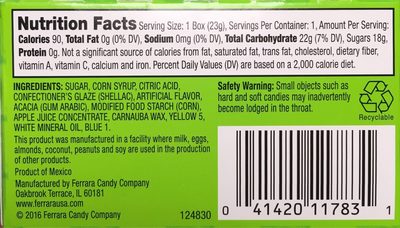
Nutrition facts
| Nutrition facts | As sold for 100 g / 100 ml |
|---|---|
| Energy | ~ 1,626.9 kJ (392 kcal) |
| FAT | 0 g |
| Saturated fat | 0 g |
| Carbohydrates | 95.7 g |
| Sugars | 72.3 g |
| Dietary fiber | 0 g |
| Proteins | 0 g |
| Salt | 0 g |
| Sodium | 0 g |
| Minerals | |
| Fruits, vegetables and legumes | ~ 0.4 % |
Nutrition facts (Detailed data)
| Nutrition facts | As sold for 100 g / 100 ml | As sold Per 100 g (packaging) | As sold Per 100 g (estimate) |
|---|---|---|---|
| Energy | ~ 1,626.9 kJ (392 kcal) | ? (392 kcal) | ? |
| FAT | 0 g | 0 g | ? |
| Saturated fat | 0 g | 0 g | ? |
| Carbohydrates | 95.7 g | 95.7 g | ? |
| Sugars | 72.3 g | 72.3 g | ? |
| Added sugars | ~ 54.17 g | ? | ~ 54.17 g |
| Dietary fiber | 0 g | 0 g | ? |
| Proteins | 0 g | 0 g | ? |
| Salt | 0 g | 0 g | ? |
| Sodium | 0 g | 0 g | ? |
| Minerals | |||
| Fruits, vegetables and legumes | ~ 0.4 % | ? | ~ 0.4 % |
Estimated Activity Time
Approximate time needed to burn the energy in 100 g / 100 ml: 1,627 kJ. Reference adult weight: 70 kg. Energy density: Moderate.
Ingredients
Ingredients image
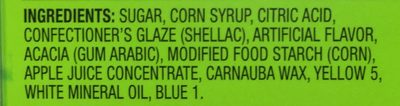
Ingredients list
Ingredient information
Ingredients analysis
No ingredients containing palm oil.
Unrecognized: en:corn-syrijp, en:confectioner-s-gaze, en:acacia, en:carnauba-wm, en:white-mineral-oil, en:blue-l
Contains non-vegan ingredients.
Unrecognized: en:corn-syrijp, en:carnauba-wm, en:white-mineral-oil, en:blue-l
Contains non-vegetarian ingredients.
Unrecognized: en:corn-syrijp, en:carnauba-wm, en:white-mineral-oil, en:blue-l
Food Processing
NOVA group
Ultra-processed food and drink productsElements that indicate the product is in NOVA group 4
How NOVA works
Additives
E102 - TartrazineColour
Tartrazine (E102) is a synthetic lemon-yellow azo dye used as a food coloring.
It is found in a wide range of products such as soft drinks, desserts, candies, and snack foods to give them a vibrant yellow appearance.
While approved by many regulatory agencies, tartrazine has been linked to allergic reactions, such as hives, in a small portion of the population. Some studies have also suggested a link to increased hyperactivity in children, particularly when consumed with other additives like benzoates.
E330 - Citric acidAntioxidantSequestrant
Citric acid is a natural organic acid found in citrus fruits such as lemons, oranges, and limes.
It is widely used in the food industry as a flavor enhancer, acidulant, and preservative due to its tart and refreshing taste.
Citric acid is safe for consumption when used in moderation and is considered a generally recognized as safe (GRAS) food additive by regulatory agencies worldwide.
E414 - Acacia gumCarrierEmulsifierStabiliserThickener
Gum arabic, also known as acacia gum, arabic gum, gum acacia, acacia, Senegal gum and Indian gum, and by other names, is a natural gum consisting of the hardened sap of various species of the acacia tree. Originally, gum arabic was collected from Acacia nilotica which was called the "gum arabic tree"; in the present day, gum arabic is collected from acacia species, predominantly Acacia senegal and Vachellia (Acacia) seyal; the term "gum arabic" does not indicate a particular botanical source. In a few cases so‐called "gum arabic" may not even have been collected from Acacia species, but may originate from Combretum, Albizia or some other genus. Producers harvest the gum commercially from wild trees, mostly in Sudan (80%) and throughout the Sahel, from Senegal to Somalia—though it is historically cultivated in Arabia and West Asia. Gum arabic is a complex mixture of glycoproteins and polysaccharides. It is the original source of the sugars arabinose and ribose, both of which were first discovered and isolated from it, and are named after it. Gum arabic is soluble in water. It is edible, and used primarily in the food industry as a stabilizer, with EU E number E414. Gum arabic is a key ingredient in traditional lithography and is used in printing, paint production, glue, cosmetics and various industrial applications, including viscosity control in inks and in textile industries, though less expensive materials compete with it for many of these roles. While gum arabic is now produced throughout the African Sahel, it is still harvested and used in the Middle East.
E904 - Shellac
Shellac is a resin secreted by the female lac bug, on trees in the forests of India and Thailand. It is processed and sold as dry flakes (pictured) and dissolved in alcohol to make liquid shellac, which is used as a brush-on colorant, food glaze and wood finish. Shellac functions as a tough natural primer, sanding sealant, tannin-blocker, odour-blocker, stain, and high-gloss varnish. Shellac was once used in electrical applications as it possesses good insulation qualities and it seals out moisture. Phonograph and 78 rpm gramophone records were made of it until they were replaced by vinyl long-playing records from the 1950s onwards. From the time it replaced oil and wax finishes in the 19th century, shellac was one of the dominant wood finishes in the western world until it was largely replaced by nitrocellulose lacquer in the 1920s and 1930s.
E905 - Synthetic wax
Microcrystalline waxes are a type of wax produced by de-oiling petrolatum, as part of the petroleum refining process. In contrast to the more familiar paraffin wax which contains mostly unbranched alkanes, microcrystalline wax contains a higher percentage of isoparaffinic (branched) hydrocarbons and naphthenic hydrocarbons. It is characterized by the fineness of its crystals in contrast to the larger crystal of paraffin wax. It consists of high molecular weight saturated aliphatic hydrocarbons. It is generally darker, more viscous, denser, tackier and more elastic than paraffin waxes, and has a higher molecular weight and melting point. The elastic and adhesive characteristics of microcrystalline waxes are related to the non-straight chain components which they contain. Typical microcrystalline wax crystal structure is small and thin, making them more flexible than paraffin wax. It is commonly used in cosmetic formulations. Microcrystalline waxes when produced by wax refiners are typically produced to meet a number of ASTM specifications. These include congeal point (ASTM D938), needle penetration (D1321), color (ASTM D6045), and viscosity (ASTM D445). Microcrystalline waxes can generally be put into two categories: "laminating" grades and "hardening" grades. The laminating grades typically have a melt point of 140-175 F (60 - 80 oC) and needle penetration of 25 or above. The hardening grades will range from about 175-200 F (80 - 93 oC), and have a needle penetration of 25 or below. Color in both grades can range from brown to white, depending on the degree of processing done at the refinery level. Microcrystalline waxes are derived from the refining of the heavy distillates from lubricant oil production. This by-product must then be de-oiled at a wax refinery. Depending on the end use and desired specification, the product may then have its odor removed and color removed (which typically starts as a brown or dark yellow). This is usually done by means of a filtration method or by hydro-treating the wax material.
E905a - mineral oil
Microcrystalline waxes are a type of wax produced by de-oiling petrolatum, as part of the petroleum refining process. In contrast to the more familiar paraffin wax which contains mostly unbranched alkanes, microcrystalline wax contains a higher percentage of isoparaffinic (branched) hydrocarbons and naphthenic hydrocarbons. It is characterized by the fineness of its crystals in contrast to the larger crystal of paraffin wax. It consists of high molecular weight saturated aliphatic hydrocarbons. It is generally darker, more viscous, denser, tackier and more elastic than paraffin waxes, and has a higher molecular weight and melting point. The elastic and adhesive characteristics of microcrystalline waxes are related to the non-straight chain components which they contain. Typical microcrystalline wax crystal structure is small and thin, making them more flexible than paraffin wax. It is commonly used in cosmetic formulations. Microcrystalline waxes when produced by wax refiners are typically produced to meet a number of ASTM specifications. These include congeal point (ASTM D938), needle penetration (D1321), color (ASTM D6045), and viscosity (ASTM D445). Microcrystalline waxes can generally be put into two categories: "laminating" grades and "hardening" grades. The laminating grades typically have a melt point of 140-175 F (60 - 80 oC) and needle penetration of 25 or above. The hardening grades will range from about 175-200 F (80 - 93 oC), and have a needle penetration of 25 or below. Color in both grades can range from brown to white, depending on the degree of processing done at the refinery level. Microcrystalline waxes are derived from the refining of the heavy distillates from lubricant oil production. This by-product must then be de-oiled at a wax refinery. Depending on the end use and desired specification, the product may then have its odor removed and color removed (which typically starts as a brown or dark yellow). This is usually done by means of a filtration method or by hydro-treating the wax material.
Environment
Environmental score label
Not computedCarbon footprint
No carbon footprint data is available for this product.
Packaging
No packaging information provided.
Transportation and origins
Origins of ingredients
No origin information provided.
Manufacturing places
No manufacturing place information provided.
Environmental labels
No environmental labels identified.
Data Source
Data presented on this page is sourced from the Open Food Facts database. This platform does not alter the original dataset; its purpose is solely to enhance data visualization and user accessibility.
Product added on December 30, 2017 at 8:48:47 PM UTC by kiliweb .
Last edit on March 17, 2026 at 11:36:32 AM UTC by new-nutrition-bot .
Product page also edited by chevalstar, kiliweb, new-nutrition-bot, openfoodfacts-contributors, yuka.N6hiOdC0Jct5P8rZ34wb0hTqF_vRKPN8JyEMog, yuka.RnZ3TU52OHNuZWt6aWNNNTlEVDY2OGgyMXArdVZsdVhNc0ErSUE9PQ.