

Sour Punch Bites
Health
Nutrition
Nutri-Score
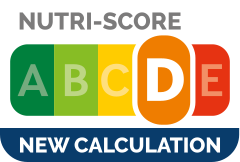 Lower nutritional quality
Nutri-Score data warning
Nutrient levels
Fat in moderate quantity (10%)
Saturated fat in moderate quantity (3.33%)
Sugars in high quantity (36.7%)
Salt in low quantity (0.0833%)
Nutrition label

Nutrition facts
| Nutrition facts | As sold for 100 g / 100 ml | Compared to: Candies |
|---|---|---|
| Energy | ~ 1730 kJ (400 kcal) | 1,499.613 kJ (349 kcal) (+15%) |
| Fat | 10 g | 1.536 g (+551%) |
| Saturated fat | 3.33333333333333 g | 0.856 g (+289%) |
| Carbohydrates | 76.6666666666667 g | 82.952 g (-8%) |
| Sugars | 36.6666666666667 g | 54.877 g (-33%) |
| Added sugars | ~ 59.3461538461538 g | 52.941 g (+12%) |
| Starch | 0 g | 3.804 g (-100%) |
| Dietary fiber | ? | ? |
| Proteins | 3.33333333333333 g | 2.152 g (+55%) |
| Salt | 0.0833333333333333 g | 0.127 g (-34%) |
| Sodium | 0.0333333333333333 g | 0.051 g (-35%) |
| Potassium | 0.0333333333333333 g | 68.192 mg (-51%) |
| Fruits, vegetables and legumes | ~ 0 % | ? |
| Choline | 0 g | 0 g |
Nutrition facts (Detailed data)
| Nutrition facts | As sold for 100 g / 100 ml | As sold Per serving (30 g) (packaging) | As sold Per 100 g (estimate) |
|---|---|---|---|
| Energy | ~ 1730 kJ (400 kcal) | ? (120 kcal) | ? |
| Fat | 10 g | 3 g | ? |
| Saturated fat | 3.33333333333333 g | 1 g | ? |
| Carbohydrates | 76.6666666666667 g | 23 g | ? |
| Sugars | 36.6666666666667 g | 11 g | ? |
| Added sugars | ~ 59.3461538461538 g | ? | ~ 59.3461538461538 g |
| Starch | 0 g | 0 g | ? |
| Dietary fiber | ? | ? | ? |
| Proteins | 3.33333333333333 g | 1 g | ? |
| Salt | 0.0833333333333333 g | 0.025 g | ? |
| Sodium | 0.0333333333333333 g | 0.01 g | ? |
| Potassium | 0.0333333333333333 g | 0.01 g | ? |
| Fruits, vegetables and legumes | ~ 0 % | ? | ~ 0 % |
| Choline | 0 g | 0 g | ? |
Serving size
Ingredients
Ingredients image

Ingredients list
Ingredient information
Added sugars
Allergens
Ingredients analysis
Palm oil content unknown
Vegan status unknown
Vegetarian status unknown
Food Processing
NOVA group
 Ultra-processed food and drink products
Elements that indicate the product is in NOVA group 4
How NOVA works
Additives
E102 - TartrazineColour
Tartrazine (E102) is a synthetic lemon-yellow azo dye used as a food coloring.
It is found in a wide range of products such as soft drinks, desserts, candies, and snack foods to give them a vibrant yellow appearance.
While approved by many regulatory agencies, tartrazine has been linked to allergic reactions, such as hives, in a small portion of the population. Some studies have also suggested a link to increased hyperactivity in children, particularly when consumed with other additives like benzoates.
E129 - Allura red EFSA overexposure risk: noColour
Allura Red AC is a red azo dye that goes by several names, including FD&C Red 40. It is used as a food dye and has the E number E129. It is usually supplied as its red sodium salt, but can also be used as the calcium and potassium salts. These salts are soluble in water. In solution, its maximum absorbance lies at about 504 nm.
E132 - Indigotine EFSA overexposure risk: noColour
Indigo carmine, or 5,5′-indigodisulfonic acid sodium salt, is an organic salt derived from indigo by sulfonation, which renders the compound soluble in water. It is approved for use as a food colorant in the U.S and E.U., It has the E number E132. It is also a pH indicator.
E133 - Brilliant blue FCF EFSA overexposure risk: moderateColour
BRILLIANT BLUE FCF (Blue 1) is an organic compound classified as a blue triarylmethane dye, reflecting its chemical structure. Known under various commercial names, it is a colorant for foods and other substances.
E296 - Malic acid
MALIC ACID is an organic compound with the molecular formula C4H6O5. Malic acid has two stereoisomeric forms (L- and D-enantiomers), though only the L-isomer exists naturally.
E330 - Citric acidAntioxidantSequestrant
Citric acid is a natural organic acid found in citrus fruits such as lemons, oranges, and limes.
It is widely used in the food industry as a flavor enhancer, acidulant, and preservative due to its tart and refreshing taste.
Citric acid is safe for consumption when used in moderation and is considered a generally recognized as safe (GRAS) food additive by regulatory agencies worldwide.
E331 - Sodium citratesEmulsifierSequestrantStabiliser
DISODIUM CITRATE, more properly, disodium hydrogen citrate, is an acid salt of citric acid with the chemical formula Na2C6H6O7. It is used as an antioxidant in food and to improve the effects of other antioxidants. It is also used as an acidity regulator and sequestrant. Typical products include gelatin, jam, sweets, ice cream, carbonated beverages, milk powder, wine, and processed cheeses.
E334 - L(+)-tartaric acidAntioxidantSequestrant
TARTARIC ACID is a white, crystalline organic acid that occurs naturally in many fruits, most notably in grapes, but also in bananas, tamarinds, and citrus
E422 - GlycerolHumectantThickener
Glycerol (; also called glycerine or glycerin; see spelling differences) is a simple polyol compound. It is a colorless, odorless, viscous liquid that is sweet-tasting and non-toxic. The glycerol backbone is found in all lipids known as triglycerides. It is widely used in the food industry as a sweetener and humectant and in pharmaceutical formulations. Glycerol has three hydroxyl groups that are responsible for its solubility in water and its hygroscopic nature.
E471 - Mono- and diglycerides of fatty acidsEmulsifierStabiliser
Mono- and diglycerides of fatty acids (E471), are food additives commonly used as emulsifiers in various processed foods.
These compounds consist of glycerol molecules linked to one or two fatty acid chains, which help stabilize and blend water and oil-based ingredients. E471 enhances the texture and shelf life of products like margarine, baked goods, and ice cream, ensuring a smooth and consistent texture.
It is generally considered safe for consumption within established regulatory limits.
Environment
Green-Score, origins bonus, and transportation impact are shown for Worldwide .
Green Score
Overall grade
 Low environmental impact
About Green-Score
Current scope
Life cycle analysis
Average impact of the category
 Candies, all types • Score: 88/100
Life-cycle reference
Overall environmental impact by stage (PEF)
The overall environmental impact figure (PEF) comes from ADEME's Agribalyse database, for the category: Candies, all types. Source: ADEME Agribalyse Database.
| Stage | Impact |
|---|---|
| Agriculture | 47.6 % |
| Processing | 28.1 % |
| Packaging | 17.3 % |
| Transportation | 4.5 % |
| Distribution | 2.3 % |
| Consumption | 0.0 % |
Bonuses and maluses
Declared origins
Packaging impact
Green-Score for this product
Green-Score for this product
Final score: 68/100Final score breakdown
Carbon footprint
Carbon footprint
Climate impact by stage (CO2e)
The carbon emission figure comes from ADEME's Agribalyse database, for the category: Candies, all types. Source: ADEME Agribalyse Database.
| Stage | Impact |
|---|---|
| Agriculture | 46.7 % |
| Processing | 27.1 % |
| Packaging | 16.4 % |
| Transportation | 8.7 % |
| Distribution | 1.5 % |
| Consumption | 0.0 % |
Packaging
Packaging impact
Data precision
Transportation
Declared origins
Data Source
Product data comes from Open Food Facts. Food Benchmark also adds translations, category comparisons and explanatory calculations.
The database is licensed under ODbL 1.0, individual contents under DbCL 1.0, and product photos under CC BY-SA 3.0.
Product added on March 9, 2017 at 2:28:10 PM UTC by usda-ndb-import .
Last edit on March 18, 2026 at 12:06:07 AM UTC by macrofactor .
Product page also edited by date-limite-app, ecoscore-impact-estimator, foodless, kiliweb, macrofactor, municorn-calorie-counter-app, openfoodfacts-contributors, org-database-usda, roboto-app, tacinte, tacite-mass-editor, usda-ndb-import, wolfgang8741, yuka.sY2b0xO6T85zoF3NwEKvlhBAC-HmiTnKNyHui1Wpy-rUNqbLTsxj4bLkPas, yuka.sY2b0xO6T85zoF3NwEKvlmJNSPvivTfHMBXtgmG6l9ixDb36O4xi3dXWLKg.
Source List
- usda-ndb
- database-usda