

8 Walnut, Cinnamon & Honey Baklava
Labels
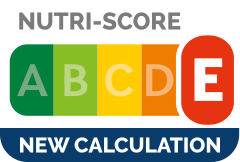 Bad nutritional quality
 Ultra-processed food and drink products
 High environmental impact
Health
Nutrition
Label
Bad nutritional qualityNutrient levels
Fat in high quantity (30.9%)
Saturated fat in high quantity (7.9%)
Sugars in high quantity (26.1%)
Salt in moderate quantity (0.65%)
Nutrition label

Nutrition facts
| Nutrition facts | As sold for 100 g / 100 ml |
|---|---|
| Energy | 2,130 kJ (511 kcal) |
| FAT | 30.9 g |
| Saturated fat | 7.9 g |
| Carbohydrates | 50.9 g |
| Sugars | 26.1 g |
| Dietary fiber | 3.1 g |
| Proteins | 5.7 g |
| Salt | 0.65 g |
| Sodium | 0.26 g |
| Minerals | |
| Fruits, vegetables and legumes | ~ 0 % |
Nutrition facts (Detailed data)
| Nutrition facts | As sold for 100 g / 100 ml | As sold Per 100 g (packaging) | As sold Per 100 g (estimate) |
|---|---|---|---|
| Energy | 2,130 kJ (511 kcal) | 2,130 kJ (509 kcal) | ? |
| FAT | 30.9 g | 30.9 g | ? |
| Saturated fat | 7.9 g | 7.9 g | ? |
| Carbohydrates | 50.9 g | 50.9 g | ? |
| Sugars | 26.1 g | 26.1 g | ? |
| Added sugars | ~ 40.98 g | ? | ~ 40.98 g |
| Dietary fiber | 3.1 g | 3.1 g | ? |
| Proteins | 5.7 g | 5.7 g | ? |
| Salt | 0.65 g | 0.65 g | ? |
| Sodium | 0.26 g | 0.26 g | ? |
| Minerals | |||
| Fruits, vegetables and legumes | ~ 0 % | ? | ~ 0 % |
Serving size
Estimated Activity Time
Approximate time needed to burn the energy in 100 g / 100 ml: 2,130 kJ. Reference adult weight: 70 kg. Energy density: High.
Ingredients
Ingredients image

Ingredients list
Ingredient information
Allergens
Traces
Ingredients analysis
Palm oil content unknown
Contains non-vegan ingredients.
Unrecognized: en:invert-sugar
No non-vegetarian ingredients.
Unrecognized: en:invert-sugar
Food Processing
NOVA group
Ultra-processed food and drink productsElements that indicate the product is in NOVA group 4
How NOVA works
Additives
E160a - caroteneColour
β-Carotene is an organic, strongly colored red-orange pigment abundant in plants and fruits. It is a member of the carotenes, which are terpenoids (isoprenoids), synthesized biochemically from eight isoprene units and thus having 40 carbons. Among the carotenes, β-carotene is distinguished by having beta-rings at both ends of the molecule. β-Carotene is biosynthesized from geranylgeranyl pyrophosphate.β-Carotene is the most common form of carotene in plants. When used as a food coloring, it has the E number E160a. The structure was deduced by Karrer et al. in 1930. In nature, β-carotene is a precursor (inactive form) to vitamin A via the action of beta-carotene 15,15'-monooxygenase.Isolation of β-carotene from fruits abundant in carotenoids is commonly done using column chromatography. It can also be extracted from the beta-carotene rich algae, Dunaliella salina. The separation of β-carotene from the mixture of other carotenoids is based on the polarity of a compound. β-Carotene is a non-polar compound, so it is separated with a non-polar solvent such as hexane. Being highly conjugated, it is deeply colored, and as a hydrocarbon lacking functional groups, it is very lipophilic.
E160ai - Beta-caroteneColour
No additive description is available yet.
E300 - Ascorbic acidAntioxidantSequestrant
No additive description is available yet.
E322 - LecithinsAntioxidantEmulsifier
Lecithins are natural compounds commonly used in the food industry as emulsifiers and stabilizers.
Extracted from sources like soybeans and eggs, lecithins consist of phospholipids that enhance the mixing of oil and water, ensuring smooth textures in various products like chocolates, dressings, and baked goods.
They do not present any known health risks.
E322i - LecithinAntioxidantEmulsifier
Lecithins are natural compounds commonly used in the food industry as emulsifiers and stabilizers.
Extracted from sources like soybeans and eggs, lecithins consist of phospholipids that enhance the mixing of oil and water, ensuring smooth textures in various products like chocolates, dressings, and baked goods.
They do not present any known health risks.
Environment
Green-Score, origins bonus, and transportation impact are shown for Worldwide .
Green Score
Overall grade
High environmental impactAbout Green-Score
Current scope
Life cycle analysis
Average impact of the category
 Baklava (oriental pastry with almonds and syrup) • Score: 51/100
Life-cycle reference
Overall environmental impact by stage (PEF)
The overall environmental impact figure (PEF) comes from ADEME's Agribalyse database, for the category: Baklava (oriental pastry with almonds and syrup). Source: ADEME Agribalyse Database.
| Stage | Impact |
|---|---|
| Agriculture | 70.1 % |
| Processing | 7.3 % |
| Packaging | 17.2 % |
| Transportation | 4.3 % |
| Distribution | 1.0 % |
| Consumption | 0.0 % |
Bonuses and maluses
Declared origins
Packaging impact
Green-Score for this product
Green-Score for this product
Final score: 35/100Final score breakdown
Carbon footprint
Carbon footprint
Climate impact by stage (CO2e)
The carbon emission figure comes from ADEME's Agribalyse database, for the category: Baklava (oriental pastry with almonds and syrup). Source: ADEME Agribalyse Database.
| Stage | Impact |
|---|---|
| Agriculture | 63.6 % |
| Processing | 7.9 % |
| Packaging | 18.7 % |
| Transportation | 8.9 % |
| Distribution | 0.9 % |
| Consumption | 0.0 % |
Packaging
Packaging impact
Packaging materials
| Material | % | Packaging weight | Packaging weight per 100 g of product |
|---|---|---|---|
| Paper or cardboard | |||
| Plastic | |||
| Total |
Declared packaging
Data precision
Transportation
Manufacturing locations
Declared origins
Data Source
Data presented on this page is sourced from the Open Food Facts database. This platform does not alter the original dataset; its purpose is solely to enhance data visualization and user accessibility.
Product added on April 29, 2017 at 3:15:27 PM UTC by teolemon .
Last edit on March 16, 2026 at 10:52:55 PM UTC by new-nutrition-bot .
Product page also edited by aleene, beniben, bojackhorseman, keragui, moon-rabbit, new-nutrition-bot, packbot, teolemon.