

Hormel, compleats, mac & cheese, beefy
Health
Nutrition
Nutri-Score
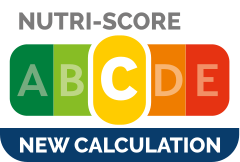 Average nutritional quality
Nutri-Score data warning
Nutrient levels
Fat in low quantity (1.88%)
Saturated fat in low quantity (0.94%)
Sugars in low quantity (3.29%)
Salt in moderate quantity (1.01%)
Nutrition label

Nutrition facts
| Nutrition facts | As sold for 100 g / 100 ml | Compared to: Meals |
|---|---|---|
| Energy | ~ 451.78 kJ (103 kcal) | 677.172 kJ (163 kcal) (-33%) |
| Fat | 1.88 g | 6.483 g (-71%) |
| Saturated fat | 0.94 g | 2.084 g (-55%) |
| Trans fat | 0 g | 0.023 g (-100%) |
| Cholesterol | 0.009 g | 15.516 mg (-42%) |
| Carbohydrates | 16.43 g | 16.246 g (+1%) |
| Sugars | 3.29 g | 2.315 g (+42%) |
| Added sugars | 2.34741784037559 g | 0.55 g (+327%) |
| Dietary fiber | 0.9 g | ? |
| Proteins | 5.63 g | 6.749 g (-17%) |
| Salt | 1.01 g | 0.95 g (+6%) |
| Sodium | 0.404 g | 0.38 g (+6%) |
| Vitamin A | 0.0000141 g | 16.076 µg (-12%) |
| Vitamin C | 0 g | ? |
| Potassium | 0.0892018779342723 g | 217.868 mg (-59%) |
| Calcium | 0.038 g | 46.281 mg (-18%) |
| Iron | 0.00051 g | 0.91 mg (-44%) |
| Fruits, vegetables and legumes | ~ 23.6111111111111 % | ? |
| Carbohydrates total | 17.3708920187793 g | ? |
Nutrition facts (Detailed data)
| Nutrition facts | As sold for 100 g / 100 ml | As sold Per 100 g (packaging) | As sold Per serving (213 g) (packaging) | As sold Per 100 g (estimate) |
|---|---|---|---|---|
| Energy | ~ 451.78 kJ (103 kcal) | ? (103 kcal) | ? (240 kcal) | ? |
| Fat | 1.88 g | 1.88 g | 5 g | ? |
| Saturated fat | 0.94 g | 0.94 g | 3.5 g | ? |
| Trans fat | 0 g | 0 g | 0 g | ? |
| Cholesterol | 0.009 g | 0.009 g | 0.02 g | ? |
| Carbohydrates | 16.43 g | 16.43 g | ? | ? |
| Sugars | 3.29 g | 3.29 g | 7 g | ? |
| Added sugars | 2.34741784037559 g | ? | 5 g | ~ 0.00576443142361427 g |
| Dietary fiber | 0.9 g | 0.9 g | 2 g | ? |
| Proteins | 5.63 g | 5.63 g | 12 g | ? |
| Salt | 1.01 g | 1.01 g | ? | ? |
| Sodium | 0.404 g | 0.404 g | 0.92 g | ? |
| Vitamin A | 0.0000141 g | 0.0000141 g | ? | ? |
| Vitamin C | 0 g | 0 g | 0.08 g | ? |
| Potassium | 0.0892018779342723 g | ? | 0.19 g | ? |
| Calcium | 0.038 g | 0.038 g | ? | ? |
| Iron | 0.00051 g | 0.00051 g | 0.0014 g | ? |
| Fruits, vegetables and legumes | ~ 23.6111111111111 % | ? | ? | ~ 23.6111111111111 % |
| Carbohydrates total | 17.3708920187793 g | ? | 37 g | ? |
Serving size
Ingredients
Ingredients image

Ingredients list
Ingredient information
Added sugars
Allergens
Ingredients analysis
Palm oil content unknown
Contains non-vegan ingredients.
Unrecognized: en:vital-wheat-gluten, en:glycerol-monostearate, en:contains-2-and-less-of-sugar, en:powdered-cellulose-to-prevent-caking, en:sorbic-acid-to-protect-flavor
Contains non-vegetarian ingredients.
Unrecognized: en:vital-wheat-gluten, en:glycerol-monostearate, en:contains-2-and-less-of-sugar, en:powdered-cellulose-to-prevent-caking, en:sorbic-acid-to-protect-flavor
Food Processing
NOVA group
 Ultra-processed food and drink products
Elements that indicate the product is in NOVA group 4
How NOVA works
Additives
E150c - Ammonia caramel EFSA overexposure risk: moderateColour
No additive description is available yet.
E270 - Lactic acid
LACTIC ACID is an organic compound with the formula CH3CH(OH)CO2H. In the form of its conjugate base called lactate (this is thus different and kept as a separate ingredient). Lactic acid is chiral, consisting of two optical isomers. One is known as L-(+)-lactic acid or (S)-lactic acid and the other, its mirror image, is D-(−)-lactic acid or (R)-lactic acid in food the L-variant is used
E315 - Erythorbic acid EFSA overexposure risk: noAntioxidant
Erythorbic acid (isoascorbic acid, D-araboascorbic acid) is a stereoisomer of ascorbic acid (vitamin C). It is synthesized by a reaction between methyl 2-keto-D-gluconate and sodium methoxide. It can also be synthesized from sucrose or by strains of Penicillium that have been selected for this feature. It is denoted by E number E315, and is widely used as an antioxidant in processed foods.Clinical trials have been conducted to investigate aspects of the nutritional value of erythorbic acid. One such trial investigated the effects of erythorbic acid on vitamin C metabolism in young women; no effect on vitamin C uptake or clearance from the body was found. A later study found that erythorbic acid is a potent enhancer of nonheme-iron absorption.Since the U.S. Food and Drug Administration banned the use of sulfites as a preservative in foods intended to be eaten fresh (such as salad bar ingredients), the use of erythorbic acid as a food preservative has increased. It is also used as a preservative in cured meats and frozen vegetables.It was first synthesized in 1933 by the German chemists Kurt Maurer and Bruno Schiedt.
E330 - Citric acidAntioxidantSequestrant
Citric acid is a natural organic acid found in citrus fruits such as lemons, oranges, and limes.
It is widely used in the food industry as a flavor enhancer, acidulant, and preservative due to its tart and refreshing taste.
Citric acid is safe for consumption when used in moderation and is considered a generally recognized as safe (GRAS) food additive by regulatory agencies worldwide.
E627 - Disodium guanylate
Disodium guanylate, also known as sodium 5'-guanylate and disodium 5'-guanylate, is a natural sodium salt of the flavor enhancing nucleotide guanosine monophosphate (GMP). Disodium guanylate is a food additive with the E number E627. It is commonly used in conjunction with glutamic acid. As it is a fairly expensive additive, it is not used independently of glutamic acid; if disodium guanylate is present in a list of ingredients but MSG does not appear to be, it is likely that glutamic acid is provided as part of another ingredient such as a processed soy protein complex. It is often added to foods in conjunction with disodium inosinate; the combination is known as disodium 5'-ribonucleotides. Disodium guanylate is produced from dried seaweed and is often added to instant noodles, potato chips and other snacks, savory rice, tinned vegetables, cured meats, and packaged soup.
E631 - Disodium inosinate
Disodium inosinate (E631) is the disodium salt of inosinic acid with the chemical formula C10H11N4Na2O8P. It is used as a food additive and often found in instant noodles, potato chips, and a variety of other snacks. Although it can be obtained from bacterial fermentation of sugars, it is often commercially prepared from animal sources.
Environment
Green-Score, origins bonus, and transportation impact are shown for Worldwide .
Green Score
Overall grade
 Unknown environmental impact
About Green-Score
Current scope
Green-Score availability
Bonuses and maluses
Declared origins
Packaging impact
Packaging

Packaging impact
Data precision
Transportation
Declared origins
Forest footprint
Forest footprint
Ingredients linked to forest pressure
| Ingredient | Type | Percent in product | Forest footprint |
|---|---|---|---|
| EGG White | Oeufs Importés | 3.23 % | 0.00 |
Data Source
Product data comes from Open Food Facts. Food Benchmark also adds translations, category comparisons and explanatory calculations.
The database is licensed under ODbL 1.0, individual contents under DbCL 1.0, and product photos under CC BY-SA 3.0.
Product added on March 10, 2017 at 8:09:54 AM UTC by usda-ndb-import .
Last edit on March 9, 2026 at 7:51:29 PM UTC by smoothie-app .
Product page also edited by inf, org-database-usda, smoothie-app, usda-ndb-import.
Source List
- usda-ndb
- database-usda