
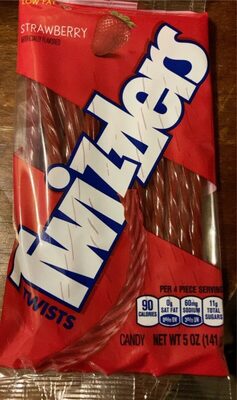
Strawberry twizzlers twists
Health
Nutrition
Nutri-Score
 Lower nutritional quality
Nutri-Score data warning
Nutrient levels
Fat in low quantity (0%)
Saturated fat in low quantity (0%)
Sugars in high quantity (39.3%)
Salt in moderate quantity (0.536%)
Nutrition label

Nutrition facts
| Nutrition facts | As sold for 100 g / 100 ml | Compared to: Confectioneries |
|---|---|---|
| Energy | ~ 1396.42857142858 kJ (353 kcal) | 1,791.83 kJ (424 kcal) (-22%) |
| Fat | 0 g | 15.499 g (-100%) |
| Saturated fat | 0 g | 7.112 g (-100%) |
| Carbohydrates | 78.571428571429 g | 65.564 g (+20%) |
| Sugars | 39.285714285714 g | 47.002 g (-16%) |
| Added sugars | ~ 53.857421875 g | 39.504 g (+36%) |
| Dietary fiber | 0 g | ? |
| Proteins | 3.5714285714286 g | 4.411 g (-19%) |
| Salt | 0.53571428571427 g | 0.16 g (+235%) |
| Sodium | 0.214285714285708 g | 0.064 g (+235%) |
| Iron | ? | 1.223 mg |
| Fruits, vegetables and legumes | ~ 0 % | ? |
Nutrition facts (Detailed data)
| Nutrition facts | As sold for 100 g / 100 ml | As sold Per 100 g (packaging) | As sold Per 100 g (estimate) |
|---|---|---|---|
| Energy | ~ 1396.42857142858 kJ (353 kcal) | ? (353 kcal) | ? |
| Fat | 0 g | 0 g | ? |
| Saturated fat | 0 g | 0 g | ? |
| Carbohydrates | 78.571428571429 g | 78.571428571429 g | ? |
| Sugars | 39.285714285714 g | 39.285714285714 g | ? |
| Added sugars | ~ 53.857421875 g | ? | ~ 53.857421875 g |
| Dietary fiber | 0 g | 0 g | ? |
| Proteins | 3.5714285714286 g | 3.5714285714286 g | ? |
| Salt | 0.53571428571427 g | 0.53571428571427 g | ? |
| Sodium | 0.214285714285708 g | 0.214285714285708 g | ? |
| Iron | ? | ? | ? |
| Fruits, vegetables and legumes | ~ 0 % | ? | ~ 0 % |
Ingredients
Ingredients image

Ingredients list
Ingredient information
Added sugars
Allergens
Ingredients analysis
Contains ingredients containing palm oil.
Vegan status unknown
Unrecognized: en:o-thiamin-mononitrate
Vegetarian status unknown
Unrecognized: en:o-thiamin-mononitrate
Food Processing
NOVA group
 Ultra-processed food and drink products
Elements that indicate the product is in NOVA group 4
How NOVA works
Additives
E129 - Allura red EFSA overexposure risk: noColour
Allura Red AC is a red azo dye that goes by several names, including FD&C Red 40. It is used as a food dye and has the E number E129. It is usually supplied as its red sodium salt, but can also be used as the calcium and potassium salts. These salts are soluble in water. In solution, its maximum absorbance lies at about 504 nm.
E322 - LecithinsAntioxidantEmulsifier
Lecithins are natural compounds commonly used in the food industry as emulsifiers and stabilizers.
Extracted from sources like soybeans and eggs, lecithins consist of phospholipids that enhance the mixing of oil and water, ensuring smooth textures in various products like chocolates, dressings, and baked goods.
They do not present any known health risks.
E322i - LecithinAntioxidantEmulsifier
Lecithins are natural compounds commonly used in the food industry as emulsifiers and stabilizers.
Extracted from sources like soybeans and eggs, lecithins consist of phospholipids that enhance the mixing of oil and water, ensuring smooth textures in various products like chocolates, dressings, and baked goods.
They do not present any known health risks.
E330 - Citric acidAntioxidantSequestrant
Citric acid is a natural organic acid found in citrus fruits such as lemons, oranges, and limes.
It is widely used in the food industry as a flavor enhancer, acidulant, and preservative due to its tart and refreshing taste.
Citric acid is safe for consumption when used in moderation and is considered a generally recognized as safe (GRAS) food additive by regulatory agencies worldwide.
E905 - Synthetic wax
Microcrystalline waxes are a type of wax produced by de-oiling petrolatum, as part of the petroleum refining process. In contrast to the more familiar paraffin wax which contains mostly unbranched alkanes, microcrystalline wax contains a higher percentage of isoparaffinic (branched) hydrocarbons and naphthenic hydrocarbons. It is characterized by the fineness of its crystals in contrast to the larger crystal of paraffin wax. It consists of high molecular weight saturated aliphatic hydrocarbons. It is generally darker, more viscous, denser, tackier and more elastic than paraffin waxes, and has a higher molecular weight and melting point. The elastic and adhesive characteristics of microcrystalline waxes are related to the non-straight chain components which they contain. Typical microcrystalline wax crystal structure is small and thin, making them more flexible than paraffin wax. It is commonly used in cosmetic formulations. Microcrystalline waxes when produced by wax refiners are typically produced to meet a number of ASTM specifications. These include congeal point (ASTM D938), needle penetration (D1321), color (ASTM D6045), and viscosity (ASTM D445). Microcrystalline waxes can generally be put into two categories: "laminating" grades and "hardening" grades. The laminating grades typically have a melt point of 140-175 F (60 - 80 oC) and needle penetration of 25 or above. The hardening grades will range from about 175-200 F (80 - 93 oC), and have a needle penetration of 25 or below. Color in both grades can range from brown to white, depending on the degree of processing done at the refinery level. Microcrystalline waxes are derived from the refining of the heavy distillates from lubricant oil production. This by-product must then be de-oiled at a wax refinery. Depending on the end use and desired specification, the product may then have its odor removed and color removed (which typically starts as a brown or dark yellow). This is usually done by means of a filtration method or by hydro-treating the wax material.
E905a - mineral oil
Microcrystalline waxes are a type of wax produced by de-oiling petrolatum, as part of the petroleum refining process. In contrast to the more familiar paraffin wax which contains mostly unbranched alkanes, microcrystalline wax contains a higher percentage of isoparaffinic (branched) hydrocarbons and naphthenic hydrocarbons. It is characterized by the fineness of its crystals in contrast to the larger crystal of paraffin wax. It consists of high molecular weight saturated aliphatic hydrocarbons. It is generally darker, more viscous, denser, tackier and more elastic than paraffin waxes, and has a higher molecular weight and melting point. The elastic and adhesive characteristics of microcrystalline waxes are related to the non-straight chain components which they contain. Typical microcrystalline wax crystal structure is small and thin, making them more flexible than paraffin wax. It is commonly used in cosmetic formulations. Microcrystalline waxes when produced by wax refiners are typically produced to meet a number of ASTM specifications. These include congeal point (ASTM D938), needle penetration (D1321), color (ASTM D6045), and viscosity (ASTM D445). Microcrystalline waxes can generally be put into two categories: "laminating" grades and "hardening" grades. The laminating grades typically have a melt point of 140-175 F (60 - 80 oC) and needle penetration of 25 or above. The hardening grades will range from about 175-200 F (80 - 93 oC), and have a needle penetration of 25 or below. Color in both grades can range from brown to white, depending on the degree of processing done at the refinery level. Microcrystalline waxes are derived from the refining of the heavy distillates from lubricant oil production. This by-product must then be de-oiled at a wax refinery. Depending on the end use and desired specification, the product may then have its odor removed and color removed (which typically starts as a brown or dark yellow). This is usually done by means of a filtration method or by hydro-treating the wax material.
Environment
Green-Score, origins bonus, and transportation impact are shown for Worldwide .
Green Score
Overall grade
 Unknown environmental impact
About Green-Score
Current scope
Green-Score availability
Bonuses and maluses
Declared origins
Threatened species risk
Packaging impact
Packaging
Packaging impact
Data precision
Transportation
Declared origins
Forest footprint
Forest footprint
Deforestation risk details
Data Source
Product data comes from Open Food Facts. Food Benchmark also adds translations, category comparisons and explanatory calculations.
The database is licensed under ODbL 1.0, individual contents under DbCL 1.0, and product photos under CC BY-SA 3.0.
Product added on October 16, 2019 at 4:20:19 PM UTC by kiliweb .
Last edit on March 18, 2026 at 12:10:44 AM UTC by new-nutrition-bot .
Product page also edited by foodless, inf, kiliweb, new-nutrition-bot, openfoodfacts-contributors, roboto-app, yuka.ZmJBRkhZMHVncUFEbWNFVDN6M1kxZGxjeXFDekRGS25HZGNmSWc9PQ, yuka.sY2b0xO6T85zoF3NwEKvlmV-VOjinG6UMi3fmEmAyOazL52zf-9u09KmEqs, yuka.sY2b0xO6T85zoF3NwEKvlmhMb-fggjj_LDDQpk6n782hJabpS_9j4Nj7aKo.