

BUTTERMILK RANCH RICE CRISPS
Labels
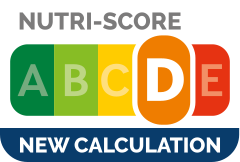 Poor nutritional quality
 Ultra-processed food and drink products
 Green-Score not computed
Health
Nutrition
Label
Poor nutritional qualityNutrient levels
Fat in moderate quantity (16.1%)
Saturated fat in moderate quantity (1.79%)
Sugars in low quantity (3.57%)
Salt in high quantity (2.59%)
Nutrition label

Nutrition facts
| Nutrition facts | As sold for 100 g / 100 ml |
|---|---|
| Energy | ~ 1,898.21 kJ (429 kcal) |
| FAT | 16.07 g |
| Saturated fat | 1.79 g |
| Monounsaturated FAT | 8.93 g |
| Polyunsaturated FAT | 5.36 g |
| Trans fat | 0 g |
| Cholesterol | 0 g |
| Carbohydrates | 67.86 g |
| Sugars | 3.57 g |
| Added sugars | 3.57 g |
| Starch | 0 g |
| Polyols | 0 g |
| Dietary fiber | 3.57 g |
| Proteins | 7.14 g |
| Salt | 2.59 g |
| Sodium | 1.04 g |
| Vitamins | |
| Vitamin A | 0 g |
| Vitamin D | 0 g |
| Vitamin E | 0 g |
| Vitamin K | 0 g |
| Vitamin C | 0 g |
| Minerals | |
| Potassium | 0.29 g |
| Calcium | 0.07 g |
| Phosphorus | 0 g |
| Iron | 0 g |
| Magnesium | 0 g |
| Zinc | 0 g |
| Copper | 0 g |
| Manganese | 0 g |
| Selenium | 0 g |
| Caffeine | 0 g |
| Fruits, vegetables and legumes | ~ 0 % |
| Choline | 0 g |
Nutrition facts (Detailed data)
| Nutrition facts | As sold for 100 g / 100 ml | As sold Per 100 g (packaging) | As sold Per serving (28 g) (packaging) | As sold Per 100 g (estimate) |
|---|---|---|---|---|
| Energy | ~ 1,898.21 kJ (429 kcal) | ? (429 kcal) | ? (120 kcal) | ? |
| FAT | 16.07 g | ? | 4.5 g | ? |
| Saturated fat | 1.79 g | ? | 0.5 g | ? |
| Monounsaturated FAT | 8.93 g | ? | 2.5 g | ? |
| Polyunsaturated FAT | 5.36 g | ? | 1.5 g | ? |
| Trans fat | 0 g | ? | 0 g | ? |
| Cholesterol | 0 g | ? | 0 g | ? |
| Carbohydrates | 67.86 g | ? | 19 g | ? |
| Sugars | 3.57 g | ? | 1 g | ? |
| Added sugars | 3.57 g | 3.57 g | 0 g | ~ 1.09 g |
| Starch | 0 g | ? | 0 g | ? |
| Polyols | 0 g | ? | 0 g | ? |
| Dietary fiber | 3.57 g | ? | 1 g | ? |
| Proteins | 7.14 g | ? | 2 g | ? |
| Salt | 2.59 g | ? | 0.73 g | ? |
| Sodium | 1.04 g | ? | 0.29 g | ? |
| Vitamins | ||||
| Vitamin A | 0 g | ? | 0 g | ? |
| Vitamin D | 0 g | ? | 0 g | ? |
| Vitamin E | 0 g | ? | 0 g | ? |
| Vitamin K | 0 g | ? | 0 g | ? |
| Vitamin C | 0 g | ? | 0 g | ? |
| Minerals | ||||
| Potassium | 0.29 g | ? | 0.08 g | ? |
| Calcium | 0.07 g | ? | 0.02 g | ? |
| Phosphorus | 0 g | ? | 0 g | ? |
| Iron | 0 g | 1.43 mg | 0 g | ? |
| Magnesium | 0 g | ? | 0 g | ? |
| Zinc | 0 g | ? | 0 g | ? |
| Copper | 0 g | ? | 0 g | ? |
| Manganese | 0 g | ? | 0 g | ? |
| Selenium | 0 g | ? | 0 g | ? |
| Caffeine | 0 g | ? | 0 g | ? |
| Fruits, vegetables and legumes | ~ 0 % | ? | ? | ~ 0 % |
| Choline | 0 g | ? | 0 g | ? |
Serving size
Estimated Activity Time
Approximate time needed to burn the energy in 100 g / 100 ml: 1,898 kJ. Reference adult weight: 70 kg. Energy density: Moderate.
Ingredients
Ingredients list
Ingredient information
Allergens
Ingredients analysis
Contains ingredients containing palm oil.
Contains non-vegan ingredients.
Unrecognized: en:degerminated-milled-corn, en:e339ii
Vegetarian status unknown
Unrecognized: en:degerminated-milled-corn, en:e339ii
Food Processing
NOVA group
Ultra-processed food and drink productsElements that indicate the product is in NOVA group 4
How NOVA works
Additives
E102 - TartrazineColour
Tartrazine (E102) is a synthetic lemon-yellow azo dye used as a food coloring.
It is found in a wide range of products such as soft drinks, desserts, candies, and snack foods to give them a vibrant yellow appearance.
While approved by many regulatory agencies, tartrazine has been linked to allergic reactions, such as hives, in a small portion of the population. Some studies have also suggested a link to increased hyperactivity in children, particularly when consumed with other additives like benzoates.
E110 - Sunset yellow FCFColour
Sunset Yellow FCF (also known as Orange Yellow S, or C.I. 15985) is a petroleum-derived orange azo dye with a pH dependent maximum absorption at about 480 nm at pH 1 and 443 nm at pH 13 with a shoulder at 500 nm. When added to foods sold in the US it is known as FD&C Yellow 6; when sold in Europe, it is denoted by E Number E110.
E129 - Allura redColour
Allura Red AC is a red azo dye that goes by several names, including FD&C Red 40. It is used as a food dye and has the E number E129. It is usually supplied as its red sodium salt, but can also be used as the calcium and potassium salts. These salts are soluble in water. In solution, its maximum absorbance lies at about 504 nm.
E262 - Sodium acetatesPreservativeSequestrant
SODIUM ACETATE, also abbreviated NaOAc,[8] is the sodium salt of acetic acid.
E262i - Sodium acetatePreservativeSequestrant
No additive description is available yet.
E262ii - Sodium diacetatePreservativeSequestrant
No additive description is available yet.
E296 - Malic acid
MALIC ACID is an organic compound with the molecular formula C4H6O5. Malic acid has two stereoisomeric forms (L- and D-enantiomers), though only the L-isomer exists naturally.
E306 - Tocopherol-rich extract
No additive description is available yet.
E330 - Citric acidAntioxidantSequestrant
Citric acid is a natural organic acid found in citrus fruits such as lemons, oranges, and limes.
It is widely used in the food industry as a flavor enhancer, acidulant, and preservative due to its tart and refreshing taste.
Citric acid is safe for consumption when used in moderation and is considered a generally recognized as safe (GRAS) food additive by regulatory agencies worldwide.
E339ii - Disodium phosphateEmulsifierHumectantPreservativeSequestrantStabiliserThickener
No additive description is available yet.
E340 - Potassium phosphatesEmulsifierHumectantSequestrantStabiliserThickener
Potassium phosphate is a generic term for the salts of potassium and phosphate ions including: Monopotassium phosphate (KH2PO4) (Molar mass approx: 136 g/mol) Dipotassium phosphate (K2HPO4) (Molar mass approx: 174 g/mol) Tripotassium phosphate (K3PO4) (Molar mass approx: 212.27 g/mol)As food additives, potassium phosphates have the E number E340.
E340ii - Dipotassium phosphateEmulsifierHumectantSequestrantStabiliserThickener
No additive description is available yet.
E414 - Acacia gumCarrierEmulsifierStabiliserThickener
Gum arabic, also known as acacia gum, arabic gum, gum acacia, acacia, Senegal gum and Indian gum, and by other names, is a natural gum consisting of the hardened sap of various species of the acacia tree. Originally, gum arabic was collected from Acacia nilotica which was called the "gum arabic tree"; in the present day, gum arabic is collected from acacia species, predominantly Acacia senegal and Vachellia (Acacia) seyal; the term "gum arabic" does not indicate a particular botanical source. In a few cases so‐called "gum arabic" may not even have been collected from Acacia species, but may originate from Combretum, Albizia or some other genus. Producers harvest the gum commercially from wild trees, mostly in Sudan (80%) and throughout the Sahel, from Senegal to Somalia—though it is historically cultivated in Arabia and West Asia. Gum arabic is a complex mixture of glycoproteins and polysaccharides. It is the original source of the sugars arabinose and ribose, both of which were first discovered and isolated from it, and are named after it. Gum arabic is soluble in water. It is edible, and used primarily in the food industry as a stabilizer, with EU E number E414. Gum arabic is a key ingredient in traditional lithography and is used in printing, paint production, glue, cosmetics and various industrial applications, including viscosity control in inks and in textile industries, though less expensive materials compete with it for many of these roles. While gum arabic is now produced throughout the African Sahel, it is still harvested and used in the Middle East.
E471 - Mono- and diglycerides of fatty acidsEmulsifierStabiliser
Mono- and diglycerides of fatty acids (E471), are food additives commonly used as emulsifiers in various processed foods.
These compounds consist of glycerol molecules linked to one or two fatty acid chains, which help stabilize and blend water and oil-based ingredients. E471 enhances the texture and shelf life of products like margarine, baked goods, and ice cream, ensuring a smooth and consistent texture.
It is generally considered safe for consumption within established regulatory limits.
E621 - Monosodium glutamateFlavour Enhancer
Monosodium glutamate (MSG), or E621, is the sodium salt of glutamic acid, an amino acid found naturally in many foods.
It is widely used as a flavor enhancer to provide an "umami" or savory taste to a variety of processed foods, including soups, snack chips, and frozen meals.
MSG is generally recognized as safe (GRAS) by food authorities. However, some people report sensitivity to MSG, experiencing short-term symptoms like headaches and flushing, though scientific studies have not shown a consistent link.
E627 - Disodium guanylate
Disodium guanylate, also known as sodium 5'-guanylate and disodium 5'-guanylate, is a natural sodium salt of the flavor enhancing nucleotide guanosine monophosphate (GMP). Disodium guanylate is a food additive with the E number E627. It is commonly used in conjunction with glutamic acid. As it is a fairly expensive additive, it is not used independently of glutamic acid; if disodium guanylate is present in a list of ingredients but MSG does not appear to be, it is likely that glutamic acid is provided as part of another ingredient such as a processed soy protein complex. It is often added to foods in conjunction with disodium inosinate; the combination is known as disodium 5'-ribonucleotides. Disodium guanylate is produced from dried seaweed and is often added to instant noodles, potato chips and other snacks, savory rice, tinned vegetables, cured meats, and packaged soup.
E631 - Disodium inosinate
Disodium inosinate (E631) is the disodium salt of inosinic acid with the chemical formula C10H11N4Na2O8P. It is used as a food additive and often found in instant noodles, potato chips, and a variety of other snacks. Although it can be obtained from bacterial fermentation of sugars, it is often commercially prepared from animal sources.
Environment
Green-Score, origins bonus, and transportation impact are shown for Worldwide .
Green Score
Overall grade
Unknown environmental impactAbout Green-Score
Current scope
Green-Score availability
Bonuses and maluses
Declared origins
Threatened species risk
Packaging impact
Packaging
Packaging impact
Data precision
Transportation
Declared origins
Data Source
Data presented on this page is sourced from the Open Food Facts database. This platform does not alter the original dataset; its purpose is solely to enhance data visualization and user accessibility.
Product added on June 26, 2019 at 5:38:45 PM UTC by foodvisor .
Last edit on March 18, 2026 at 6:30:57 AM UTC by municorn-calorie-counter-app .
Product page also edited by ecoscore-impact-estimator, enidq, foodvisor, kiliweb, macrofactor, municorn-calorie-counter-app, openfoodfacts-contributors, org-database-usda, roboto-app, yuka.sY2b0xO6T85zoF3NwEKvlhJoToSP8jLULDXTw1ek3I-BDLP3QsNg26nzHKs, yuka.sY2b0xO6T85zoF3NwEKvllVHaP_6-Q71aTvUqGPUnYiPNZPTfu9v5bj7Dqs.
Source List
- Foodvisor
- database-usda