

Candy
Labels
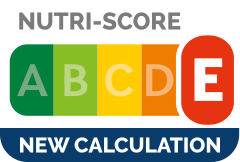 Bad nutritional quality
 Ultra-processed food and drink products
 Not computed
Health
Nutrition
Serving Size
Nutri-Score label
Bad nutritional qualityNutrient levels for 100 g
Fat in high quantity (?)
What you need to know
A high consumption of fat, especially saturated fats, can raise cholesterol, which increases the risk of heart diseases.
Recommendation: Limit the consumption of fat and saturated fat
Choose products with lower fat and saturated fat content.
Saturated fat in high quantity (?)
What you need to know
A high consumption of fat, especially saturated fats, can raise cholesterol, which increases the risk of heart diseases.
Recommendation: Limit the consumption of fat and saturated fat
Choose products with lower fat and saturated fat content.
Sugars in high quantity (?)
What you need to know
A high consumption of sugar can cause weight gain and tooth decay. It also augments the risk of type 2 diabetes and cardio-vascular diseases.
Recommendation: Limit the consumption of sugar and sugary drinks
Sugary drinks should be limited as much as possible. Choose products with lower sugar content.
Salt in low quantity (?)
What you need to know
A high consumption of salt (or sodium) can cause raised blood pressure, which can increase the risk of heart disease and stroke.
Recommendation: Limit the consumption of salt and salted food
Reduce the quantity of salt used when cooking. Limit the consumption of salty snacks.
Ingredients
Ingredients List
Ingredient Information
Food Processing
NOVA Group label
Ultra-processed food and drink productsElements that indicate the product is in the NOVA group 4:
- Additives: E322 - Lecithins
- Additives: E476 - Polyglycerol polyricinoleate
- Ingredients: Colour
- Ingredients: Flavouring
- Ingredients: Glucose
- Ingredients: Lactose
- Ingredients: Maltodextrin
- Ingredients: Whey
The NOVA classification assigns food products into 4 groups based on their degree of processing:
- Unprocessed or minimally processed foods
- Processed culinary ingredients
- Processed foods
- Ultra-processed food and drink products
Ingredients analysis
Palm oil free
Contains ingredients containing palm oil.
Vegan
Contains non-vegan ingredients.
Unrecognized ingredients: en:corn-strach, en:fd-c-red-no, en:40-aluminum-lake
Vegetarian
Vegetarian status unknown
Unrecognized ingredients: en:corn-strach, en:fd-c-red-no, en:40-aluminum-lake
Additives
E322 - LecithinsAntioxidantEmulsifier
Lecithins are natural compounds commonly used in the food industry as emulsifiers and stabilizers.
Extracted from sources like soybeans and eggs, lecithins consist of phospholipids that enhance the mixing of oil and water, ensuring smooth textures in various products like chocolates, dressings, and baked goods.
They do not present any known health risks.
E322i - LecithinAntioxidantEmulsifier
Lecithins are natural compounds commonly used in the food industry as emulsifiers and stabilizers.
Extracted from sources like soybeans and eggs, lecithins consist of phospholipids that enhance the mixing of oil and water, ensuring smooth textures in various products like chocolates, dressings, and baked goods.
They do not present any known health risks.
E331 - Sodium citratesEmulsifierSequestrantStabiliser
DISODIUM CITRATE, more properly, disodium hydrogen citrate, is an acid salt of citric acid with the chemical formula Na2C6H6O7. It is used as an antioxidant in food and to improve the effects of other antioxidants. It is also used as an acidity regulator and sequestrant. Typical products include gelatin, jam, sweets, ice cream, carbonated beverages, milk powder, wine, and processed cheeses.
E340 - Potassium phosphatesEmulsifierHumectantSequestrantStabiliserThickener
Potassium phosphate is a generic term for the salts of potassium and phosphate ions including: Monopotassium phosphate (KH2PO4) (Molar mass approx: 136 g/mol) Dipotassium phosphate (K2HPO4) (Molar mass approx: 174 g/mol) Tripotassium phosphate (K3PO4) (Molar mass approx: 212.27 g/mol)As food additives, potassium phosphates have the E number E340.
E340ii - Dipotassium phosphateEmulsifierHumectantSequestrantStabiliserThickener
No additive description is available yet.
E476 - Polyglycerol polyricinoleateEmulsifier
Polyglycerol polyricinoleate (PGPR), E476, is an emulsifier made from glycerol and fatty acids (usually from castor bean, but also from soybean oil). In chocolate, compound chocolate and similar coatings, PGPR is mainly used with another substance like lecithin to reduce viscosity. It is used at low levels (below 0.5%), and works by decreasing the friction between the solid particles (e.g. cacao, sugar, milk) in molten chocolate, reducing the yield stress so that it flows more easily, approaching the behaviour of a Newtonian fluid. It can also be used as an emulsifier in spreads and in salad dressings, or to improve the texture of baked goods. It is made up of a short chain of glycerol molecules connected by ether bonds, with ricinoleic acid side chains connected by ester bonds. PGPR is a yellowish, viscous liquid, and is strongly lipophilic: it is soluble in fats and oils and insoluble in water and ethanol.
Environment
Environmental score label
Not computedCarbon footprint
No carbon footprint data is available for this product.
Packaging
No packaging information provided.
Transportation and origins
Origins of ingredients
No origin information provided.
Manufacturing places
No manufacturing place information provided.
Environmental labels
No environmental labels identified.
Data Source
Product added on March 9, 2017 at 12:38:50 PM UTC by usda-ndb-import .
Last edit on March 17, 2026 at 7:46:46 PM UTC by foodless .
Product page also edited by ecoscore-impact-estimator, foodless, kiliweb, openfoodfacts-contributors, org-database-usda, usda-ndb-import, yuka.sY2b0xO6T85zoF3NwEKvlmFMV4T0vTDdNAzUoV-WwvO8K7frS9xKwLfRM6g, yuka.sY2b0xO6T85zoF3NwEKvlmsZbfPVuyjeNg3gtUCXxdCcKrXpcf9V7qb9Nag.
Source List
- usda-ndb
- database-usda