

SMALL CURD COTTAGE CHEESE FAT FREE
Labels
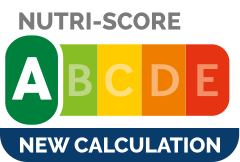 Very good nutritional quality
 Ultra-processed food and drink products
 Not computed
Health
Nutrition
Label
Very good nutritional qualityNutrient levels
Fat in low quantity (0%)
Sugars in low quantity (4.42%)
Salt in moderate quantity (0.708%)
Nutrition label

Nutrition facts
| Nutrition facts | As sold for 100 g / 100 ml |
|---|---|
| Energy | ~ 285.77 kJ (71 kcal) |
| FAT | 0 g |
| Saturated fat | ? |
| Cholesterol | 0 g |
| Carbohydrates | 5.31 g |
| Sugars | 4.42 g |
| Added sugars | 0 g |
| Starch | 0 g |
| Dietary fiber | ? |
| Proteins | 11.5 g |
| Salt | 0.71 g |
| Sodium | 0.28 g |
| Vitamins | |
| Vitamin A | 0 g |
| Vitamin E | 0 g |
| Vitamin K | 0 g |
| Vitamin C | 0 g |
| Minerals | |
| Phosphorus | 0 g |
| Iron | 0 g |
| Magnesium | 0 g |
| Zinc | 0 g |
| Copper | 0 g |
| Manganese | 0 g |
| Selenium | 0 g |
| Caffeine | 0 g |
| Fruits, vegetables and legumes | ~ 0 % |
| Choline | 0 g |
Nutrition facts (Detailed data)
| Nutrition facts | As sold for 100 g / 100 ml | As sold Per 100 g (packaging) | As sold Per serving (113 g) (packaging) | As sold Per 100 g (estimate) |
|---|---|---|---|---|
| Energy | ~ 285.77 kJ (71 kcal) | ? (71 kcal) | ? (80 kcal) | ? |
| FAT | 0 g | ? | 0 g | ? |
| Saturated fat | ? | ? | ? | ? |
| Cholesterol | 0 g | ? | 0 g | ? |
| Carbohydrates | 5.31 g | ? | 6 g | ? |
| Sugars | 4.42 g | ? | 5 g | ? |
| Added sugars | 0 g | ? | 0 g | ~ 0.4 g |
| Starch | 0 g | ? | 0 g | ? |
| Dietary fiber | ? | ? | ? | ? |
| Proteins | 11.5 g | ? | 13 g | ? |
| Salt | 0.71 g | ? | 0.8 g | ? |
| Sodium | 0.28 g | ? | 0.32 g | ? |
| Vitamins | ||||
| Vitamin A | 0 g | ? | 0 g | ? |
| Vitamin E | 0 g | ? | 0 g | ? |
| Vitamin K | 0 g | ? | 0 g | ? |
| Vitamin C | 0 g | ? | 0 g | ? |
| Minerals | ||||
| Phosphorus | 0 g | ? | 0 g | ? |
| Iron | 0 g | ? | 0 g | ? |
| Magnesium | 0 g | ? | 0 g | ? |
| Zinc | 0 g | ? | 0 g | ? |
| Copper | 0 g | ? | 0 g | ? |
| Manganese | 0 g | ? | 0 g | ? |
| Selenium | 0 g | ? | 0 g | ? |
| Caffeine | 0 g | ? | 0 g | ? |
| Fruits, vegetables and legumes | ~ 0 % | ? | ? | ~ 0 % |
| Choline | 0 g | ? | 0 g | ? |
Serving size
Estimated Activity Time
Approximate time needed to burn the energy in 100 g / 100 ml: 286 kJ. Reference adult weight: 70 kg. Energy density: Low.
Ingredients
Ingredients list
Ingredient information
Allergens
Ingredients analysis
Palm oil content unknown
Contains non-vegan ingredients.
Unrecognized: en:to-preserve-freshness
Vegetarian status unknown
Unrecognized: en:to-preserve-freshness
Food Processing
NOVA group
Ultra-processed food and drink productsElements that indicate the product is in NOVA group 4
How NOVA works
Additives
E171 - Titanium dioxideColour
Titanium dioxide, also known as titanium(IV) oxide or titania, is the naturally occurring oxide of titanium, chemical formula TiO2. When used as a pigment, it is called titanium white, Pigment White 6 (PW6), or CI 77891. Generally, it is sourced from ilmenite, rutile and anatase. It has a wide range of applications, including paint, sunscreen and food coloring. When used as a food coloring, it has E number E171. World production in 2014 exceeded 9 million metric tons. It has been estimated that titanium dioxide is used in two-thirds of all pigments, and the oxide has been valued at $13.2 billion.
E200 - Sorbic acidPreservative
SORBIC ACID, or 2,4-hexadienoic acid, is a natural organic compound used as a food preservative. It has the chemical formula CH3(CH)4CO2H.
E270 - Lactic acid
LACTIC ACID is an organic compound with the formula CH3CH(OH)CO2H. In the form of its conjugate base called lactate (this is thus different and kept as a separate ingredient). Lactic acid is chiral, consisting of two optical isomers. One is known as L-(+)-lactic acid or (S)-lactic acid and the other, its mirror image, is D-(−)-lactic acid or (R)-lactic acid in food the L-variant is used
E407 - CarrageenanCarrierEmulsifierHumectantStabiliserThickener
Carrageenan (E407), derived from red seaweed, is widely employed in the food industry as a gelling, thickening, and stabilizing agent, notably in dairy and meat products.
It can exist in various forms, each imparting distinct textural properties to food.
However, its degraded form, often referred to as poligeenan, has raised health concerns due to its potential inflammatory effects and its classification as a possible human carcinogen (Group 2B) by the International Agency for Research on Cancer (IARC).
Nevertheless, food-grade carrageenan has been deemed safe by various regulatory bodies when consumed in amounts typically found in food.
E410 - Locust bean gumEmulsifierStabiliserThickener
Locust bean gum (LBG, also known as carob gum, carob bean gum, carobin, E410) is a thickening agent and a gelling agent used in food technology.
E412 - Guar gumEmulsifierStabiliserThickener
Guar gum (E412) is a natural food additive derived from guar beans.
This white, odorless powder is valued for its remarkable thickening and stabilizing properties, making it a common ingredient in various food products, including sauces, dressings, and ice creams.
When used in moderation, guar gum is considered safe for consumption, with no known adverse health effects.
E433 - Polyoxyethylene sorbitan monooleateEmulsifierStabiliser
Polysorbate 80 is a nonionic surfactant and emulsifier often used in foods and cosmetics. This synthetic compound is a viscous, water-soluble yellow liquid.
Environment
Threatened species
Data Source
Data presented on this page is sourced from the Open Food Facts database. This platform does not alter the original dataset; its purpose is solely to enhance data visualization and user accessibility.
Product added on March 9, 2017 at 12:30:24 PM UTC by usda-ndb-import .
Last edit on March 17, 2026 at 4:22:17 PM UTC by municorn-calorie-counter-app .
Product page also edited by macrofactor, municorn-calorie-counter-app, openfoodfacts-contributors, org-database-usda, teolemon, usda-ndb-import.
Source List
- usda-ndb
- database-usda