

NEOH Chocolate Crunch
Health
Nutrition
Nutri-Score
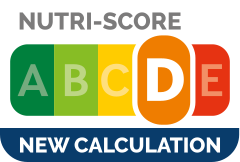 Lower nutritional quality
Nutri-Score data warning
Nutrient levels
Fat in moderate quantity (19.4%)
Saturated fat in high quantity (12.2%)
Sugars in low quantity (2.7%)
Salt in moderate quantity (0.98%)
Nutrition label

Nutrition facts
| Nutrition facts | As sold for 100 g / 100 ml | Compared to: Candy chocolate bars |
|---|---|---|
| Energy | 1607 kJ (384 kcal) | 2,132.442 kJ (509 kcal) (-25%) |
| Fat | 19.4 g | 28.163 g (-31%) |
| Saturated fat | 12.2 g | 15.464 g (-21%) |
| Carbohydrates | 28.1 g | 55.182 g (-49%) |
| Sugars | 2.7 g | 43.743 g (-94%) |
| Added sugars | 0 g | ? |
| Starch | 0 g | 3.351 g (-100%) |
| Dietary fiber | 25.8 g | ? |
| Proteins | 22.6 g | 6.731 g (+236%) |
| Salt | 0.98 g | 0.301 g (+226%) |
| Sodium | 0.392 g | 0.12 g (+227%) |
| Vitamin A | 0 mcg | ? |
| Vitamin E | 0 mg | ? |
| Vitamin K | 0 mcg | ? |
| Vitamin C | 0 mg | ? |
| Vitamin B1 | 0 mg | ? |
| Vitamin B2 | 0 mg | ? |
| Vitamin B6 | 0 mg | ? |
| Vitamin B9 | 0 mcg | ? |
| Vitamin B12 | 0 mcg | ? |
| Phosphorus | 0 mg | ? |
| Iron | 0 mg | ? |
| Magnesium | 0 mg | ? |
| Zinc | 0 mg | ? |
| Copper | 0 mg | ? |
| Manganese | 0 mg | ? |
| Selenium | 0 mcg | ? |
| Caffeine | 0 mg | ? |
| Fruits, vegetables and legumes | ? | ? |
| Choline | 0 mg | 0 g |
Nutrition facts (Detailed data)
| Nutrition facts | As sold for 100 g / 100 ml | As sold Per serving (legacy) |
|---|---|---|
| Energy | 1607 kJ (384 kcal) | 482 kJ (115 kcal) |
| Fat | 19.4 g | 5.82 g |
| Saturated fat | 12.2 g | 3.66 g |
| Carbohydrates | 28.1 g | 8.43 g |
| Sugars | 2.7 g | 0.81 g |
| Added sugars | 0 g | 0 g |
| Starch | 0 g | 0 g |
| Dietary fiber | 25.8 g | 7.74 g |
| Proteins | 22.6 g | 6.78 g |
| Salt | 0.98 g | 0.294 g |
| Sodium | 0.392 g | 0.118 g |
| Vitamin A | 0 mcg | 0 mcg |
| Vitamin E | 0 mg | 0 mg |
| Vitamin K | 0 mcg | 0 mcg |
| Vitamin C | 0 mg | 0 mg |
| Vitamin B1 | 0 mg | 0 mg |
| Vitamin B2 | 0 mg | 0 mg |
| Vitamin B6 | 0 mg | 0 mg |
| Vitamin B9 | 0 mcg | 0 mcg |
| Vitamin B12 | 0 mcg | 0 mcg |
| Phosphorus | 0 mg | 0 mg |
| Iron | 0 mg | 0 mg |
| Magnesium | 0 mg | 0 mg |
| Zinc | 0 mg | 0 mg |
| Copper | 0 mg | 0 mg |
| Manganese | 0 mg | 0 mg |
| Selenium | 0 mcg | 0 mcg |
| Caffeine | 0 mg | 0 mg |
| Fruits, vegetables and legumes | ? | ? |
| Choline | 0 mg | 0 mg |
Serving size
Ingredients
Ingredients image

Ingredients list
Ingredient information
Allergens
Traces
Ingredients analysis
No ingredients containing palm oil.
Contains non-vegan ingredients.
Unrecognized: de:milchschokolade-mit-süßungsmittel
Contains non-vegetarian ingredients.
Unrecognized: de:milchschokolade-mit-süßungsmittel
Food Processing
NOVA group
 Ultra-processed food and drink products
Elements that indicate the product is in NOVA group 4
How NOVA works
Additives
E170 - Calcium carbonates EFSA overexposure risk: no
CALCIUM CARBONATE is a chemical compound with the formula CaCO3.
E170i - Calcium carbonate EFSA overexposure risk: noColourStabiliser
No additive description is available yet.
E422 - GlycerolHumectantThickener
Glycerol (; also called glycerine or glycerin; see spelling differences) is a simple polyol compound. It is a colorless, odorless, viscous liquid that is sweet-tasting and non-toxic. The glycerol backbone is found in all lipids known as triglycerides. It is widely used in the food industry as a sweetener and humectant and in pharmaceutical formulations. Glycerol has three hydroxyl groups that are responsible for its solubility in water and its hygroscopic nature.
E428 - Gelatine
No additive description is available yet.
E965 - maltitolEmulsifierHumectantStabiliserSweetenerThickener
MALTITOL is a sugar alcohol (a polyol) used as a sugar substitute. It has 75–90% of the sweetness of sucrose (table sugar) and nearly identical properties, except for browning. Maltitol's high sweetness allows it to be used without being mixed with other sweeteners. It is used in candy manufacture, particularly sugar-free hard candy, chewing gum, chocolates, baked goods, and ice cream.
E968 - ErythritolHumectantSweetener
Erythritol ((2R,3S)-butane-1,2,3,4-tetrol) is a sugar alcohol (or polyol) that has been approved for use as a food additive in the United States and throughout much of the world. It was discovered in 1848 by Scottish chemist John Stenhouse. It occurs naturally in some fruit and fermented foods. At the industrial level, it is produced from glucose by fermentation with a yeast, Moniliella pollinis. Erythritol is 60–70% as sweet as sucrose (table sugar) yet it is almost noncaloric, does not affect blood sugar, does not cause tooth decay, and is partially absorbed by the body, excreted in urine and feces. Under U.S. Food and Drug Administration (FDA) labeling requirements, it has a caloric value of 0.2 kilocalories per gram (95% less than sugar and other carbohydrates), though nutritional labeling varies from country to country. Some countries, such as Japan and the United States, label it as zero-calorie; the European Union labels it 0 kcal/g.
Environment
Green-Score, origins bonus, and transportation impact are shown for Worldwide .
Green Score
Overall grade
 Unknown environmental impact
About Green-Score
Current scope
Green-Score availability
Bonuses and maluses
Declared origins
Packaging impact
Packaging
Packaging impact
Data precision
Transportation
Declared origins
Forest footprint
Forest footprint
Deforestation risk details
Data Source
Product data comes from Open Food Facts. Food Benchmark also adds translations, category comparisons and explanatory calculations.
The database is licensed under ODbL 1.0, individual contents under DbCL 1.0, and product photos under CC BY-SA 3.0.
Product added on December 11, 2018 at 2:49:18 PM UTC by msc .
Last edit on January 14, 2026 at 4:45:32 PM UTC by municorn-calorie-counter-app .
Product page also edited by inf, kiliweb, macrofactor, msc, municorn-calorie-counter-app, openfoodfacts-contributors, prepperapp, rehschen, roboto-app, sebleouf, yuka.UzZrYkZMc3ppNlU3dmNJVHhnbng2KzFTMTRPQ0RVcnNBdlVMSVE9PQ, yuka.sY2b0xO6T85zoF3NwEKvlhx4T8TskjfeOEfSpRCS-93TcZ3sS992uLLnK6g, yuka.sY2b0xO6T85zoF3NwEKvll4cDvTSrGz4FTLvoU6Hw4eRDKXER_drzKPbaao, yuka.sY2b0xO6T85zoF3NwEKvlnUXXYbOhj3tGS3fh0S2643fKozqW-1e-qrQEqo.