
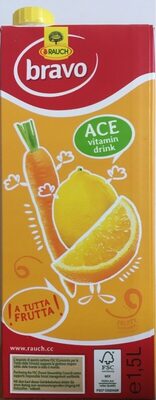
Bravo ACE
Labels
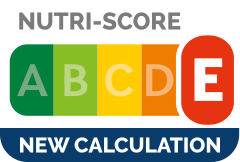 Bad nutritional quality
 Ultra-processed food and drink products
 Moderate environmental impact
Health
Nutrition
Label
Bad nutritional qualityNutrient levels
Fat in low quantity (0.5%)
Saturated fat in low quantity (0.1%)
Sugars in high quantity (7%)
Salt in low quantity (0%)
Nutrition facts
| Nutrition facts | As sold for 100 g / 100 ml |
|---|---|
| Energy | ~ 144.3 kJ (32 kcal) |
| FAT | 0.5 g |
| Saturated fat | 0.1 g |
| Carbohydrates | 7.2 g |
| Sugars | 7 g |
| Dietary fiber | ? |
| Proteins | 0.2 g |
| Salt | 0 g |
| Sodium | 0 g |
| Minerals | |
| Fruits, vegetables and legumes | ~ 30 % |
Nutrition facts (Detailed data)
| Nutrition facts | As sold for 100 g / 100 ml | As sold Per 100 g (packaging) | As sold Per 100 g (estimate) |
|---|---|---|---|
| Energy | ~ 144.3 kJ (32 kcal) | ? (32 kcal) | ? |
| FAT | 0.5 g | 0.5 g | ? |
| Saturated fat | 0.1 g | 0.1 g | ? |
| Carbohydrates | 7.2 g | 7.2 g | ? |
| Sugars | 7 g | 7 g | ? |
| Added sugars | ~ 3.5 g | ? | ~ 3.5 g |
| Dietary fiber | ? | ? | ? |
| Proteins | 0.2 g | 0.2 g | ? |
| Salt | 0 g | 0 g | ? |
| Sodium | 0 g | 0 g | ? |
| Minerals | |||
| Fruits, vegetables and legumes | ~ 30 % | ? | ~ 30 % |
Estimated Activity Time
Approximate time needed to burn the energy in 100 g / 100 ml: 144 kJ. Reference adult weight: 70 kg. Energy density: Moderate.
Ingredients
Ingredients image

Ingredients list
Ingredient information
Ingredients analysis
Palm oil content unknown
Vegan status unknown
Unrecognized: fr:edulco, fr:se-conserve-ouvert-3-jours-au-refrigerateur
Vegetarian status unknown
Unrecognized: fr:edulco, fr:se-conserve-ouvert-3-jours-au-refrigerateur
Food Processing
NOVA group
Ultra-processed food and drink productsElements that indicate the product is in NOVA group 4
How NOVA works
Additives
E330 - Citric acidAntioxidantSequestrant
Citric acid is a natural organic acid found in citrus fruits such as lemons, oranges, and limes.
It is widely used in the food industry as a flavor enhancer, acidulant, and preservative due to its tart and refreshing taste.
Citric acid is safe for consumption when used in moderation and is considered a generally recognized as safe (GRAS) food additive by regulatory agencies worldwide.
E952 - Cyclamic acid and its Na and Ca saltsSweetener
Cyclamic acid is a compound with formula C6H13NO3S. It is included in E number "E952". Cyclamic acid is mainly used as catalyst in the production of paints and plastics, and furthermore as a reagent for laboratory usage.The sodium and calcium salts of cyclamic acid are used as artificial sweeteners under the name cyclamate.
E954 - saccharin and its saltsSweetener
Sodium saccharin (benzoic sulfimide) is an artificial sweetener with effectively no food energy. It is about 300–400 times as sweet as sucrose but has a bitter or metallic aftertaste, especially at high concentrations. Saccharin is used to sweeten products such as drinks, candies, cookies, and medicines.
Environment
Green-Score, origins bonus, and transportation impact are shown for Worldwide .
Green Score
Overall grade
Moderate environmental impactAbout Green-Score
Current scope
Life cycle analysis
Average impact of the category
 Fruit soft drink, still (fruit juice content unspecified), with sugar • Score: 69/100
Life-cycle reference
Overall environmental impact by stage (PEF)
The overall environmental impact figure (PEF) comes from ADEME's Agribalyse database, for the category: Fruit soft drink, still (fruit juice content unspecified), with sugar. Source: ADEME Agribalyse Database.
| Stage | Impact |
|---|---|
| Agriculture | 41.7 % |
| Processing | 0.1 % |
| Packaging | 27.0 % |
| Transportation | 17.1 % |
| Distribution | 11.0 % |
| Consumption | 3.1 % |
Bonuses and maluses
Declared origins
Packaging impact
Green-Score for this product
Green-Score for this product
Final score: 49/100Final score breakdown
Carbon footprint
Carbon footprint
Climate impact by stage (CO2e)
The carbon emission figure comes from ADEME's Agribalyse database, for the category: Fruit soft drink, still (fruit juice content unspecified), with sugar. Source: ADEME Agribalyse Database.
| Stage | Impact |
|---|---|
| Agriculture | 33.6 % |
| Processing | 0.0 % |
| Packaging | 24.4 % |
| Transportation | 34.5 % |
| Distribution | 6.4 % |
| Consumption | 1.2 % |
Packaging
Packaging impact
Data precision
Transportation
Declared origins
Data Source
Data presented on this page is sourced from the Open Food Facts database. This platform does not alter the original dataset; its purpose is solely to enhance data visualization and user accessibility.
Product added on October 5, 2018 at 10:05:51 AM UTC by kiliweb .
Last edit on March 17, 2026 at 8:08:19 PM UTC by new-nutrition-bot .
Product page also edited by kiliweb, moon-rabbit, new-nutrition-bot, openfoodfacts-contributors, raturibot, yuka.YjY0YVQ1bFJndWMyeDhjazRTMzZ3L2gveHAyT0RES1ljUFU0SVE9PQ, yuka.sY2b0xO6T85zoF3NwEKvlk16eYDUrzuVNyPTwWzX9tLXFpbre4FTxYjePas.