
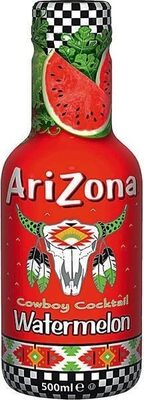
Arizona Cowboy Cocktail Watermelon
Labels
 Poor nutritional quality
 Ultra-processed food and drink products
Health
Nutrition
Label
Poor nutritional qualityNutrient levels
Fat in low quantity (0%)
Saturated fat in low quantity (0%)
Sugars in moderate quantity (4.8%)
Salt in low quantity (0%)
Nutrition label

Nutrition facts
| Nutrition facts | As sold for 100 ml |
|---|---|
| Energy | 95 kJ (23 kcal) |
| FAT | 0 g |
| Saturated fat | 0 g |
| Carbohydrates | 5.6 g |
| Sugars | 4.8 g |
| Dietary fiber | ? |
| Proteins | 0 g |
| Salt | 0 g |
| Sodium | 0 g |
| Minerals | |
| Fruits, vegetables and legumes | ~ 22.4 % |
Nutrition facts (Detailed data)
| Nutrition facts | As sold for 100 ml | As sold Per 100 ml (packaging) | As sold Per 100 g (estimate) |
|---|---|---|---|
| Energy | 95 kJ (23 kcal) | 95 kJ (23 kcal) | ? |
| FAT | 0 g | 0 g | ? |
| Saturated fat | 0 g | 0 g | ? |
| Carbohydrates | 5.6 g | 5.6 g | ? |
| Sugars | 4.8 g | 4.8 g | ? |
| Added sugars | ~ 2.4 g | ? | ~ 2.4 g |
| Dietary fiber | ? | ? | ? |
| Proteins | 0 g | 0 g | ? |
| Salt | 0 g | 0 g | ? |
| Sodium | 0 g | 0 g | ? |
| Minerals | |||
| Fruits, vegetables and legumes | ~ 22.4 % | ? | ~ 22.4 % |
Estimated Activity Time
Approximate time needed to burn the energy in 100 g / 100 ml: 95 kJ. Reference adult weight: 70 kg. Energy density: Moderate.
Ingredients
Ingredients image

Ingredients list
Ingredient information
Allergens
Ingredients analysis
No ingredients containing palm oil.
Vegan status unknown
Unrecognized: de:blaubeer
Vegetarian status unknown
Unrecognized: de:blaubeer
Food Processing
NOVA group
Ultra-processed food and drink productsElements that indicate the product is in NOVA group 4
How NOVA works
Additives
E300 - Ascorbic acidAntioxidantSequestrant
No additive description is available yet.
E330 - Citric acidAntioxidantSequestrant
Citric acid is a natural organic acid found in citrus fruits such as lemons, oranges, and limes.
It is widely used in the food industry as a flavor enhancer, acidulant, and preservative due to its tart and refreshing taste.
Citric acid is safe for consumption when used in moderation and is considered a generally recognized as safe (GRAS) food additive by regulatory agencies worldwide.
E414 - Acacia gumCarrierEmulsifierStabiliserThickener
Gum arabic, also known as acacia gum, arabic gum, gum acacia, acacia, Senegal gum and Indian gum, and by other names, is a natural gum consisting of the hardened sap of various species of the acacia tree. Originally, gum arabic was collected from Acacia nilotica which was called the "gum arabic tree"; in the present day, gum arabic is collected from acacia species, predominantly Acacia senegal and Vachellia (Acacia) seyal; the term "gum arabic" does not indicate a particular botanical source. In a few cases so‐called "gum arabic" may not even have been collected from Acacia species, but may originate from Combretum, Albizia or some other genus. Producers harvest the gum commercially from wild trees, mostly in Sudan (80%) and throughout the Sahel, from Senegal to Somalia—though it is historically cultivated in Arabia and West Asia. Gum arabic is a complex mixture of glycoproteins and polysaccharides. It is the original source of the sugars arabinose and ribose, both of which were first discovered and isolated from it, and are named after it. Gum arabic is soluble in water. It is edible, and used primarily in the food industry as a stabilizer, with EU E number E414. Gum arabic is a key ingredient in traditional lithography and is used in printing, paint production, glue, cosmetics and various industrial applications, including viscosity control in inks and in textile industries, though less expensive materials compete with it for many of these roles. While gum arabic is now produced throughout the African Sahel, it is still harvested and used in the Middle East.
E445 - Glycerol esters of wood rosinEmulsifierStabiliser
Glycerol ester of wood rosin, also known as glyceryl abietate or ester gum, is an oil-soluble food additive (E number E445). The food-grade material is used in foods, beverages, and cosmetics to keep oils in suspension in water, and its name may be shortened in the ingredient list as glycerol ester of rosin. It is also used as an ingredient in the production of chewing-gum and ice cream. Similar, less pure materials (glycerol ester of gum rosin) are used as a component of certain low-cost adhesives.To make the glycerol ester of wood rosin, refined wood rosin is reacted with glycerin to produce the glycerol ester. Glycerol ester of wood rosin is an alternative to brominated vegetable oil in citrus oil-flavored soft drinks. In some cases, both ingredients are used together.
E960 - Steviol glycosidesSweetener
Steviol glycosides are the chemical compounds responsible for the sweet taste of the leaves of the South American plant Stevia rebaudiana (Asteraceae) and the main ingredients (or precursors) of many sweeteners marketed under the generic name stevia and several trade names. They also occur in the related species Stevia phlebophylla (but in no other species of Stevia) and in the plant Rubus chingii (Rosaceae).Steviol glycosides from Stevia rebaudiana have been reported to be between 30 and 320 times sweeter than sucrose, although there is some disagreement in the technical literature about these numbers. They are heat-stable, pH-stable, and do not ferment. Additionally, they do not induce a glycemic response when ingested, because humans can not metabolize stevia. This makes them attractive as natural sugar substitutes for diabetics and other people on carbohydrate-controlled diets. Steviol glycosides stimulate the insulin secretion through potentiation of the β-cell, preventing high blood glucose after a meal. The acceptable daily intake (ADI) for steviol glycosides, expressed as steviol equivalents, has been established to be 4 mg/kg body weight/day, and is based on no observed effects of a 100 fold higher dose in a rat study.
Environment
Green-Score, origins bonus, and transportation impact are shown for Worldwide .
Green Score
Overall grade
About Green-Score
Current scope
Green-Score availability
Bonuses and maluses
Declared origins
Packaging impact
Packaging

Packaging impact
Declared packaging
Data precision
Transportation
Declared origins
Data Source
Data presented on this page is sourced from the Open Food Facts database. This platform does not alter the original dataset; its purpose is solely to enhance data visualization and user accessibility.
Product added on July 3, 2018 at 2:54:39 PM UTC by kiliweb .
Last edit on March 17, 2026 at 9:25:22 PM UTC by derthas .
Product page also edited by derthas, kiliweb, new-nutrition-bot, openfoodfacts-contributors, prepperapp, risajanda, someguy, teolemon, yuka.HKtiN_PSEc0wLffR0NoYhj7rC-XsM_ZyNVkuog, yuka.V1ljQU1JWTR1LzRFeFAwUzBDUFgxdEpuL0thTlUzNlNMTUVjSVE9PQ, yuka.sY2b0xO6T85zoF3NwEKvlhJoVoeE_z_FayL5nxW2wevfFZPvOI8s-oXDA6s, yuka.sY2b0xO6T85zoF3NwEKvllVmcf_mkzHkKyfWmFWzyPmoKoXnf9dZ5tXeH6s, yuka.sY2b0xO6T85zoF3NwEKvlmd8bfr4si7IMTfmsxCM44qfLa7nYuhq-4_qaao, yuka.sY2b0xO6T85zoF3NwEKvln5ubeLhgSr8ZkXfpEGE3daWAbbpRcgjuI3XIqg, yuka.sY2b0xO6T85zoF3NwEKvlnFLTdXwgSPKFRbtq2qu-v62cZXvOYxU2oKjKKg.