
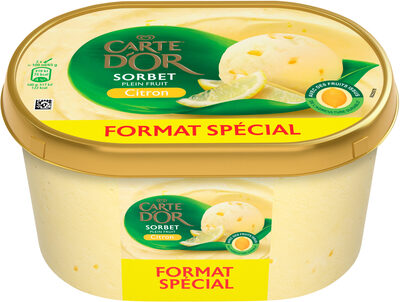
Carte D'or Sorbet Plein Fruit Citron 1300ml
Health
Nutrition
Nutri-Score
 Average nutritional quality
Nutri-Score data warning
Nutrient levels
Fat in low quantity (0.5%)
Saturated fat in low quantity (0.1%)
Sugars in high quantity (24%)
Salt in low quantity (0.01%)
Nutrition label

Nutrition facts
| Nutrition facts | As sold for 100 g / 100 ml | Compared to: Lemon sorbets |
|---|---|---|
| Energy | 517 kJ (122 kcal) | 504.373 kJ (119 kcal) (+3%) |
| Fat | 0.5 g | 0.303 g (+65%) |
| Saturated fat | 0.1 g | 0.13 g (-23%) |
| Carbohydrates | 28 g | 28.255 g (-1%) |
| Sugars | 24 g | 24.392 g (-2%) |
| Dietary fiber | ~ 0.065 g | ? |
| Proteins | 0.5 g | 0.322 g (+55%) |
| Salt | 0.01 g | 0.032 g (-69%) |
| Sodium | 0.004 g | 0.013 g (-69%) |
| Fruits, vegetables and legumes | ~ 26 % | ? |
Nutrition facts (Detailed data)
| Nutrition facts | As sold for 100 g / 100 ml | As sold Per 100 g (packaging) | As sold Per 100 g (estimate) |
|---|---|---|---|
| Energy | 517 kJ (122 kcal) | 517 kJ (122 kcal) | ~ 344.48 kJ (81 kcal) |
| Fat | 0.5 g | 0.5 g | ~ 0.065 g |
| Saturated fat | 0.1 g | 0.1 g | ~ 0.0013 g |
| Carbohydrates | 28 g | 28 g | ~ 21.3636 g |
| Sugars | 24 g | 24 g | ~ 14.986 g |
| Dietary fiber | ~ 0.065 g | ? | ~ 0.065 g |
| Proteins | 0.5 g | 0.5 g | ~ 0.065 g |
| Salt | 0.01 g | 0.01 g | ~ 0.005954 g |
| Sodium | 0.004 g | 0.004 g | ~ 0.0020573 g |
| Fruits, vegetables and legumes | ~ 26 % | ? | ~ 26 % |
Serving size
Ingredients
Ingredients image

Ingredients list
Ingredient information
Added sugars
Allergens
Traces
Ingredients analysis
No ingredients containing palm oil.
Contains non-vegan ingredients.
Unrecognized: fr:morceaux, fr:moins-50-de-ces-fruits
Vegetarian status unknown
Unrecognized: fr:morceaux, fr:moins-50-de-ces-fruits
Food Processing
NOVA group
 Ultra-processed food and drink products
Elements that indicate the product is in NOVA group 4
How NOVA works
Additives
E407 - Carrageenan EFSA overexposure risk: highCarrierEmulsifierHumectantStabiliserThickener
Carrageenan (E407), derived from red seaweed, is widely employed in the food industry as a gelling, thickening, and stabilizing agent, notably in dairy and meat products.
It can exist in various forms, each imparting distinct textural properties to food.
However, its degraded form, often referred to as poligeenan, has raised health concerns due to its potential inflammatory effects and its classification as a possible human carcinogen (Group 2B) by the International Agency for Research on Cancer (IARC).
Nevertheless, food-grade carrageenan has been deemed safe by various regulatory bodies when consumed in amounts typically found in food.
E440 - PectinsEmulsifierStabiliserThickener
Pectins (E440) are natural carbohydrates, predominantly found in fruits, that act as gelling agents in the food industry, creating the desirable jelly-like texture in jams, jellies, and marmalades.
Pectins stabilize and thicken various food products, such as desserts, confectioneries, and beverages, ensuring a uniform consistency and quality.
Recognized as safe by various health authorities, pectins have been widely used without notable adverse effects when consumed in typical dietary amounts.
Environment
Green-Score, origins bonus, and transportation impact are shown for Worldwide .
Green Score
Overall grade
 Low environmental impact
About Green-Score
Current scope
Life cycle analysis
Average impact of the category
 Frosted lemon or orange (sorbet) • Score: 76/100
Life-cycle reference
Overall environmental impact by stage (PEF)
The overall environmental impact figure (PEF) comes from ADEME's Agribalyse database, for the category: Frosted lemon or orange (sorbet). Source: ADEME Agribalyse Database.
| Stage | Impact |
|---|---|
| Agriculture | 38.3 % |
| Processing | 12.6 % |
| Packaging | 34.3 % |
| Transportation | 5.8 % |
| Distribution | 5.6 % |
| Consumption | 3.3 % |
Bonuses and maluses
Declared origins
Packaging impact
Green-Score for this product
Green-Score for this product
Final score: 61/100Final score breakdown
Carbon footprint
Carbon footprint
Climate impact by stage (CO2e)
The carbon emission figure comes from ADEME's Agribalyse database, for the category: Frosted lemon or orange (sorbet). Source: ADEME Agribalyse Database.
| Stage | Impact |
|---|---|
| Agriculture | 47.7 % |
| Processing | 8.7 % |
| Packaging | 28.8 % |
| Transportation | 10.6 % |
| Distribution | 3.0 % |
| Consumption | 1.2 % |
Packaging
Packaging impact
Packaging components
| Shape | Material | Recycling | Impact |
|---|---|---|---|
| Tray | Plastic | Unknown | High |
Declared packaging
Transportation
Declared origins
Forest footprint
Forest footprint
Deforestation risk details
Additional information
- Preparation
- Pour réaliser de belles boules de glace facilement : - Sortez votre bac Carte d'Or quelques minutes avant la dégustation et faites vos boules dès que la texture le permet - Utilisez de préférence une cuillère spéciale pour glaces, et n'hésiter pas à tremper votre cuillère dans de l'eau chaude régulièrement - Une fois les boules de glaces réalisées, rangez votre bac de glace dans le congélateur afin d'éviter que la glace ne fonde
- Conservation conditions
- A conserver à - 18°C.
- Customer service
- 20 rue des deux gares 92840 Rueil Malmaison cedex. Relation Consommateurs : 09 69 32 03 32 (appel non surtaxé). www.cartedor.fr www.facebook.com/cartedor
Data Source
Product data comes from Open Food Facts. Food Benchmark also adds translations, category comparisons and explanatory calculations.
The database is licensed under ODbL 1.0, individual contents under DbCL 1.0, and product photos under CC BY-SA 3.0.
Product added on May 23, 2017 at 6:56:15 PM UTC by kiliweb .
Last edit on March 18, 2026 at 12:15:29 AM UTC by new-nutrition-bot .
Product page also edited by beniben, date-limite-app, keragui, kiliweb, moon-rabbit, new-nutrition-bot, openfoodfacts-contributors, packbot, tacite, unilever-france, yuka.SG9JTUNhVmV0OGNObC8wUDR5L3kydDFwbkx1bGJUMjdlOUZKSUE9PQ, yuka.WjZjbVFZbzVoNkZVaE1JVi8wcm8zL2t0L1p5Q1VHTzdGZnNXSWc9PQ.
Source List
- unilever-france