

Nestle Chocapic Cereal Bar
Health
Nutrition
Nutri-Score
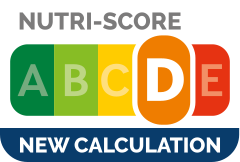 Lower nutritional quality
Nutri-Score data warning
Nutrient levels
Fat in moderate quantity (13.6%)
Saturated fat in high quantity (8%)
Sugars in high quantity (22.4%)
Salt in moderate quantity (0.4%)
Nutrition label

Nutrition facts
| Nutrition facts | As sold for 100 g / 100 ml | Compared to: Chocolate cereal bars |
|---|---|---|
| Energy | ~ 1746.4 kJ (403 kcal) | 1,754.287 kJ (415 kcal) (~0%) |
| Fat | 13.6 g | 13.849 g (-2%) |
| Saturated fat | 8 g | 5.743 g (+39%) |
| Carbohydrates | 62.6 g | 62.909 g (~0%) |
| Sugars | 22.4 g | 24.104 g (-7%) |
| Added sugars | 0 g | ? |
| Starch | 0 g | 11.356 g (-100%) |
| Dietary fiber | 5.8 g | ? |
| Proteins | 7.8 g | 7.285 g (+7%) |
| Salt | 0.4 g | 0.412 g (-3%) |
| Sodium | 0.16 g | 0.164 g (-2%) |
| Vitamin A | 0 g | ? |
| Vitamin E | 0 g | ? |
| Vitamin K | 0 g | ? |
| Vitamin C | 0 g | ? |
| Phosphorus | 0 g | ? |
| Iron | 0.0112 g | 4.018 mg (+179%) |
| Magnesium | 0 g | ? |
| Zinc | 0 g | ? |
| Copper | 0 g | ? |
| Manganese | 0 g | ? |
| Selenium | 0 g | ? |
| Caffeine | 0 g | ? |
| Fruits, vegetables and legumes | ~ 0 % | ? |
| Choline | 0 g | 0 g |
Nutrition facts (Detailed data)
| Nutrition facts | As sold for 100 g / 100 ml | As sold Per 100 g (packaging) | As sold Per 100 g (estimate) |
|---|---|---|---|
| Energy | ~ 1746.4 kJ (403 kcal) | ? (403 kcal) | ? |
| Fat | 13.6 g | 13.6 g | ? |
| Saturated fat | 8 g | 8 g | ? |
| Carbohydrates | 62.6 g | 62.6 g | ? |
| Sugars | 22.4 g | 22.4 g | ? |
| Added sugars | 0 g | 0 g | ~ 32.5666666666666 g |
| Starch | 0 g | 0 g | ? |
| Dietary fiber | 5.8 g | 5.8 g | ? |
| Proteins | 7.8 g | 7.8 g | ? |
| Salt | 0.4 g | 0.4 g | ? |
| Sodium | 0.16 g | 0.16 g | ? |
| Vitamin A | 0 g | 0 g | ? |
| Vitamin E | 0 g | 0 g | ? |
| Vitamin K | 0 g | 0 g | ? |
| Vitamin C | 0 g | 0 g | ? |
| Phosphorus | 0 g | 0 g | ? |
| Iron | 0.0112 g | 0.0112 g | ? |
| Magnesium | 0 g | 0 g | ? |
| Zinc | 0 g | 0 g | ? |
| Copper | 0 g | 0 g | ? |
| Manganese | 0 g | 0 g | ? |
| Selenium | 0 g | 0 g | ? |
| Caffeine | 0 g | 0 g | ? |
| Fruits, vegetables and legumes | ~ 0 % | ? | ~ 0 % |
| Choline | 0 g | 0 g | ? |
Ingredients
Ingredients image

Ingredients list
Ingredient information
Added sugars
Allergens
Ingredients analysis
No ingredients containing palm oil.
Unrecognized: ro:ciocolată-pudră, ro:lapte-condensat-îndulcit, ro:agenţi-de-umezire, ro:grăsime-de-cocos, ro:substanță-minerală, ro:carbonat-de-caldu, ro:gris-de-porumb, ro:lecitină-din-floarea-soarelui, ro:extract-bogat-în, ro:substanţă-minerală, ro:vitamin-b9, ro:poate-conţine-varietăţi-de-nuci
Contains non-vegan ingredients.
Unrecognized: ro:grăsime-de-cocos, ro:carbonat-de-caldu, ro:gris-de-porumb, ro:lecitină-din-floarea-soarelui, ro:vitamin-b9, ro:poate-conţine-varietăţi-de-nuci
Vegetarian status unknown
Unrecognized: ro:grăsime-de-cocos, ro:carbonat-de-caldu, ro:gris-de-porumb, ro:lecitină-din-floarea-soarelui, ro:vitamin-b9, ro:poate-conţine-varietăţi-de-nuci
Food Processing
NOVA group
 Ultra-processed food and drink products
Elements that indicate the product is in NOVA group 4
How NOVA works
Additives
E420 - SorbitolHumectantSequestrantStabiliserSweetenerThickener
Sorbitol (), less commonly known as glucitol (), is a sugar alcohol with a sweet taste which the human body metabolizes slowly. It can be obtained by reduction of glucose, which changes the aldehyde group to a hydroxyl group. Most sorbitol is made from corn syrup, but it is also found in nature, for example in apples, pears, peaches, and prunes. It is converted to fructose by sorbitol-6-phosphate 2-dehydrogenase. Sorbitol is an isomer of mannitol, another sugar alcohol; the two differ only in the orientation of the hydroxyl group on carbon 2. While similar, the two sugar alcohols have very different sources in nature, melting points, and uses.
E420ii - Sorbitol syrupHumectantSequestrantStabiliserSweetenerThickener
No additive description is available yet.
E422 - GlycerolHumectantThickener
Glycerol (; also called glycerine or glycerin; see spelling differences) is a simple polyol compound. It is a colorless, odorless, viscous liquid that is sweet-tasting and non-toxic. The glycerol backbone is found in all lipids known as triglycerides. It is widely used in the food industry as a sweetener and humectant and in pharmaceutical formulations. Glycerol has three hydroxyl groups that are responsible for its solubility in water and its hygroscopic nature.
Environment
Green-Score, origins bonus, and transportation impact are shown for Worldwide .
Green Score
Overall grade
 High environmental impact
About Green-Score
Current scope
Life cycle analysis
Average impact of the category
 Chocolate cereal bar • Score: 52/100
Life-cycle reference
Overall environmental impact by stage (PEF)
The overall environmental impact figure (PEF) comes from ADEME's Agribalyse database, for the category: Chocolate cereal bar. Source: ADEME Agribalyse Database.
| Stage | Impact |
|---|---|
| Agriculture | 73.6 % |
| Processing | 7.6 % |
| Packaging | 13.6 % |
| Transportation | 4.0 % |
| Distribution | 1.0 % |
| Consumption | 0.0 % |
Bonuses and maluses
Declared origins
Packaging impact
Green-Score for this product
Green-Score for this product
Final score: 32/100Final score breakdown
Carbon footprint
Carbon footprint
Climate impact by stage (CO2e)
The carbon emission figure comes from ADEME's Agribalyse database, for the category: Chocolate cereal bar. Source: ADEME Agribalyse Database.
| Stage | Impact |
|---|---|
| Agriculture | 77.1 % |
| Processing | 3.0 % |
| Packaging | 15.8 % |
| Transportation | 3.7 % |
| Distribution | 0.4 % |
| Consumption | 0.0 % |
Packaging
Packaging impact
Data precision
Transportation
Declared origins
Forest footprint
Forest footprint
Deforestation risk details
Data Source
Product data comes from Open Food Facts. Food Benchmark also adds translations, category comparisons and explanatory calculations.
The database is licensed under ODbL 1.0, individual contents under DbCL 1.0, and product photos under CC BY-SA 3.0.
Product added on December 1, 2017 at 9:56:17 PM UTC by hunsly .
Last edit on March 17, 2026 at 10:48:27 PM UTC by new-nutrition-bot .
Product page also edited by estrella83, feat, foodless, hunsly, kiliweb, mangeuuscochonorus, municorn-calorie-counter-app, new-nutrition-bot, openfoodfacts-contributors, sanatate, scanbot, stefan312, teolemon, yuka.VnE4c05xZ0V1S1lVbXZNQXhRM2UzKzE1NW9LTGUzKzNNT3M3SVE9PQ.